Wednesday, 9 February 2011

Sydney Botanical Gardens

Our arrival into Sydney, Australia was delayed by enough to disrupt my plans for the day. The temperature was already high with threats that it might reach 4OC. I postponed my trip to Waterfall and took an easy trip to the Botanical Gardens instead to look for Tawny Frogmouths and dragonflies.
In a tiny pool by the tropical glass houses, some Fiery Skimmers, Orthetrum villosovittatum, were chasing each other around. They were very approachable and allowed me to get closer than the macro focusing facility on my Nikon P100.
A Magpie Lark came down to a rock to bathe and get some relief from the heat which was really beginning to build now.
The Australian Emerald, Hemicordulia australiae, wouldn’t stop for a moment in its frenetic chasing, so it had to be taken in flight. This one was found over the little stream that feeds into the twin ponds. It occasionally hovered in a patch of sunlight between the deep shadows, which gave me somewhere to shelter from the sun as I watched and which set up this nice effect.
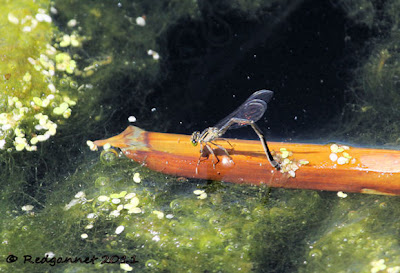
On the Main pond, above the mullet and the eels, a Common Glider, Tramea loewii, another restless ode, patrolled its area with diligence and vigour. I was not able to translate it into a digital code of zeros and ones. The damselflies here however were static enough for pictures as they sat on the floating weed. The Blue River Damsel, Pseudagrion microcephalum, is also known as a Blue Sprite in Asia. There is a P. australasiae which is almost identical in the male pattern, but which does not reach Australia I understand .If anyone can confirm this ode I would be grateful. Please note the blue bar across the back of the head which causes me some doubt.
In a conifer style tree a pair of Noisy Miners were making even more of a fuss than usual. A quick investigation, hoping to find an owl or perhaps a snake, revealed their brood of fledglings.
The Common Bluetail, Ischnura heterosticta, was a fourth outing for the red pen today. This is probably not surprising as I have not looked for odes in Australia before. If anyone would care to confirm these for me too, I would be grateful, particularly the lower ones.
I don’t have a field guide and am relying on internet surfing to find something to make a reasonable match, but without an exhaustive guide for comparison, it is difficult to be certain.
G.L. as usual had given me a couple of prompts. He had given me directions to find Tawny Frogmouths and Powerful Owl in the gardens. At one of his predictions for the frogmouth in a Swamp Mahogany tree by the wall, there was no sign of the bird, just an old piece of carpet. The Powerful Owl roost remains in potentia as I was not able to find anything there today.

Bird species; 14

Little Pied Cormorant 4, Australian White Ibis 14, Australian Wood Duck 1, Pacific Black Duck 8, Buff-banded Rail 1, Dusky Moorhen 15, Masked Lapwing 4, Silver Gull 8, Sulphur-crested Cockatoo 8, Rainbow Lorikeet 20, Tawny Frogmouth 1, Noisy Miner 15, Magpie Lark 1, Pied Butcherbird 1.

Odonata species; 5

Common Bluetail, Ischnura heterosticta 4, Blue River Damsel, Pseudagrion microcephalum, Common Glider, Tramea loewii 1, Australian Emerald, Hemicordulia australiae 12, Fiery Skimmers, Orthetrum villosovittatum 10.

Sunday, 6 February 2011

Pak Thale, Bangkok

I have wanted to visit Pak Thale (pronounced Talley) ever since I first heard of it last Monday. As Friday dawns, here I am, nothing if not self-indulgent.

There is no specific website for Pak Thale that I could find, but may I recommend Nick Upton’s http://www.thaibirding.com/ if you ever consider a visit. Essentially, it is an extensive area of evaporation ponds for salt extraction. The whereabouts of the birds depends on the varying water levels in the pans, but they are all at different stages of the flooding and evaporation process so there is always one that will be just right. It is a large area and personal transport is essential if you want to explore the full potential and make a trip down to the sand spit at Laem Pak Bia (and you will).


My target bird was of course, the Spoon-billed Sandpiper with perhaps a Malaysian Plover to make a nice brace of lifers, but I hit a snag straight away. The hotel cars ran to Thai Baht 8,000 for a return trip of about 120kms each way. On the face of it, TB 4,000 (£80 or US $130 at current exchange rate) seemed a bargain for a street taxi, but http://www.thaibirding.com/ had mentioned that buses pass through nearby Phetchaburi and on enquiry, they cost £2.40/US $5. Seldom do decisions come more easily. From Phetchaburi, I hired Mr Sopon and his incredible motorbike taxi to get me 14kms to the coast and the salt pans.

The ride to Pak Thale, a small village on the north-western coast of the Gulf of Thailand, took us through a rural and agricultural region with reed-filled ditches and irrigation ponds on both sides of the road. A Cinnamon Bittern crossed ahead of us, Indian Rollers hawked from the snags and a Greater Coucal looked up at us from a ditch as we whizzed by.

Lesser Sand Plover and Kentish Plover

When we arrived in the village, a helpful local rode ahead of us to put us in a good place to find birds. A sign with a Spoon-billed Sandpiper gave me confidence that he was taking us to the right place, but on arrival, although there were plenty of birds, it did not tally with the map from Nick Upton’s site which pinpoints a spoonie hot-spot, so we trawled the area looking for a landmark and noticed a big salt collection truck which showed that vehicle access could be gained deep into the salt fields (Google Earth ref; 13 08'45"N 100 03' 47"E). As we pulled up, the Burmese workers loading salt onto the truck pointed out a chap with a scope looking very intently at something. I walked over and signalled my presence with a gentle “pish.” He beckoned me over and pointed to a loose flock of feeding Red-necked Stints. They all looked pretty similar from sideways on.


 One of them fed with a shovelling motion rather than a picking action and when it turned towards me, it revealed the spatulate bill that characterises the Spoon-billed Sandpiper. Better still, there were two of them. The other birder was Mark Andrews, a guide with Wildwings the nature tour company, who was out on an exploratory trip. He told me that there were another 4 in the adjacent pan, but a Merlin came through and put the birds up before we could find them again. Happy with his 6, and encouraged by the highest count of the year so far, Mark moved on to continue his preparation, but not before priming me for the Great Knot roost along the road.


Without wishing to turn this post into a love-in advert for http://www.thaibirding.com/ the spoonies were within 150meters of Nick’s prediction. Considering the area covered by salt pans and ponds and the number of birds that would need to be scanned, having the target zone narrowed down to a manageable size was a huge help. I stayed for a while, hoping to find them for myself and succeeded in finding two separate birds among the Greater and Lesser Sand Plovers, Kentish Plovers, Curlew Sandpipers, Spotted Redshank and Common Greenshank. Perhaps the two close acquaintances from earlier had split up, but I worked hard to find them again over a wide expanse of shallow water amongst a lot of birds, so I shall count 4 as my tally.


It was a strangely bittersweet moment, seeing such an iconic and endearing bird, but at the same time realising just how tiny they are and how vulnerable they will be when they embark on their journey north, having to overfly so many traditional staging points which have been lost to development. I am very grateful to Mark for pointing out the first two. Knowing that they were there gave me the confidence to persevere in finding the other two. There were a lot of salt pans and a lot of birds.


When the birds flew again from some perceived threat, I left Pak Thale and went looking for the Great Knot roost. The road runs north and south along the gulf coast. All the way, salt pans and birds, lots of them. Although I had wanted to stop and have a look at some of the birds in the rural lands on the way to Pak Thale in the morning, I prioritised my arrival to coincide with high tide at 09.00. Retrospectively, this was not  highly important as the birds had plenty of feeding opportunities in the pans and did not seem to be reliant on the state of the tide.
The Great Knot were not where Mark had predicted and we searched through each group of roosting birds before finding them close to the Environmental Research Project.
I hadn’t anticipated that the roost would be quite so big with more than a thousand birds the majority of which were the knot. There were plenty of the small plovers and larger Grey Plovers too, but I was on the lookout for Noordman’s Greenshank who seem to favour Great Knot as their roosting companions. The flock was thick and a long way off the road, but the salt workers didn’t mind me picking my way along the thin pond divides to try to get a better look. A few Kentish Plovers in the foreground flew up to tell me that I was quite close enough thank you.

From here, I scoped the flock until I noticed a slightly up-turned bill in a gap between some Grey Plovers. Even with the scope, it was difficult to see. The photo is super-zoomed, enhanced and cropped, but in the middle you should see the short upper-legged Noordman’s Greenshank. Look to the right and you will see a second. Seventeen had been counted earlier when the flock was further up the road.


Time as ever was getting away from me. Mr Sopon pillioned me around the Environmental Research Project for the briefest of tours. The birds were very approachable as long as we stayed on the motorbike, and birders in cars were able to get a very close looks at Red-wattled Plover, Pacific Golden Plovers and Chinese Pond Herons. It is possible that a few of the pond herons may have been the Javan species which is a very common resident immediately to the north of here, but which are indistinguishable in their non-breeding colours. We couldn’t stop for long as I had arranged to go out to the sand spit at Laem Pak Bia on a boat at 14.00 and I didn’t want to miss it.


There are plenty of boats that will take birders out to the sand spit with its gull and wader roosts, but I had met Mr Daeng (?) earlier in the day, been recommended to him by the Wildwings guide, Mark and had made the arrangement. Mark was already there having some lunch in the restaurant, but wasn’t going out to the spit. Mr Daeng himself was already booked up with a large group and his friend who was to operate my boat had let him down. He asked if I would mind sharing with another punter who was due in a few minutes.
How lucky am I? His other client turned out to be Nick Upton, author of the effusely recommended http://www.thaibirding.com/ and full-time bird guide. Of course I wouldn’t mind sharing. Nick was very familiar with the inhabitants of the spit, and was making a special visit to show a client the Malaysian Plover and the recently re-discovered White-faced Plover.

Great Knot

For various reasons, we were unable to land on the part of the spit required to get a good look at the 2 target birds, but Nick was well acquainted with the habits of the White-faced Plover and soon had it in his scope, on the far beach beyond another large flock of Great knots and assorted waders. It was very distant and disappeared over the ridge before I could see it. I thought that my chance had gone until I noticed the little bird reappear by some rocks and Nick confirmed it as the White-faced Plover.

The story of the plover is slightly odd. Recently, many people have been reporting them from widely spread locations in South-east Asia and questioning their status. The bird has turned out to be a “lost” plover described by Robert Swinhoe in 1870. Swinhoe omitted to assign a type specimen and collections have been confusing them with the South-east Asia form of the Kentish Plover ever since. It has now been recognised as the White-faced Plover and allocated Aegialites [Charadrius] dealbatus. For more and for some pictures, visit; http://www.thaibirding.com/ornithology/lostplover.html where else?


It was far too distant for pictures and so was the hunched chick-like silhouette of a Malaysian Plover that Nick found shortly afterwards. Our stay on the spit was all too short. A large flock of Great Knot were restless and kept taking flight passing behind our boat and settling again for a short while before getting up again for another fly-past. There were plenty of other birds too including Greater and Lesser Sand Plovers, Sanderlings and a Pacific Reef-egret.

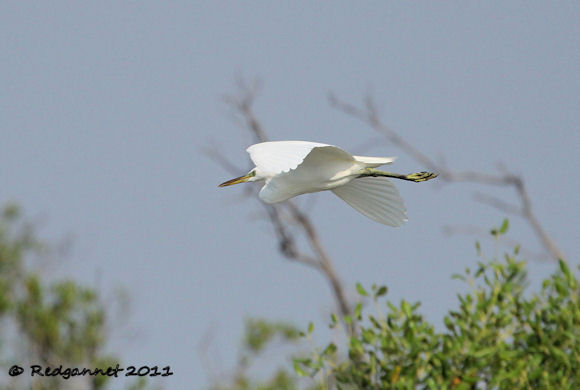
On the return boat-ride through the mangroves, Nick’s client had his eye in, spotting 8 Collared Kingfishers and a Black-capped Kingfisher. I was beginning to think that I would have to get a new red crayon when a Chinese Egret gave a perfect fly-by.


I took a little break with Mr Sopon before we headed back to Petchaburi to catch the minibus home. I took the opportunity to check the gulls that I had been looking at all day and found them to be Brown-headed Gulls. Superficially similar to Black-headed Gulls, their useful field mark of much more black on the primaries proved useful, closer up, the light-eye and redder bill made distinction easy. It’s not often I say that about a gull. Even less often do I get to tick 6 new birds in one day. It would have been worth 8 grand of anybody’s money. If you don't have £160 to lavish on a day out at the salt pans, or would prefer to save some money back to donate to a worthwhile cause, cheaper options are discussed below.
I was worried that the minibus from Bangkok to Phetchaburi (approx 120kms) would be similar to the African Matatu taxis. With a similar policy, it only runs once it is full, but the vehicle was in excellent condition (as were all the other minibuses at the station and on the road) and the driver seemed competent. It was a reasonably comfortable 2 hour ride. The minibus station is at the bottom of the steps at the Victory Monument Metro Station and the cost was 120 Baht (@50=£1). The Metro trains start from 06.00 and I had to wait 20 minutes for the minibus to fill up.

Ask the driver to stop short of Phetchaburi at a convenient place to get a motorbike taxi for Pak Thale. Mr Sopon was happy to take 800 Baht for pillioning me around for 8 hours and then dropping me back to the minibus station in Phetchaburi. Take the minibus from the originating station. It does not leave with empty seats often and it does not advertise its destination, so you will wait a long time if you try to catch it further down-route.

Very little English was spoken. Ask the concierge at your hotel to write out some useful phrases in Thai. A useful one would have been “please stay with me all day” as Mr Sopon was confused as to what I required of him.

Hiring a car would be very possible and a reasonable if not half-so-exciting alternative. The road to Phetchaburi is a very good highway and the back roads to Pak Thale were fairly easy to navigate, just keep heading east.

www.thaibirding.com has maps and the names of places in Thai script. These were very useful. The Google Earth reference point for Pak Thale refers to the parking area and hot-spot for Spoon-billed Sandpipers on Nick’s map.

Mr Daeng (?), the boat driver is good at finding the plovers on the sand spit at Laem Pak Bia. His restaurant/boat ramp is at the end of the road on the south side of the channel (Google Earth ref; 13 02' 27.50"N 100 05' 20"E). Many of the boat drivers will leave you to your own devices once on the spit. This is not so bad when the appropriate part of the spit is accessible. It was not today and I would have been unlikely to find the plovers without some assistance.

Bird species; 62


Little Grebe 6, Little Cormorant 60, Grey Heron 3, Great Egret 6, Intermediate Egret 4, Little Egret 40, Chinese Egret 3, Pacific Reef Egret 1, Cattle Egret 4, Chinese Pond Heron 200, Striated Heron 1, Cinnamon Bittern 1, Painted Stork 5, Black-shouldered Kite 1, Shikra 1, Black-winged Stilt 100, Red-wattled Lapwing 20, Pacific Golden Plover 5, Grey Plover 65, Kentish Plover 85, Malaysian Plover 1, White-faced Plover 1, Lesser Sand Plover 160, Greater Sand Plover 50, Black-tailed Godwit 60, Eastern Curlew 150, Spotted Redshank 30, Marsh Sandpiper 40, Common Greenshank 17, Noordman’s Greenshank 3, Wood Sandpiper 3, Common Sandpiper 2, Great Knot 1000, Sanderling 20, Red-necked Stint 200, Curlew Sandpiper 300, Spoon-billed Sandpiper 4, Brown-headed Gull 600, Caspian Tern 4, Great Crested Tern 30, Common Tern 200, Whiskered Tern 3, Little Tern 25, Spotted Dove 40, Zebra Dove 3, Greater Coucal 1, House Swift 30, White-breasted Kingfisher 3, Collared Kingfisher 8, Black-capped Kingfisher 2, Blue-throated Bee-eater 2, Indian Roller 2, Dollarbird 1, Pacific Swallow 60, Yellow Wagtail 1, Streak-eared Bulbul 6, Oriental Magpie Robin 3, Brown Shrike 4, Black Drongo 25, Large-billed Crow 10, White-vented Myna 25, Common Myna 25, Asian Pied Starling 10.


Saturday, 5 February 2011

Crawling

This post is a copy of the 10000 Birds sumbission.

The ground is my friend. For someone who spends so much of his time in the air, the feeling of a secure surface comforts me as a mother's hug soothes a child.

Since becoming an adult I have maintained a respectable distance between me and the ground as befits a grown-up conforming to public dignity, but a recent aquaintance has caused me to reconsider my attitude and revert to the horizontal.

Jeannie loves to crawl. She crawls through the grass and the undergrowth, seeing things that are missed or trampled underfoot by the vertical adherents. It's a whole other world down here where the small things are. In the words of Sebastian the Crab (The Little Mermaid, Walt Disney) and as echoed by Jeannie, "Darlin' it's better, Down where it's wetter, Take it from me!"
Jeannie is possessed of a hunger to explore every last inch of her beloved Moreleta Kloof Nature Reserve, in Pretoria, South Africa and she finds that getting right down to it can reveal so much more than remaining upright. That's obvious, of course, but how many of us actually get down onto our bellies to inspect something from a different perspective? The last time I did, a concerned birder thought that I had collapsed and came across to check that I was OK!

Now you or I might be too concerned about public opinion to be caught with our behinds sticking out from a bush, or we may worry that our children will be bullied at school for having an eccentric parent (in fact, when I go out, my family insist that I leave all identification at home so that if I die doing something stupid, they won't have to suffer the indignity of being associated with me). This does not prey on Jeannie's mind however as she slithers and slides through the reeds of the wetland discovering new and exciting things every day. Her grandchildren take an active interest and even join in.
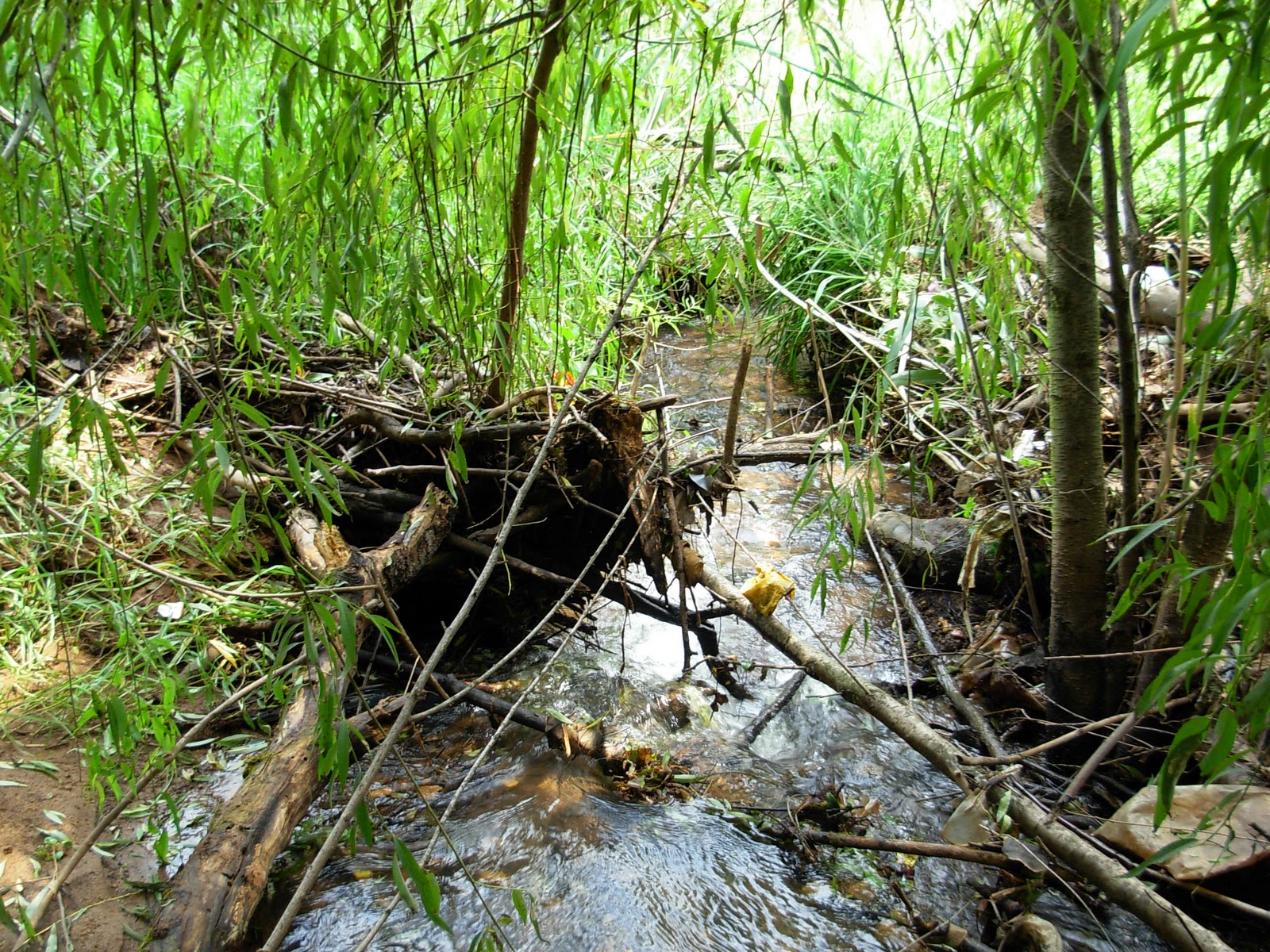
Moreleta Kloof is nearly 100 hectares of South African bush fenced off as a nature reserve. The kloof (cliff or escarpment) overlooks the reserve from the north-west. Rademeyerspruit (stream) runs along the base into a weedy vlei (dam) thence into the reed beds towards the north-east. The rest of the sanctuary is made up of grassland, scrub, riverine forest and protea hillside. Jeannie seems determined to wriggle inch and scramble her way through all the habitats and experience as much as the area has to offer.

The thought of what might be encountered in the South African leaf-litter from the viewpoint of an ankle causes me some reservations, but also adds an excitement that cannot be found at my fully drawn height. My imagination is running wild at the prospect of following Jeannie into the swamp where she immerses herself as deeply as she can into a place that she loves so passionately. Jeannie is usually covered in scratches from sliding through the undergrowth and ticks and leeches are her constant companions, but she still crawls enthusiastically into patches of bush that most of us miss with our staid "stick to the path" policy.
Please understand that I am not encouraging readers of this blog to abandon birding protocol and forget their values that respect creatures' rights to live undisturbed. Most reserves maintain a "stay on the path" policy because visitor numbers are high and the damage and disturbance caused by people leaving the tracks would be considerable; Jeannie is very lucky to have access to a very quiet wilderness where her impact is insignificant. She minimises her effect by following the trampled tracks of the zebra through the grassland, the Blesbok through the reeds and tiny antelopes called duikers make inroads into the bushes that allow her access there.
I realise that I may be burned at the stake for encouraging people to go off-piste, but I am convinced that anyone reading at this site has a sense of what is appropriate and where, when and how a path may be left. It may also be blasphemous to suggest that they might find anything other than birds while they are crawling, but what a world there is to see when you are knee high to a grasshopper.

I have committed myself to a crawling session with Jeannie on my next visit and I am very excited about it. If anyone else has tried it, leave a comment. If you want to try, please beware in public parks. I took a short walk on my local patch to assess the potential for crawling and found that human litter and dog faeces were probably the biggest obstacle to a good slither.

Start in your garden, then approach your local reserve to see if they would be amenable to such an idea. Perhaps put in a request for a ranger-led scramble to test the waters. The thought of getting down and dirty at this cold, wet time of year may not sound appealing, but a bit of ground work may need to be done first. My thoughts are that late summer, after the sensitive times of flowering and nesting are done, would be a good time for crawling, so make enquiries with this in mind.
Wouldn't it be great if we could all be as lucky as Jeannie? But there are other ways to experience the smell of humus in the morning. Local reserves are always looking for volunteers to join them on working parties. Getting involved in a session will often bring the participants closer to the ground than they would normally care to be found. Even sitting quietly, observing what happens in a tiny space can bring a real intimacy between the watcher and the watched. There are a group of people in the UK called 'meter watchers'. They mark out a square with sides of one meter in a garden or other habitat and watch it. Simple, but very rewarding I am told. Have fun and let me know how you get on.


Friday, 4 February 2011

Walter Sisulu Botanical Gardens

Follow the path into the gorge at Walter Sisulu (Witwatersrand) Botanical Gardens and there, beside the waterfall, you will see the eerie of the famous resident Black (Verreaux’s) Eagles. It is an enchanting place to be as the eagles wheel above and the Crocodile River begins its journey to Hartebeestpoort Dam.


There is a steep path and steps that leads up the side of the cataract and allows one to scale the kloof (cliff or escarpment) and reach the top of the falls. From here it is possible to look down on the eagles as they catch early morning air currents rising up the cliff-face. They have abandoned the top nest in favour of the privacy afforded by the lower one which cannot be seen from above. Notice boards requesting visitors not to throw stones at the eagles conjures dark theories as to why they prefer to be out of sight.


A path with a much shallower incline leads gently down through indigenous trees and scrub of the slope on the western side of the gardens. I would have used this one to scale the cliff if I had known. This was a productive area with Tawny-flanked Prinia, African Paradise Flycatcher and Speckled Mousebird. In the larger riverine trees at the foot of the path, a pair of Southern Boubou sang a sweet duet. There is a hide overlooking a small dam on the western side of the river.


A pair of African Black Duck roosted on a floating log at the dam and the inevitable weavers lent some colour to the scene. A path runs through the hide, but without exception everyone who passed through, including the children, were impeccably behaved. The board-walked wetland behind the dam had been drained and looks as though it may be due for renovation.


On a weekend morning the park was very busy from the get go. The aspiring classes from the Roodepoort neighbourhood between Johannesburg and Krugersdorp were picnicking. From 08.00 yummy mummies and driven daddies competed with each other to stake a claim to the prime picnic sites where they set up extravagant picnic parties for their offspring, which seemed to have coincidentally clashed with their networking parties. The cafe at the gardens does a very good breakfast.


It is a beautiful garden and would be well worth a visit on a weekday morning when you might do better than my pathetic list as below. The gardens open at 08.00 and an entrance fee of RSA 35 applies. It is ironic to note that the admission price causes an affluent demographic in the visitors book that would have saddened the anti-apartheid campaigner for whom the park is named. A list of the potential 220 birds which have been seen is available at reception.
Find the gardens at Google Earth ref; 26 05’ 13”S 27 50’ 52”E and visit the following website which gives a write up about the park and the eagles; http://www.joburg.org.za/content/view/353/188/  

Bird species; 28

Striated Heron 1, Sacred Ibis 6, Hadada Ibis 6, African Black Duck 2, Black-shouldered Kite 3, Verreaux’s Eagle 2, Helmeted Guineafowl 4, Red-eyed Dove 30, Ring-necked Dove 2, Laughing Dove 8, African Palm Swift 3, White-rumped Swift 5, Speckled Mousebird 1, Greater Striped Swallow 6, Cape Wagtail 1, Common Bulbul 25, Kurrichane Thrush 10, Cape Robin-chat 2, Tawny-flanked Prinia 4, Fiscal Flycatcher 2, African Paradise Flycatcher 1, Cape White-eye 2, Southern Boubou 2, Common Myna 10, Red-winged Starling 5, House Sparrow 10, Black-throated Canary 5, Yellow-fronted Canary 1.

Wednesday, 2 February 2011

Pilanesberg NP, Johannesberg, South Africa

The summer rains have brought green and growth to the African bush. the dams are full and the grass is as high as an elephant's thigh. With so much surface water available, the game animals are not tied to the permanent waterholes and can range freely to take advantage of the seasonal abundance.
Pilanesberg National Park, near Johannesberg in South Africa has about 500 square kilometers of free range for the animals to lose themselves in. The dry, African winter is usually considered the best time for animal viewing as the vegetation is sparse and the game is drawn to the waterholes, so sightings are usually more predictable and closer. Today, during the wet summer, the game was indeed spread out, but this meant that the viewers were thin on the ground too and I felt as the the whole park was mine alone. A Black-backed Jackal came out onto the road and ran along ahead of me for a hundred meters or so.
I was serenaded by the Ring-necked Dove, whose "drink lager" call is surely the most evocative of the sounds in the African bush. The day started slightly dull, but soon cleared up to become a beautifully bright morning. I took the main black-topped road from the southern gate at Bakubung and travelled north into the heart of the park. Close to the road was a very nice mixed herd of Zebra, Brindled Wildebeast and Impala, but the high grass and their heads down feeding attitude made photographs pointless. 
Luckily, the birds were still calling and displaying prominently. The Rufous-naped Lark has a very distinctive clear tri-syllabic whistle which came in through both open windows of the car and caused a delicious surround-sound effect. For good measure, in case whistling is not your thing, the lark also flaps its wings at great speed to cause a vibration for added effect. 
Other birds such as the Red-billed Ox-pecker found alternative perches to make themselves available for the camera.
The edges of the road were prolific for buntings. Cinnamon-breasted Buntings had a shorter flight distance than the Golden breasted Bunting, but neither of them would allow me close enough to get a picture other than through the windscreen. Only a Brown-crowned Tchagra, which I surprised around a corner, froze for a moment before retreating back into the scrub.
The Pilanesberg Centre was very quiet with no sightings pinned up on their map. Usually, successful safariers (can there be such a word?) help out others by indicating with coloured pins on a map where the prime mammal species have been spotted, but nothing today. I pinned up the Elephant, but doubted if it would be much help as he was moving on and would be miles away by now.
Helmeted Guineafowl are always around by the centre and this one posed in the car park.
Everything slows down after breakfast. The mammals head for the shade and the birds are less obvious. At times like this, a chap's mind turns to odonata. Dragonflies are cold-blooded and need a little time and warmth to start their day.They had had plenty of both by now and I found some by a puddle near the big Mankwe Dam.
The Banded Groundlings, Brachythemis leucosticta (male top, female below) were especially abundant and now that the temperature was getting high, they were visible by every patch of surface water. The name was well chosen for a species that was not seen perched anywhere but on the ground.
A vivid green bird was feeding its well-grown chick in an acacia bush close to the road. When I got my Bushnells up, I realised that they were Dideric Cuckoos and it was a male offering a piece of food to the female as a prelude to mating. The male has a bright red eye-ring which the female lacks.
The wet season in South Africa is characterised with violent storms and quick showers. Between the rain, the sky often clears up again leaving a beautiful, if humid, afternoon. The birds that feed from prominent perches were still hoping to catch a late lunch, but the rain dampened their chances for a while.
At one point, I felt that I had entered the Eurozone. Within a very short distance, I encountered the European Bee-eater, the Eurasian Swallow and as the sun came back out, a European Roller.
I had moved from the scub onto the grasslands now. Pilanesberg is blessed to have many habitats from rock-strewn mountain-side to large permanent water, acacia scrub and grassland. The park is managed and controlled burns are instigated if natural fires don't clear some of the long-grass meadows. A large shape caught my eye, it was a White Rhino. The animal's head was down, and the long grass hid much of it, but rhino 'tocks are unmistakeable. As a double with only my second 'big five' of the day was a Kori Bustard,  the world's largest flying bird!
I made a big circle from Manyane gate around Dithabaneng to check on the elephant carcass that I had seen on my last visit. Only a few of the large bones were left visible and they were strewn over a wide area.
Shortly before Dithabaneng meets the junction of the main north/south road, I saw a herd of Elephants off to the left. they seemed to be moving quite deliberately along and I suspected that they would come out onto the main road shortly. I waited in ambush for a while and although I didn't see the Elephants again, a Black Rhinoceros showed briefly in the scrub.
I found some more dragonflies while I was waiting. The Jaunty Dropwing, Trithema sticta was equally at home on the ground and easily seen around the puddles along the road.
The other ode is one of the Orthetrum family, a tricky bunch to identify specifically. I have narrowed this one down to two possibilities, but am taking advice before committing myself. Look again later and hopefully I will have an ID for it.
There is a big hide on the main Mankwe Dam which  visited shortly before having to head for the gates to be out by dusk. Here the weavers were out in force again with a Red Bishop sitting up for the best shot of this species this week.
A pair of Water Dikkop or Thick-knee were down by the water at the Hippo viewing point, although on this occasion, there were no Hippos to be viewed.
I calculated that I had time to drive to Kwa Maritane Gate to exit the park, but half way there, the road was blocked and impassable. I had to turn round and make a dash for Bakubung Gate again, which left me rushed and with very little time to stop. At last a Golden-breasted Bunting sat up to have its picture taken and I resigned myself to being late.

Bird species; 88

Little Grebe 2, White-breasted Cormorant 8, Long-tailed Cormorant 2, African Darter 2, Grey Heron 1, Intermediate Egret 1, Cattle Egret 2, Hamerkop 1, Marabou Stork 53, Hadada Ibis 8, White-faced Whistling-duck 4, Egyptian Goose 18, Yellow-billed Duck 4, African Fish Eagle 2, Steppe Buzzard 1, Amur Falcon 1, Cape Francolin 6, Swainson’s Francolin 15, Helmeted Guineafowl 12, Kori Bustard 1, Water Thick-knee 2, Blacksmith Lapwing 20, Crowned Lapwing 5, Wattled Lapwing 4, Common Sandpiper 1, Speckled Pigeon 6, Ring-necked Dove 40, Laughing Dove 30, Grey Go-away-bird 12, Dideric Cuckoo 5, Speckled Mousebird 1, Red-faced Mousebird 6, Malachite Kingfisher 1, Pied Kingfisher 6, European Roller 4, Lilac-breasted Roller 1, African Grey Hornbill 3, Yellow-billed Hornbill 4, Crested Barbet 1, Black-collared Barbet 1, Rufous-naped Lark 30, European Swallow 30, Pearl-breasted Swallow 1, Greater Striped Swallow 8, Lesser Striped Swallow 15, Rufous-chested Swallow 9, Grassveld Pipit 2, Cape Wagtail 4, Common Bulbul 12, Groundscraper Thrush 2, White-browed Robin-chat 8, Kalahari Scrub Robin 2, Familiar Chat 4, Rattling Cisticola 15, Zitting Cisticola 4, Black-chested Prinia 3, Cape Crombec 4, Spotted Flycatcher 4, Arrow-marked Babbler 4, Cape White-eye 2, Red-backed Shrike 20, Lesser Grey Shrike 15, Common Fiscal 2, Magpie Shrike 5, Brown-crowned Tchagra 3, Fork-tailed Drongo 2, Pied Crow 2, Common Myna 2, Cape Glossy Starling 12, Red-winged Starling 3, Red-billed Ox-pecker 8, House Sparrow 10, Mossie 15, Southern Grey-headed Sparrow 1, Scaly Weaver 3, Southern Masked Weaver 80, Yellow-crowned Bishop 6, Red Bishop 15, White-winged Widowbird 2, Red-collared Widowbird 1, Village Indigobird 1, Pin-tailed Whydah 6, Black-throated Canary 10, Yellow-fronted Canary 1, Cinnamon-breasted Bunting 25, Golden-breasted Bunting 8.


Impala

Mammal species; 14

African Elephant 30, White Rhinoceros 7, Black Rhinoceros 1, Zebra 60, Brindled Wildebeast 200, Impala 400, Hippo 2, Red Hartebeast 6, Tsesebe 4, Eland, 15, Black-backed Jackal 1, Springbok 120, Southern Giraffe 18, Warthog 12.

Look for other posts for Pilanesberg and South Africa and the rest of the Dark Continent on the dedicated Africa page
 http://redgannet.blogspot.com/p/africa.html