Our arrival into Sydney, Australia was delayed by enough to disrupt my plans for the day. The temperature was already high with threats that it might reach 4OC. I postponed my trip to Waterfall and took an easy trip to the Botanical Gardens instead to look for Tawny Frogmouths and dragonflies.
 In a tiny pool by the tropical glass houses, some Fiery Skimmers, Orthetrum villosovittatum, were chasing each other around. They were very approachable and allowed me to get closer than the macro focusing facility on my Nikon P100.



Bird species; 14
Odonata species; 5
Common Bluetail, Ischnura heterosticta 4, Blue River Damsel, Pseudagrion microcephalum, Common Glider, Tramea loewii 1, Australian Emerald, Hemicordulia australiae 12, Fiery Skimmers, Orthetrum villosovittatum 10.


A Magpie Lark came down to a rock to bathe and get some relief from the heat which was really beginning to build now.

The Australian Emerald, Hemicordulia australiae, wouldn’t stop for a moment in its frenetic chasing, so it had to be taken in flight. This one was found over the little stream that feeds into the twin ponds. It occasionally hovered in a patch of sunlight between the deep shadows, which gave me somewhere to shelter from the sun as I watched and which set up this nice effect.
On the Main pond, above the mullet and the eels, a Common Glider, Tramea loewii, another restless ode, patrolled its area with diligence and vigour. I was not able to translate it into a digital code of zeros and ones. The damselflies here however were static enough for pictures as they sat on the floating weed. The Blue River Damsel, Pseudagrion microcephalum, is also known as a Blue Sprite in Asia. There is a P. australasiae which is almost identical in the male pattern, but which does not reach Australia I understand .If anyone can confirm this ode I would be grateful. Please note the blue bar across the back of the head which causes me some doubt.

In a conifer style tree a pair of Noisy Miners were making even more of a fuss than usual. A quick investigation, hoping to find an owl or perhaps a snake, revealed their brood of fledglings.

The Common Bluetail, Ischnura heterosticta, was a fourth outing for the red pen today. This is probably not surprising as I have not looked for odes in Australia before. If anyone would care to confirm these for me too, I would be grateful, particularly the lower ones.

I don’t have a field guide and am relying on internet surfing to find something to make a reasonable match, but without an exhaustive guide for comparison, it is difficult to be certain.


G.L. as usual had given me a couple of prompts. He had given me directions to find Tawny Frogmouths and Powerful Owl in the gardens. At one of his predictions for the frogmouth in a Swamp Mahogany tree by the wall, there was no sign of the bird, just an old piece of carpet. The Powerful Owl roost remains in potentia as I was not able to find anything there today.

Bird species; 14
Little Pied Cormorant 4, Australian White Ibis 14, Australian Wood Duck 1, Pacific Black Duck 8, Buff-banded Rail 1, Dusky Moorhen 15, Masked Lapwing 4, Silver Gull 8, Sulphur-crested Cockatoo 8, Rainbow Lorikeet 20, Tawny Frogmouth 1, Noisy Miner 15, Magpie Lark 1, Pied Butcherbird 1.
Odonata species; 5
Common Bluetail, Ischnura heterosticta 4, Blue River Damsel, Pseudagrion microcephalum, Common Glider, Tramea loewii 1, Australian Emerald, Hemicordulia australiae 12, Fiery Skimmers, Orthetrum villosovittatum 10.


 It has a 24x optical zoom. By some jiggery pokery, the tech specs claim this equates to 26-624mm on a 35mm format SLR camera. My DSLR has a sensor which is smaller than 35mm and thereby produces a cropping effect. This is how my 400mm appears to be 640mm.
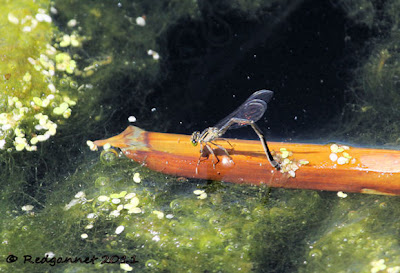
 I bought the camera from a shop beside a small river near Dadeland Mall. In a stretch of less than 50m of riverbank, I saw 9 different types of dragonflies. Most of them have yet to be identified, but there is enough detail here to confirm that it is a Halloween Pennant.
 To my mind, I think it is an oversight not to provide a remote release facility. With 624mm of throbbing focal length, I would have to use a tripod and with a tripod, I like to use a remote release. It is true that no other compact digital cameras provide the feature either, but why not? Digiscopers have had to develop grips and frames and pushers and pressers in order to achieve what is really a very simple function if built in at the design stage.
 It was a Scarlet Skimmer, Crocothemis servilia. This dragonfly has appeared in the blog before and today takes the crown for the most widespread ode that this blogger has seen. First seen in Singapore, it has subsequently been found in Hong Kong, where it goes by the name of Crimson Darter, and in India during October.
  Without any evidence to the contrary, I am assuming this to be the female.
 Another seemingly abundant species, which also fails to make it into the "Beginner's Guide to Dragonflies", which I am currently using as my reference field-guide.
 The Blue Dasher was the original holder of the distribution title having been seen from Toronto, Canada to Califonia.
  I can now reveal that it is a
  I believe it to be a
 It was about the right size and the abdomen is suggestive of amberwing. The eyes and the yellow marks on the thorax fit the descriptions of the amberwing. The wings however made me doubt the accuracy of my assumptions. The creature left it's wings to flutter in the light breeze in the same way that I had seen the Halloween Pennant doing on my previous visit. The wings were also much more heavily marked than I have seen in any photos or illustrations. There were both Eastern Amberwings and Halloween Pennants in the vicinity to compare size and flutteriness with. I see that the amberwings sometimes imitate wasps, but the fluttering did not seem reminiscent of any wasp that I had seen before. So I find myself unsatisfied with Eastern Amberwing. Perhaps there is a tiny pennant that I have not found in my research yet. All thoughts are welcome.