Thursday, 10 January 2013

Mayfield and Charleston Slough, Palo Alto, San Francisco, Dec 2012

I had ridden the train one hour south from San Francisco to reach the Baylands Preserve at Palo Alto. After spending the morning around the Duck Pond and Lucy Evans’ Interpretative Centre, I moved on to Mayfield Slough and Charleston Slough for the afternoon. From the junction just beyond the airport on Embarcadero Road (at Google Earth ref; 37°27'13.73"N 122° 6'35.56"W), turn right (south) instead of left and follow the road around.
Many of the birds seen in the morning were ticked again, but a few extra species that were missed in the morning were added. American Wigeon was the first bird seen in the reeds across the channel opposite the junction. Green Teal, Mallard and of course Northern Shoveler (the most populous bird of the day by far) were also seen here.
 

The channel on the left is affected by the tides of the bay and the water had just reached its highest mark for the day. On the right is Mayfield Slough which is controlled with a sluice, but (I think) is also subjected to tidal movement. Good numbers of Canvasback and a Western Grebe were seen on the slough.


Just before the bridge, I saw a White-tailed Kite hovering above the point. It made a swooping attempt to catch a meal but missed and glided away as I approached.

An island on Mayfield Slough made a popular roosting spot for a flock of Willet with a few Marbled Godwit mixed in, until a Northern Harrier flushed them up. A number of gulls just beyond them did not trouble the eBirder in me, but they can still be seen on Google Earth if you cut and paste these coordinates; 37°26'56.11"N 122° 5'31.63"W.


Suddenly I was enveloped in a storm of tiny wings and rushing wind as a large flock of “peeps” crossed the track. I didn’t see what had flushed them, but they were reluctant to settle. Eventually, they landed further across Mayfield Slough, but were still nervous and restless. They flushed two or three times as I watched. I had assumed them to probably be Western or maybe Least Sandpipers, they appeared to be the right size, but my experience with large flocks of them is limited. Do they form tight flocks, banking and turning in much the same way that Dunlin do?


A short way further down the slough I found that they do mix in with each other.


On the left of the path is Charleston Slough. Canvasbacks added to their already impressive number here. By contrast, a pair of Gadwall were the only ones seen today. A small island was thick with roosting birds. Most of them were Marbled Godwits, but there were also Black-necked Stilt, Willet and the seemingly ubiquitous Shoveler.


The biggest concentration of birds was seen in the seep pond at Google Earth ref; 37°26'5.73"N 122° 5'56.71"W. 


Long-billed Dowitchers, American Avocets and mixed gulls were roosting here with species flocked together according to their feather.


A couple stopped to pass the time of day and asked me why the birds were so chatty. The Long-billed Dowitchers are known for their habit of chattering as they feed. It seems that they keep it up while roosting too.


At the edges of the flocks a few other species found room to roost and feed, possibly gaining some comfort from the hundreds of pairs of eyes keeping lookout for them.


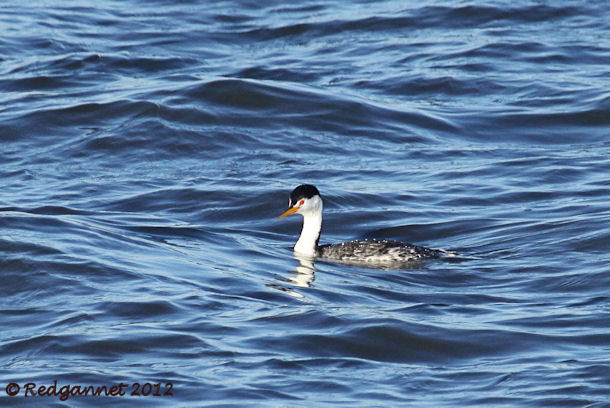
The way home took me along the Bayside Trail parallel to Shoreline Drive. A flock of Surf Scoter were seen alongside the Ruddy Duck out on the water with Lesser Scaup and a Clarke’s Grebe closer in.


A Red-tailed Hawk landed on a street lamp as I passed and posed very nicely.


The Burrowing Owls continue to elude me here, but a Barn Owl made up for it as I worked my way back to the Caltrain station.

Birds seen; 37

Canada Goose 15, Gadwall 2, American Wigeon 90, Mallard 40, Northern Shoveler 950, Green-winged Teal 25, Canvasback 610, Greater Scaup 10, Lesser Scaup 2, Surf Scoter 60, Common Golden-eye 5, Ruddy Duck 220, Pied-billed Grebe 1, Eared Grebe 2, Western Grebe 1, Clarke’s Grebe 1, Double-crested Cormorant 3, Brown Pelican 1, Great Blue Heron 1, Great Egret 2, Snowy Egret 9, Black-crowned Night Heron 1, White-tailed Kite 1, Northern Harrier 1, Red-tailed Hawk 1, American Coot 400, Black-necked Stilt 30, American Avocet 400, Willet 250, Marbled Godwit 210, Western Sandpiper 15, Dunlin 8, Long-billed Dowitcher 700, Barn Owl 1, Western Scrub-jay 2, Western Meadowlark 1, House Finch 45.

12 extra species were seen this afternoon bringing the day’s tally to 67.

There are a couple of options to reach the Caltrain station for return to San Francisco. From the seep pond at Terminal Blvd, follow San Antonio Rd south for 2 miles to the San Antonio Station at Google Earth ref; 37°24'24.41"N 122° 6'22.18"W.

From the barrier across N Shoreline Blvd at Google Earth ref; 37°25'43.07"N 122° 4'41.35"W, continue south for 1.8 miles. Turn left opposite Jack in a Box onto Stierlin Rd. Mountain View Station Google Earth ref; 37°23'42.09"N 122° 4'39.81"W is a further half mile.

For previous posts from Palo Alto Baylands, follow the links below;


Visit the dedicated USA and CanadaPage for more posts from the area.
 

Wednesday, 9 January 2013

Baylands Preserve, Palo Alto, San Francisco, Dec 2012


The first Caltrain service on a Sunday or Holiday schedule leaves from the 4th St. San Francisco Terminal (Google Earth ref; 37°46'35.96"N 122°23'41.54"W ) at 08.15, arriving California Ave (Google Earth ref; 37°25'44.22"N 122° 8'29.23"W) around an hour later. I had found that bikes can be brought on the train. This, I anticipated would speed my 2 mile journey along N. California Ave. to the Baylands Preserve at Palo Alto.


Actually, I took just as long I would have done on foot as I was distracted numerous times, notably by a flock of Cedar Waxwings feeding in a holly bush. Also found along the avenue, part of an approach list of 19 birds, were Nuttall’s WoodpeckerGolden-crowned Warbler and Western Bluebird.


It was 10.00 by the time I reached the salt marshes, mud and Duck Pond of the Baylands Reserve at Google Earth ref; 37°27'23.53"N 122° 6'32.64"W.
The Duck Pond was too full of gulls for my tastes, so I moved quickly past and onto the slough behind it, preferring the challenge of identifying dowitchers to that of trying to separate gulls.


These were Long-billed Dowitchers, feeding and roosting close to the edge. The top of the tide was still a couple of hours away, so the birds would only get closer. They seem quite unwary of people here.


A quick glance across the slough brought American Avocet, Canvasback and Northern Shoveler. A more attentive scan also brought Marbled Godwit, Green Teal and a Long-billed Curlew.


Most of the peeps appeared to be Least Sandpiper, but a few Western Sandpipers were also found, though their muddied legs made my preferred method of separating them more difficult.


I joined a photographer on the crook of the slough which gave a good vantage for fly-by shots and we fired away merrily as anything that passed. This American Avocet had a growth and a wrybill.


The American Avocet were as approachable as I have seen them and a couple of pairs appeared to be indulging in courtship behaviour, though there was no sign of any breeding plumage yet. The rear bird of the pair below appeared to be guiding the bird in the foreground by gently nudging and shepherding it. The bill of the female is more up-curved at the end, but I would hesitate to say which of this pair was which. If pressed I might say that the one nearest the camera is slightly more up-turned and it does have a cuter look.


I followed the path around the slough towards the bridge. The inlet here allows the water through and a Common Golden-eye was diving in the current. 


Lucy Evans Baylands Interpretative Centre stands just on the other side of the bridge at Google Earth ref; 37°27'34.68"N 122° 6'22.71"W. A veranda stretches around one side and gives access onto the boardwalk that crosses the salt marsh and reaches out to the bay. The water here was especially smooth and the reflections were almost perfect. Strange how I don't recall the water being quite so blue. I will have to put it down to the UV filter.


From the veranda, I could see a few birds in the small pool to the north. American Avocets, Least Sandpipers and a Greater Yellowlegs were feeding here. 
The marsh was quiet along the boardwalk, but there were plenty of birds in the distance.


A Northern Harrier passed along by the waterline and may have had a mate staying low on the marsh. It made one close pass that I didn't see 'til it was almost past me.
Out on the bay Greater Scaup and Canvasback joined the shoveler. 


The tide was high by now and I was hoping that the rails might have been pushed up through the vegetation and into the open, but none were seen.

Birds seen; 55

Canada Goose 6, Mallard 70, Cinnamon Teal 2, Northern Shoveler 720, Green-winged Teal 20, Canvasback 125, Greater Scaup 30, Common Golden–eye 1, Ruddy Duck 75, Pied-billed Grebe 1, Western Grebe 3, Great Blue Heron 1, Great Egret 1, Snowy Egret 3, Turkey Vulture 4, White-tailed Kite 1, Northern Harrier 3, Cooper’s Hawk 1, Peregrine Falcon 1, American Coot 200, Black-necked Stilt 21, American Avocet 208, Greater Yellowlegs 1, Willet 5, Long-billed Curlew 1, Marbled Godwit 25, Western Sandpiper 20, Least Sandpiper 66, Long-billed Dowitcher 200, Bonaparte’s Gull 24,  Mew Gull 15, Ring-billed Gull 12, Glaucous-winged Gull 3, Mourning Dove 1, Anna’s Hummingbird 2, Nuttall’s Woodpecker 1, Black Phoebe 2, Western Scrub-jay 2, American Crow 4, Common Raven 3, Chestnut-backed Chickadee 2, Bushtit 6, Western Bluebird 4, American Robin 25, Northern Mockingbird 1, Cedar Waxwing 25, Orange-crowned Warbler 1, Yellow-rumped Warbler 1, California Towhee 3, Song Sparrow 3, White-crowned Sparrow 10, Brewer’s Blackbird 150, House Finch 4, Pine Siskin 1.

For previous posts from Palo Alto Baylands, follow the links below;

Visit the dedicated USA and CanadaPage for more posts from the area including Golden Gate Park  and Crissy Field 

Thursday, 3 January 2013

AT and T Stadium at McCovey Cove, San Francisco, Dec2012


A Sunday service on Caltrain left me with some early daylight between dawn and the first train. The AT&T Stadium, home to the Giants baseball team, is very close to the station at 3rd St. and Berry. McCovey Cove hugs the bay here and a few Western Grebes were the first bird identified this morning.
 

I was avoiding the gulls where possible, but was confident enough to take the Heerman’s Gulls.
 

I had planned to invest in a new Sibley as mine has fallen apart, but forgot that Borders Bookshop on Union Square had closed down. This was a particular personal sorrow for me as my son was conceived in the coffee shop there (that’s a whole different story, so back to Sibley). I find Gulls difficult at the best of times, but without a field guide, I was not going to work to hard on them today.
 

Across the bridge, the shore is buffered with rocks and a small flock of scaup floated beyond the headland. I needed either of the scaup to round out my Year List, so went in pursuit to find that these were Great Scaup with the high forehead and large bill spot.
 

On the foreshore a single Least Sandpiper picked its way along the rocks.
Upstream of the bridge, some wild parsley-looking plants held White-crowned Sparrow and House Finch.

Birds seen;

Greater Scaup 6, Bufflehead 4, Horned Grebe 1, Western Grebe 9, Double-crested Cormorant 3, Least Sandpiper 1, Heerman’s Gull 5, Western Gull 20, American Crow 3, European Starling 5, White-crowned Sparrow 8, House Finch 4.

This post will be the first of 3 for today’s trip. Baylands Reserve at Lucy Evans Centre and Mayfield/Charleston Slough will be written up as soon as I get the chance.
In the meantime, previous posts to the Palo Alto Baylands can be seen at the links below;
 
Visit the dedicated USA and CanadaPage for more posts from the area including Golden Gate Park and Crissy Field

Wednesday, 2 January 2013

Reflections from San Francisco

Happy New Year.
I have just arrived home from San Francisco with loads of photos. With a busy week ahead, I don’t know when I will have to time to write up the trip, so here are a few tasters to whet your appetite.

 
These Long-billed Dowitchers were seen at Baylands Preserve, Palo Alto.


American Avocets appeared to be pairing up and these two were indulging in what seemed to be courtship behaviour.

 
This River Otter was found at SutroBaths where he has been hanging out since the end of September. It is thought that he may have swum across the mouth of the bay to get to Point Lobos.

 
Corey’s psychedelic Pied-billed Grebes inspired this shot with vivid green foliage reflected from Strawberry Hill, Golden Gate Park.
 

Thursday, 27 December 2012

Central Park, New York, Dec 2012


T’was the day before Christmas and I had been told,
That Owls can be seen as the weather grows cold.
“Dash away,” I exclaimed, as I sprang from my bed,
And beer from the night before danced in my head.

The weather was mild and the day had turned fair,
I hurried along, so I soon would be there.
And there, in the park, at the top of a tree,
I looked up and a Barred Owl looked back down at me.
 

This is of course, the now famous Barred Owl of Central Park. I had cycled as far as the Loeb Boathouse to see if the owls (for there are thought to be at least two), were still being reported. The last entry had been a few days before and “Pishing” Bob Di Canio had indeed noted two birds.  
I moved swiftly through the Ramble, only stopping momentarily at the bird feeding station by Azalea Pond. From there I passed through the Shakespeare Garden and towards the Pinetum. There I saw a young lady looking intently into a tree. I approached slowly and she pointed out a “big brown lump” high, to the right, in a pine tree.
 

It wasn’t a great view, but it was the only one available as the bird had positioned itself so as to be invisible from any other angle. From this angle it was only possible to see its lower belly and undertail. Luckily it was not asleep and began preening to allow me to see a little more of it.
 

Two Blue Jays passed closely by and screeched at it half-heartedly and moved on quickly. This didn’t disturb the owl in the least which carried on preening and treated me to a full wing and leg stretch.
 

These pictures are the best of a bad bunch. I had tried to over-expose to gain a bit of detail on the bird. Unfortunately, the owl was high and silhouetted and by looking up into the tree, my eyes adjusted to the brightness of the sky, so when I looked back to the replayed picture on my screen, it still looked under exposed, so I over-adjusted. Eyes are not very accurate light meters and I have been caught out like this on a couple of occasions before.
 

Tufted Titmice were abundant in the park today and very bold. This one perched on my bicycle before dropping down onto my tripod. Does anyone, by chance, have a locking lever flap for a Velbon Tripod? Actually, I need four of them. The legs are currently suppoted by tightly wound rubber bands. 
 
 
Before I moved on I checked under the tree to see if the owl had dropped any pellets. There were a couple that looked rather old and dry, possibly from a smaller owl, but directly beneath the bird was a large, still moist pellet.
 

Between the Pinetum and the Reservoir a Red-tailed Hawk perched high in a bare tree. At the Reservoir Mallards lined the edges while estimated hundreds of Herring and Ring-billed Gulls roosted out on the hard stand.
 

Around the rest of the park, White-throated Sparrows were even more common than the Tufted Titmice.

Birds seen; 25

Canada Goose 120, Mallard 60, Red-tailed Hawk 1, American Coot 1, Ring-billed Gull 200, Herring Gull 200, Great Black-backed Gull 18, Mourning Dove 1, Barred Owl 1, Red-bellied Woodpecker 2, Yellow-bellied Sapsucker 1, Downy Woodpecker 3, American Crow 2, Black-capped Chickadee 12, Tufted Titmouse 80, White-breasted Nuthatch 6, American Rovin 25, European Starling 25, White-throated Sparrow 100, Dark-eyed Junco 2, Northern Cardinal 2, Common Grackle 150, House Finch 20, American Goldfinch 20, House Sparrow 15.
 
 
For more posts from Central Park, follow the links below;

Visit the dedicated USA and Canadapage for more posts from New York, including Jamaica Bay.