Saturday, 13 November 2010

Mattheson Hammock, Miami, USA

James Bond had an Aston Martin DB5, suits from Saville Row and his trusty Walther PPK. John Steed, from 'The Avengers' preferred the Bentley, bowler and sword-stick. Even Austin Powers had a Jaguar E-type.
I was finding it difficult to maintain my 'International Man of Mystery' persona in my birding silks, riding a Mary Poppins bike that I had borrowed from the hotel.

Mattheson Hammock was 5 miles away. No public bus served the route, taxis are unreliable for return and 'Q' has been spending so much time trying to fix my lens, that he forgot to send the flying motorscooter. So a bicycle was the most practical solution, although I had hoped for one that would allow me to retain a bit of dignity and sexual credibility.

In my line of work where image will always take second place to practicality, I cut a fine dash as I passed some of my more flamboyant and outrageous colleagues on their way to..., well I'm not sure what they were going to do. They did tell me.., but I can't have heard them correctly. They called out and asked if I wanted to join them for a bit of Ruff. When I turned them down, they suggested Brambling (they were very knowledgeable about birds, considering). Having never brambled before, I wasn't sure what to expect, but it was quite fun.

I had been on an unproductive visit to Snapper Creek in the evening when I rode past my colleagues looking like Julie Andrews on patrol. The small river is very close to Best Buy. I had been promising myself a bridge camera for some time and since my lens may be out of action for a while, now seemed like a good time. I plumped for the Nikon P100. Fully charged and with the instruction manual briely glanced at, I set out into the darkness of the next morning.

The ride only took about 20 minutes on good flat roads, but the traffic was quite heavy on Old Cutler Road as I approached Mattheson Hammock (the bikes do not have lights, so make your own arrangements if you are setting out early or returning late).
The picnic area to the right of the entrance is my favourite place to start. There were Palm Warblers on the ground and a couple of Black-throated Blue Warblers in the trees. On the grass close to a lake were three White Ibis, probing the soft ground.

If you are planning to visit Matheson Hammock and hope to do so either early in the morning or later in the evening, bring insect repellent. Bring the strong stuff. The tiny biters were very irritating this morning despite frequent applications. Once the sun came up, they moved into the shade of the trees and the rest of the day was pleasantly insect-free.

The camera took a long time to warm up this morning. The air was warm and humid and the condensation kept forming on the glass that had been chilled in an air-conditioned room overnight. Note to self; next time, take out binoculars and wear them during the ride to give them a chance to acclimatise.
Other birds around the picnic area included Blue-gray Gnatcatcher, Red-bellied Woodpecker, Yellow-bellied Sapsucker and Gray Catbird. The entrance to Fairchild Tropical Gardens is just beyond the picnic tables. I was attracted by a sharp "chyut." in a small tree. I couldn't see anything, so I hazarded a pish which produced a movement, but the bird remained in cover. I waited for a moment and pished again. This time the bird came out for a better look and I recognised the black streaking on the flanks, the black markings on the face and coloured throat of a Yellow-throated Warbler. I had never seen one before, but had passed over its image dozens of times as I scanned field guides to identify one of its Dendroica cousins.
An Anhingha was perched with its wings spread on a branch over the lake. The camera did not like to focus on the bird, but preferred the bushes beyond. I had to rely on manual focus to get a picture. A similar problem occurred when I tried to take pictures of birds in amongst foliage, but I wasn't quick enough to switch to manual focus for the Prairie Warbler or the Northern Cardinal.

Back at the entrance, I headed along the road, through the mangroves, to the shore. The road forks right towards the marina across the creek. The left fork leads to a large car park which looks out across a shallow bay and serves a water sports area and a lagoon beach.
The weather was threatening and it looked as if it might rain at any moment. Downtown Miami, in the distance to the north, looked as if it had displeased the Gods.
As the tide drops, beds of sea grass are exposed and this area is popular with herons. Great Blue and Little Blue Herons, Great Egrets and a Yellow-crowned Night Heron were hunting close to shore when I arrived and ventured further out as the water became shallower.
An artificial lagoon is usually a popular place for local sun and sand enthusiasts. There were a couple of diehards there today despite the leaden skies. A pair of Laughing Gulls in flight caught a stray sunbeam which threw their eye rings into stark contrast with the darkness of the approaching rain.
A flock on the lagoon were mostly Laughing Gulls, but one Herring Gull and a couple of Royal Terns were mixed in with them. I had to take a close look at the flock. The Laughing Gulls appeared to be of assorted sizes and I was hoping to tease a Franklin's Gull out one of the smaller ones, but I couldn't.
The lagoon has been constructed as a circular pond. There is a beach and a couple of lifeguard stations. A path runs around the outside and is washed by the inshore waters of the ocean. It has a couple of inlets that allow the pond to be flushed by each high tide. A small group of Ruddy Turnstones were feeding on the ocean side of the path.

I learned some new and exciting facts about Turkey Vultures today;

A flock of Turkey Vultures in the air circling to gain height is known as a 'kettle.'

A group on the ground is known as a 'venue.'

If you see them perched in a tree, you could use 'wake.'

The wings out stance that they adopt when perched is called the horaltic pose. I have found the term used frequently in reference to Turkey Vultures, but not to any other bird. Does it also apply to cormorants and other birds that extend their wings in a similar pose?

These facts come courtesy of various sites that I was searching through as I tried to find out about the light coloured growths on Turkey Vultures' faces. I don't know if they are caused by bacteria blooms or are they perhaps lappets gained through maturity?
A sudden wind heralded the imminent arrival of the rain. The Turkey Vultures on the ground beyond the lagoon spread their wings to greet it and lifted into the air without a single flap between them.

The only place to shelter from the downpour was the mens changing room. I felt a bit conspicuous standing in the doorway with my cissie bike, so I whistled a few lively show tunes to keep my spirits up.
Once the rain cleared, I took a last turn around the car park looking out across the grass beds. A distant Osprey was hopefully trailing its feet through the water as it flew out to a post in the middle of the bay. Some more Ruddy Turnstones were picking through washed up weed while a Willet bathed by the waterline.
On the way home a small Buteo caught my attention. It was clinging to the spike growing from the top of a palm. It was smaller and the breast was more heavily marked than the Red-tailed Hawks that I commonly see. Comparing the photo to a field guide, I believe it to be a Broad-winged Hawk, which would make it my second lifer for the day. 

To present a more holistic impression of Matheson Hammock it would be as well to include a few comments about other creatures apart from birds that were seen this morning. 


There were a few butterflies around including the ones pictured here. There were moths too, but if I were to start taking pictures of moths, I wouldn't have to go beyond my own wallet and wardrobe. 
There were lots of lizards that scurried away through the rustling undergrowth before I could get a look at them. I have photos of Cuban Anoles from my previous visits, but I cannot say with any certainty what this one is. 
We are into November now and I was surprised to see so many dragonflies still about. Very few settled for me to get a good look at, but I suspect that many were Black Saddlebags Tramea lacerata and a few were Blue Dasher Pachydiplax Longipennis. This is a female Crimson Darter Crocothhemis servilia which is an introduced species. 
Talking of which, introduced exotics are very common in Florida and especially in Miami it would seem. Is there a collective noun for alien species? I saw half a treeful of them as I cycled back to the hotel. The extravagant whistling from a Hill Myna caught my ear. I found two of them in a bare tree with Canary-winged Parakeets, Common Starlings and a Eurasian Collared Dove. Across the road was a White-crowned Pigeon and overflying, a flock of Red-crowned Parrots. It was like being in an ex-pat enclave.

Bird species; 43
 
Brown Pelican 6, Double-crested Cormorant 40, American Anhinga 1, Great Blue Heron 4, Great Egret 2, Little Blue Heron 6, Yellow-crowned Night Heron 1, White Ibis 35, Turkey vulture 60, Black Vulture 1, Osprey 1, Sharp-shinned Hawk 2, Broad-winged Hawk 1, American Kestrel 1, Common Moorhen 2, Willet 1, Ruddy Turnstone 15, American Herring Gull 1, Laughing Gull 60, Royal Tern 3, White-crowned Pigeon 1, Mourning Dove 4, Eurasian Collared Dove 4, Canary-winged Parakeet 50, Ruby-throated Hummingbird 1, Belted Kingfisher 1, Red-bellied Woodpecker, Yellow-bellied Sapsucker 1, Gray Catbird 3, Northern Mockingbird 3, Blue/gray Gnatcatcher 3, Blue Jay 4, American Crow 15, Orange-crowned Warbler 2, Black-throated Blue Warbler 2, Yellow-throated Warbler 1, Prairie Warbler 1, Palm Warbler 12, Northern Cardinal 5, Red-winged Blackbird 5, Common Starling 50, Hill Myna 2, Boat-tailed Grackle 40.


Mattheson Hammock, Miami, USA

Wednesday, 10 November 2010

Return to Reculver

You may recall in the most recent post, that I promised you some pictures of Snow Buntings. This meant another trip to Reculver and another windswept day, this time a cruel, biting northerly.
A few guys had been sea-watching from the shelter of the towers, but I arrived as they were packing up after a disappointing session. The last couple of days of bad weather might have pushed a few offshore birds into view, but only the most experienced eyes were able to pick out the Leach's Petrel.
The Brent Geese (B b bernicla) gave a good flypast and I was able to get a few photos using my Canon 100-400mm which has been fixed and is back in service.
With my prime target the buntings, I started from the towers end and headed east towards Minnis Bay. I was most hopeful of seeing the buntings on the shingle tiers against the sea wall opposite the oyster farm. Sure enough reports from birders coming in the opposite direction mentioned buntings, but they were 'flighty'.
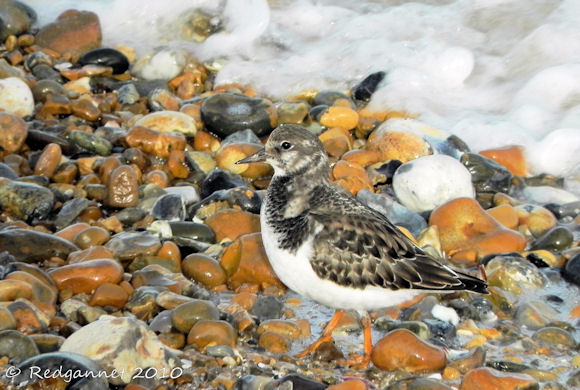
The Ruddy Turnstones made good lens fodder again.
 Shortly after, I saw the buntings for the first time; a flock of around 12 - 15, heading back the way I had come. They landed close to the wall about 200meters west of me. I approached slowly, not wanting to flush them, but a couple with dogs coming the other way saved me the walk and sent them back past me again 200meters east. This time I managed to get close enough to take a shot, but a flourescent cyclist put them up again and they disappeared out of sight towards Minnis Bay.
I couldn't see the birds on the screen of the Nikon  P100. The viewfinder is eletronic too and I had to take a wild shot in the general vicinity and hope that a bird appeared in one of them. I used the Nikon instead of the Canon because......., don't ask. Just don't ask! There was swearing! 
Of 4 pictures, I managed to capture 1 1/2 buntings.
Here is the whole one, cropped from the photo above, but I do not consider the promise fulfilled by this and I shall endeavour to do better.
I had five sightings altogether, inevitably, they were flying in the direction that I had just come from.
Still, my choices were to go birding on a bright and breezy day, or to stay in and revise for my yearly exams. So frustrating, unproductive and cold the day may have been, but I was outside and had managed to add a few more species to my Reculver list.
The accepted list numbers 200+, so I still have a long way to go.
 
Bird species; 30
 
Great Cormorant 30, Little Egret 2, Brent Goose 300, Mallard 25,Common Eider 14, Common Buzard 1, Common Kestrel 2, Eurasian Oystercatcher 1, European Golden Plover 120, Grey Plover 6, Common Redshank 22, Ruddy Turnstone 14, Sanderling 3, Common Gull 13, Herring Gull 30, Black-headed Gull 50,Stock Dove 50, Wood Pigeon 40, Meadow Pipit 5, Pied Wagtail 2, Common Blackbird 1, Common Stonechat 3, Great Tit 1, Eurasian Magpie 6, Carrion Crow 30, Hooded Crow 1, Common Starling 400, Chaffinch 25, European Goldfinch 6, Snow Bunting 15.
 

Monday, 8 November 2010

Reculver Seawall, Kent, UK

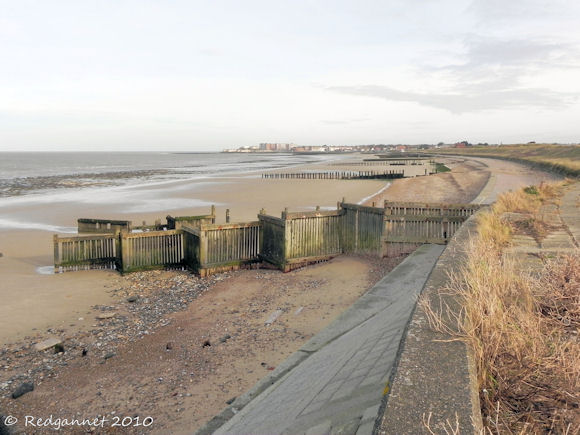
From the Minnis Pub on the southern (Kent) shore of the Thames Estuary (Google Earth ref; 51° 22’ 46”N, 1°16’ 52”E), I was looking west and could see the towers of the ruined, 12th Century church of St Mary’s at Reculver (51°22’46”N, 1°11’58”E).
It is a bit further than this picture might suggest. As the crow flies it is about 3.5 miles or 5.75 kms. Any crow would have had its work cut out today though as there was a strong wind blowing. Even the Black-headed Gulls were struggling to appear graceful and elegant in flight. Confused doggies ran in circles as balls, thrown for them, were returned to the throwers by the stiff south westerly.
Occasionally, events conspire to give me a chance to bird in my own backyard. As I spend so much time working away from home, I try to devote as much attention to my family as I can when I get back, but in the absence of copious presents, they tire of this attention very quickly. This week I have a few extra days off and their patience is wearing thin, so I took myself off to look for Snow Buntings.
These birds are one of the rarest breeding birds in the UK, though they are widespread on the East Coast during the winter. They are a scarce, but regular feature of the shingle beaches of the estuary and have been recorded at Reculver each year from October onwards since Christopher Hindle started documenting bird sightings there in 1963 . His diary on the Kent Ornithological Society website http://www.kentos.org.uk/Reculver/Reculver.htm showed that they had arrived for the season and my wife was making a comparison between the tidiness of the house when I am at home and when I am away. So in order to contribute as best I could to domestic bliss, I went out.

The tide was just beginning to recede as I arrived. This was more coincidence than contrivance, but it suited me well as the shorebirds were pushed closer to the sea wall and the Ruddy Turnstones made easy pickings for my new camera. I bought a Nikon P100 to use while my big lens is being repaired and it has produced a few nice pictures already. I don’t enjoy using it as much as a DSLR, but it has impressed me.
The buffeting wind made photography difficult. It came whistling across the levels and hit the raised dyke with full force. I would have had a lot of very shaky pictures with the DSLR, but the stabilising technology in the bridge-type Nikon coped very well. I walked with the water on my right. The turnstones were the first onto the wet shingle as the tide retreated, though some were still roosting on a breakwater.
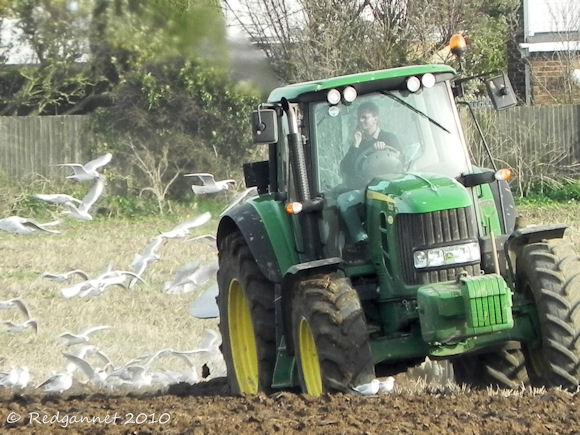
On my left, a freshly ploughed field proved irresistible to Northern Lapwings, Starlings and Black-headed Gulls.The sea wall runs fairly straight and parallel to the water. It meanders gently on a couple of occasions as it skirts Plumpudding Island and Coldharbour Lagoon.
The raised walkway and shingle banks provided lea shelter for roosting Oystercatchers, Grey Plovers, Sanderling and a couple of Ringed Plovers. The wind carried the sound of bird scarers from the flat fields inland and had the required effect of putting all the waders to flight from the beach. I took a few shots with the camera and was surprised to find that I could recognise the birds when I downloaded the card later on.The digital zoom facility wasn’t able to do justice to the Common Redshanks of Coldharbour Lagoon, but when the wind was trying to push me in with them, it wasn’t a bad effort.
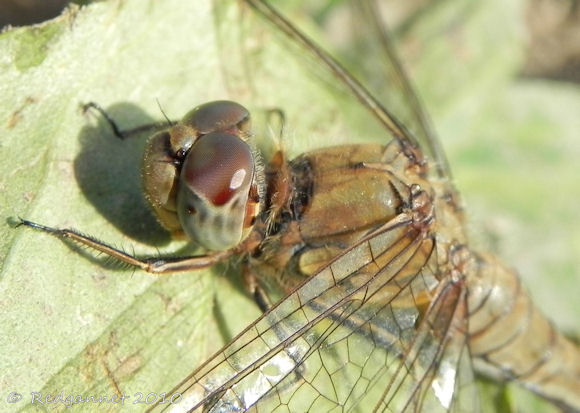
I turned inland from here and followed the River Wantsum upstream. At the railway line I turned left and sauntered slowly through thorn trees laden with dark red berries. I lingered in the area in the hope that some of the reported influx of Bohemian Waxwings might put in an appearance. Instead a late Common Darter got the treatment from the Nikon’s macro facility. This individual is a female which has turned brown indicating great age. In order to get close to the dragonfly, I had to lie down on to the ground which prompted a concerned birder to come to check that I was OK. He told me that Snow Buntings had been seen that morning on the beach just beyond where I had turned inland.

Waxwings, Snow Buntings. Snow Buntings, Waxwings. Decisions decisions. Either bird would be a lifer, but I plumped for the bunting due to its here and nowness. There is a Tesco superstore close to our house. It has a big car park full of rowan trees, so the Waxwings can come to me.
The buntings feed on seeds from coarse grasses that grow in sand dunes and coastal habitats. Finding a brown, grey and white bird on the brown, grey and white shingle wouldn’t be easy, but they are restless feeders which I was hoping would make them stand out.Perhaps like the rest of the birds today, they were keeping their heads down out of the wind. The hoped for flashes of white from the extended wings never materialised despite a good look through the mixed grass and shingle areas. They are very confiding birds I believe and don’t flush quickly. Therefore if they were sitting still and staying put, the chances of outwitting their camouflage were low.
Soon it was time to go home and mess up the house again, but not before a Peregrine swept across the seawall and down into Coldharbour Lagoon. The redshank scattered and like a sweet wrapper from a fast car’s window, were caught up and swept away by the wind as they cleared the shelter offered by the raised road. The falcon dipped back behind the wall and was gone. Earlier, one had been reported putting a Hooded Crow, a recent rarity, to flight as it hunted further along.
I was heading back to my car when a small flock of birds caught my eye. They were travelling east to west across the water, about 5 meters beyond the small breakers. It struck me immediately that these were not wading birds. The undulating flight and white inner panels in the wings of 3 of the birds left me with only one choice; Snow Buntings. It was not possible to get a photograph, but I intend to return and get one.

Christopher has kindly given me the text of a booklet that he prepared for self-guided walks around the Reculver Marshes. It is reproduced below and remains the copyright of Christopher Hindle.

Bird Species; 28

Great Cormorant 35, Little Egret 1, Brent Goose 32, Common Kestrel 2, Peregrine Falcon 1, Eurasian Oystercatcher 120, Northern Lapwing 45, Grey Plover 60, Ringed Plover 2, European Curlew 3, Common Redshank 14, Ruddy Turnstone 60, Sanderling 40, Common Gull 6, Herring Gull 40, Black-headed Gull 400, Stock Dove 30, Common Wood Pigeon 15, Eurasian Collared Dove 4, Meadow Pipit 9, Pied Wagtail 15, Common Blackbird 2, Eurasian Magpie 2, Rook 4, Carrion Crow 30, Common Starling 150, Chaffinch 35, Snow Bunting 8


RECULVER by kind permission of Christopher Hindle.

Reculver Country Park lies on the N.E. coast of Kent, 2 miles east of Herne Bay. The main landmark at Reculver is Reculver Towers, the remains of a twelfth century monastic church, which itself is situated on top of a Roman Fort. West of the Towers are the low eroding cliffs at Bishopstone and east is the seawall which stretches to Minnis Bay. Behind this seawall are Reculver Marshes which are now given over almost exclusively to agriculture.

Reculver is particularly good at migration times - April and May, and August to October - when almost anything can turn up in the right weather conditions. Reculver can be particularly rewarding in winter when one can get excellent views of the regular flock of Brent Geese, together with good numbers of waders on the beach. Here it is also possible to see Snow Buntings and even occasionally Shorelarks. In summer Ringed Plovers breed on the shingle, and on the land behind the seawall birds such as Reed and Sedge Warblers and Yellow Wagtails, Meadow Pipits and Reed Buntings breed.

ACCESS

BY ROAD - Leave the A299 (Thanet Way) east of Herne Bay at the turn off marked Reculver. From here it is a mile and a half to the car park below Reculver Towers (TR225694).

NEAREST TRAIN STATION - Herne Bay

BUS - A half hourly bus service runs from Herne Bay to Reculver - for further details phone Stagecoach - 01227-472082.

FACILITIES

TOILETS - Reculver Country Park Centre and King Ethelbert Public House.

REFRESHMENTS - The King Ethelbert Public House, and a cafe near the telephone box is open during the summer months.

INFORMATION - visit the Reculver Country Park Centre beside the car park to get information and leaflets. There are also information display boards at the entrance to the car park and at Reculver Towers.

TIMING - Allow 2-3 hours for the complete circular walk. It is not often hot at Reculver!

Be prepared to wrap up warm, particularly in winter when a wind off the sea can make it feel significantly colder than inland. A start before 9.00am or in the late afternoon will probably produce the largest variety of species.

1. Reculver Car Park.

Looking west from the car park at low tide during the winter you may see groups of Brent Geese(W) feeding at the waters edge below the coastguard lookout at Bishopstone. In the summer months Fulmars(S) regularly patrol these cliffs, which hold Kent’s largest Sand Martin(S) colony - Stock Doves(R) also nest on these cliffs.

Now walk from the car park sea wall up the path towards Reculver Towers.

2. Reculver Towers

If it is windy Reculver Towers can provide a sheltered place to watch birds flying past, often quite close inshore. In spring and autumn Common(SM), Sandwich(SM) and Little Terns(SM) may be seen, whilst in winter you are more likely to see Red-throated Divers(W), ducks(W), Brent Geese(W) and various species of gull. The grassy areas and walls of the Roman Fort also attract migrants, particularly in autumn. Look out for Yellow Wagtails(SM) on the grass and Pied Flycatchers(M), Redstarts(M), Willow Warblers(M) and Chiffchaffs(M) around the walls.

From the Towers the footpath leads down and left to the seawall. From here walk east a short distance and through the gate to view the Oyster Farm and its pools.

3. Oyster Farm

The extensive pools associated with the Oyster Farm often attract waders such as Redshank(R), Greenshank(M) and Common Sandpiper(M), and in cold weather in winter, ducks such as Red-breasted Merganser(W) and Goldeneye(W) and the occasional grebe(W) can be seen. Also keep your eyes open for Kingfisher(R) and Rock Pipit(WM) in this area.

Now walk east along the seawall.

4. Seawall

Walking along the seawall towards Cold Harbour will turn up a variety of wading birds. If the tide is low, look particularly at the mussel beds where you can see Oystercatcher (RW), Redshank(R), Turnstone(W), Ringed Plover(R), Curlew(W), Grey Plover(W) and Dunlin(W). Sanderling(W) can often be seen running about like clockwork toys feeding near the water’s edge. If the tide is in, keep your eyes open on the sea and watch for passing Cormorants(R) and waders, or Little Terns(S) feeding off shore. On the seawall itself you may see Wheatears(SM) and Yellow Wagtails(SM) in summer and Reed(R) and Snow Buntings(W) in winter. If you are lucky enough to choose the right day in September or October you may witness the migration of thousands of Swallows(S) and Sand(S) and House Martins(S) as they fly along the seawall. The shingle on the seaward side of the wall is the best place in the area to see Shorelarks(W) in the winters when they arrive in Kent. The fields inland regularly hold up to 500 Brent Geese(W) in winter, together with Mallard(R), Teal(W), Wigeon(W) and a large flock of Mute Swans(R). Frequently look out to the embankment, known as the Green Wall, which runs parallel to the seawall as Hen Harriers(W) and occasionally Short-eared Owls(W) hunt up and down it.

The walk from the Oyster Farm to Cold Harbour is about one and a half miles and will take 30-40 minutes.

5. Cold Harbour Lagoon

The lagoon itself is used throughout the year by birds. Look for Redshank(R), Turnstone(W), Dunlin(W) and Shelduck(R). Meadow Pipits(R), Reed Buntings(R), Skylarks(R)and Greenfinches(R) feed in the small patch of saltmarsh. Over the shingle ridge there is normally a large high tide roost of waders, on occasions numbering over a thousand birds - Turnstone(W), Sanderling(W), Oystercatcher(RW), Grey Plover(W), Redshank(R), Dunlin(W) and the occasional Curlew(W), Bar-tailed Godwit(W) or Purple Sandpiper(W). PLEASE DO NOT DISTURB SLEEPING BIRDS, BUT WATCH THEM FROM A DISTANCE . There are usually duck sitting on the sea off Cold Harbour- Eider(R), Common Scoter(M), Wigeon(W) and Mallard(R). In the past Little Terns(S) bred on this shingle bank, but now too much disturbance means that birds seen here are usually non-breeders or migrating birds.

From the seawall behind the lagoon a footpath runs south beside the River Wantsum towards the railway line.

6. River Wantsum

This narrow river is the western limit of the Isle of Thanet and you may see Mute Swan(R), Heron(R) or Moorhen(R) here. The reeds and scrub at its edge have breeding Reed(S) and Sedge Warblers(S), and if you are lucky you may hear a Grasshopper Warbler(S) living up to its name. In really cold winters when inland waters freeze the River can attract duck and grebes. In recent years these have included Smew(W), Goldeneye(W) and Slavonian Grebe(W).

Continue down this path, up the railway embankment and over the railway crossing to walk along beside the Chambers Wall bushes.

7. Chambers Wall Bushes

This line of bushes, adjacent scrub and reeds has breeding Whitethroat(S), Lesser Whitethroat(S), Linnet(RM), Goldfinch(RM) and Yellowhammer(R) and also acts as a magnet to migrating birds - almost anything can turn up here! Early mornings and evenings are the best time to see migrants. Look out for Fieldfare(W) and Redwing(W) flying in from Scandinavia in the autumn, and in spring and autumn you will see various warblers(M), flycatchers(M) and chats(M).

When you reach the small, fishermen’s car park return back down the path, but after 100 yards take the left fork across a bridge and walk to the railway embankment and Green Wall.

8. Railway Embankment and Green Wall
The bushes besides the railway attract birds such as Whitethroat(S), Whinchat(SM) and Reed(S) and Sedge Warblers(S). Hen Harrier(W), Merlin(W), Kestrel(R) and Short-eared Owl(W) can often be seen hunting over the marsh. This whole area is on the flight path of large numbers of winter and summer visitors, and depending on when you visit you may see Chaffinches(M), Bramblings(M), Meadow Pipits(RM), Fieldfares(W), Redwings(W), Lapwings(WM) and Swallows(S) and martins(S) moving through, usually flying west.

Walk westwards along the railway embankment until it heads towards the sea then follow the Green Wall all the way back to Reculver.


RECULVER SEAWALL, BEACH AND BIRDS

The shingle beach between Reculver and Minnis Bay forms a feeding and roosting place for many birds, and also a breeding place for Ringed Plovers. At low tide a variety of waders feed on the sand, mud and mussel beds. The lagoon at Cold Harbour still has a remnant area of salt marsh with its associated plants. During the summer and autumn the seawall attracts many insects from the surrounding farmland, which in turn attracts insect eating birds like wagtails, pipits, wheatears and whinchats.

BRENT GEESE are winter visitors from their breeding grounds in northern Russia. Historically they were much rarer than they are today, but in the last twenty years, they have learnt to eat winter wheat, barley and oil seed rape and their numbers have increased dramatically.

HEN HARRIERS frequently visit the marsh during the winter months. Look out for their slow flight and V-shaped wings as they hunt over the marsh. Females and immatures are brown with white rumps whilst males are pale grey with black wing tips.

OYSTERCATCHERS are mainly winter visitors, but the odd pair breeds on the beach or on the agricultural land behind the seawall. Large numbers roost at Cold Harbour at high tide and feed on the mussel beds at low tide. They are very obvious and noisy birds.

RINGED PLOVERS are present all year and are regular breeders on the shingle beach. The eggs and young are wonderfully camouflaged against the shingle and virtually impossible to see. Watch out for their display flight and calling during late spring and summer, but please do not disturb them.

TURNSTONES are mainly winter visitor, but a few non-breeders stay all summer. This species lives up to its name, turning over stones to eat sand shrimps and other creatures. A common bird on Reculver beach with a large roost at Cold Harbour at high tide.

LITTLE TERNS used to breed at Reculver with as many as 36 pairs in the 1970’s, however increased recreational use of the beach between Reculver and Minnis Bay means the species has not bred for some time. It is however still regularly seen off Reculver during the summer months.

SHORELARKS are rare birds and a Reculver speciality although they are not seen in every year. In winters when they do arrive in Kent, there favourite place at Reculver is on the beach between the Green Wall and Cold Harbour.

YELLOW WAGTAILS are summer visitors from Africa and nest on the agricultural land south of the seawall. During August large numbers of migrant Yellow Wagtails feed on insects on the seawall. They have an elongated appearance and a very distinctive call note - “tsweep.”

SNOW BUNTINGS visit Reculver in most winters and can often be seen feeding on the beach above high water mark. When a group takes off listen for their call note “teu” and look out for the large white flashes on their wings. Adult males are particularly pale and attractive birds.

Sunday, 7 November 2010

Miami Dragonflies, August 2009

This post has been transferred in from the now dormant http://www.redgannetdragonflies.blogspot.com/ for ease of linking. It was previously published there on 31st August 2009

On a trip to Miami this week, I was tempted by a new camera and succumbed. I had been looking for a little while at the Nikon Coolpix P90, hoping that it would save me a lot of carrying and lens changing. It has a 24x optical zoom. By some jiggery pokery, the tech specs claim this equates to 26-624mm on a 35mm format SLR camera. My DSLR has a sensor which is smaller than 35mm and thereby produces a cropping effect. This is how my 400mm appears to be 640mm.
Most of my photos are taken at the high end of my 100-400mm Canon. If I need a landscape picture though, I have to change to an 18-55mm. The macro lens is a 50mm Sigma. It is a lot to carry around and a common problem is dust which enters the camera during lens changing. So, a camera with a high top-end zoom, a wide angle capability and a macro function too, might just be the solution. It even has a video capability.
Could it perform well enough to replace the SLR and all it’s lenses? To save you skipping to the bottom of the page in anticipation to find out if in fact it is the answer to all my problems, I am sad to say, it is not.
There is no arguing with the macro function. The result from a quick practice was stupendous. The photo below has been reduced in quality for the blog, but believe me, it is breathtaking on my 17”monitor in the study. I bought the camera from a shop beside a small river near Dadeland Mall. In a stretch of less than 50m of riverbank, I saw 9 different types of dragonflies. Most of them have yet to be identified, but there is enough detail here to confirm that it is a Halloween Pennant.
One issue with the macro function is that the optical zoom is restricted so it is not much bigger than the 50mm Sigma. The "live view" function though allows the picture to be composed at arms length which is a big advantage over my current SLR without "live view". The screen folds out to give good sight even at odd angles. The screen is nice and bright too which allows one to view pictures even in the bright Florida sun.
The wide angle and mid range zoom are fine. I have no problems there.
The top-end zoom works well when the subject is clearly differentiated from the background. Otherwise the auto focus struggles. A dragonfly perched on a stalk with water vegetation behind it took a couple of attempts to get into a decent focus. In this circumstance, I was quite close to the subject. There is a manual focus facility which is operated with the multi function control. It works OK in controlled conditions, but would be a little slow in the event that the subject was moving. To my mind, I think it is an oversight not to provide a remote release facility. With 624mm of throbbing focal length, I would have to use a tripod and with a tripod, I like to use a remote release. It is true that no other compact digital cameras provide the feature either, but why not? Digiscopers have had to develop grips and frames and pushers and pressers in order to achieve what is really a very simple function if built in at the design stage.
I was unaware of a time lag between pressing the button and the shutter releasing. This used to be a dreadful problem, but the Nikon Coolpix P90 appears to have bettered it.
There is sill an issue with the power saving mode. (The battery supplied with the camera is a l-ion and much better than AAAs. Thank you very much to Wendy from Best Buy, Dadeland, for charging the battery for me. It took more than 200 pictures today without showing a power alert.) An SLR will reboot instantaneously when required to take a picture. The P90 took a few moments, but it was reasonably quick compared with other compacts.
I haven’t tried the video facility yet. Maybe I will open an account at Utube when I do.
On the whole, I like it and I think it is good value for money. Will it replace my SLR and lenses? No I don’t think so, unless I become too old and tired to carry that much stuff about. It lacks the immediacy of the SLR and the “hands on” feel of the slide zoom and manual focus ring. Will some of my lenses be consigned to the shelf or the lots at E-bay? Probably not. It will probably just end up as even more weight carried in my rucksack.

Miami Dragonflies, November 2009

This post was originally published on the now dormant http://www.redgannetsdragonflies.blogspot.com/ on 3rd November 2009. It has been transferred in to simplify linking.

Temperatures reached an unseasonal 85+ today during a trip to Miami. Calm air and easy access to Snapper Creek made choice of activities a formality.
I had visited Snapper Creek a few weeks ago and bought a new camera at the Best Buy, adjacent to the river and taken a memorable piture of a Halloween Pennant. Today with yet another new camera, the Canon 50D, I was hoping to recreate that success.
As I approached the river, I noticed a Great Egret and 2 White Ibis close to the water's edge. A pair of large iguanas were moving towards the sunlit grass.
Snapper Creek is approx 8 meters wide at this point and has 2 or 3 meters of grass on both banks. The margins have grass and a few other emergent plants. In some spots, mats of weed cling close to the banks. The water is very clear and has a good flow. There are many fish, some quite sizeable.
The first ode was seen from the Northern bank right beside the bridge at Dadelands North Metrorail station. It was a Scarlet Skimmer, Crocothemis servilia. This dragonfly has appeared in the blog before and today takes the crown for the most widespread ode that this blogger has seen. First seen in Singapore, it has subsequently been found in Hong Kong, where it goes by the name of Crimson Darter, and in India during October.
The website Odonata Central has very little to say about this species, which I found surprising for such an apparently abundant and dramatic-looking creature. This leads me to wonder if it has been introduced or escaped along with the iguanas and the parrots. Despite it's uncertain provenance, it is quite approachable and sits well for pictures. Without any evidence to the contrary, I am assuming this to be the female.
Next was the tiny, Spot-tailed Dasher. Another seemingly abundant species, which also fails to make it into the "Beginner's Guide to Dragonflies", which I am currently using as my reference field-guide.
The little dasher was then displaced by the much larger, Blue Dasher. The Blue Dasher was the original holder of the distribution title having been seen from Toronto, Canada to Califonia.

Then came the dragonfly which had been at the back of my mind when I had chosen to come to Snapper Creek. I had taken a picture of it for the previous Miami post, but it had not been sufficiently detailed to allow me to properly identify it. I can now reveal that it is a Tawny Pennant, Brachymesia herbula. I was beginning to suspect that the Stokes's had forgotten to visit Florida while researching their book as 3 out of 4 odes seen so far had been omitted. Despite that, the guide will probably please most people who don't get anal about identifying down to the sub-special levels.

I doff my hat to Warwick and Michele Tarboten for this next photo. I would not have even considered taking a shot, were it not for the photo on the back cover of their "A Fieldguide to the Damselflies of South Africa". Now, if ever you are considering writing an Odonata fieldguide, may I suggest this as a standard to which you should aspire. I believe it to be a Rambur's Forktail. This species is mentioned by the beginner's guide, but when you do not have the full set for comparison, how can a definitive identification be made?
And so to the one that got away. This was my best picture of the day which makes it frustrating not to get a positive ID. My suspicions lead me towards a female Eastern Amberwing. It was about the right size and the abdomen is suggestive of amberwing. The eyes and the yellow marks on the thorax fit the descriptions of the amberwing. The wings however made me doubt the accuracy of my assumptions. The creature left it's wings to flutter in the light breeze in the same way that I had seen the Halloween Pennant doing on my previous visit. The wings were also much more heavily marked than I have seen in any photos or illustrations. There were both Eastern Amberwings and Halloween Pennants in the vicinity to compare size and flutteriness with. I see that the amberwings sometimes imitate wasps, but the fluttering did not seem reminiscent of any wasp that I had seen before. So I find myself unsatisfied with Eastern Amberwing. Perhaps there is a tiny pennant that I have not found in my research yet. All thoughts are welcome.

Odonata species; 8
Rambur's Forktail 12, Eastern Meadowhawk 4, Eastern Amberwing 6, Scarlet Skimmer 8, Spot-tailed Dasher 8, Blue Dasher 2, Tawny Pennant 12, Halloween Pennant 1,

Miami Dragonflies, Dade. MIA