Monday, 25 June 2012

Bukit Timah, Singapore, June 2012

Bukit Timah is a forested Hill in the centre of Singapore Island. I would venture to say that it may be the highest spot in the country, but don’t hold me to that. There is a steep initial climb for about 200 meters from the Visitor Centre before the gradient becomes more bearable towards the summit. All in all, the climb would probably not take more than 15 to 20 minutes, but that time might be better spent around the base of the hill where more birds seem to hang out.


At the entrance, a cycle track cuts into the forest on the right. Beware of mountain bikers here who assume that they have the right of way.


Pin-striped Tit-babblers were common along this track as were the Asian Glossy Starlings, Pink-necked Green Pigeons and Yellow-vented Bulbuls. Greater Racket-tailed Drongos were chasing relentlessly back and forth to feed a pair of chicks.


Please excuse this picture of a Banded Woodpecker which was taken from the deep, dark, wood and had to be enhanced dramatically to bring up the image. The bird was clinging to the trunk with its legs splayed wide to enable it to get closer to the trunk and listen for grubs moving inside. Its wings were spread to keep it from rolling from side to side on its keel.


The highlight of the visit was finding Hindhede Park. Even though the entrance is located right beside the Visitor Centre, I had never ventured into this section of the reserve. Primarily, it is a picnic and playground, but the forest is closing back in to reclaim the tables and climbing frames. More Greater Racket-tailed Drongos and Common Ioras were seen on the short stroll as far as the platform that looks out over the flooded quarry.


A photographer was trying to capture a shot of a Stork-billed Kingfisher diving for fish. He did this by throwing out a piece of bread which attracted the small fish. When the fish splashed, they in turn attracted the kingfisher which plunged into the shoal three times as I watched. This was the best that I managed, but there is more to come from my next visit, I can assure you.


Sadly, I have to put the Blue-eared Kingfisher down as a miss. We managed to scale the language barrier as the other photographer told me that he was waiting for the little blue kingfisher that comes later in the evening. He excitedly called and pointed at a ripple, then into a bank-side tree, but I just couldn’t see it. So I have two good reasons to return on my next trip to Singapore.

 Birds seen; 15

White-bellied Sea Eagle 1, Pink-necked Pigeon 10, Stork-billed Kingfisher 3, Banded Woodpecker 1, Common Iora 1, Black-naped Oriole 1, Greater Racket-tailed Drongo 6, Pied Fantail 1, Pacific Swallow 2, Yellow-vented Bulbul 8, Common Tailorbird 1, Pin-striped Tit-babbler 8, Asian Glossy Starling 12, Javan Myna 15, Orange-bellied Flowerpecker 1.

I made the journey to Bukit Timah as an extension of the trip to the Botanic Garden. Buses 67, 170 and 171 all pass by the Botanic Garden MRT station and continue to the stop close to Bukit Timah at Google Earth ref; 01 20 35N 103 46 31E. From here, look north to see the big aeriels at the top of the hill. Head towards them and cross the footbridge over the main road, pass under the little railway bridge on Hindhede Dr. and continue straight up for the Visitor Centre at Google Earth ref; 01 20 55N 103 46 37E.

Alternatively all three of the buses mentioned above pass within 200m of Newton MRT Station.

Visit the dedicated Asia Page for more posts from the area such as Singapore Botanic Gardens, Sungei Buloh and Paser Ris.

Saturday, 23 June 2012

Botanic Gardens in Singapore, June 2012

No trip to Singapore would be complete without a visit to the wonderful Botanic Gardens there. I arrived by MRT at the Eco Pond end of the gardens, starting the day with the conundrum that is the swiftlets. 


I had spent a lot of time on them already, but this morning they were joined by a far easier species in the form of a Grey-rumped Treeswift. White-breasted Waterhens were common around the pond’s edge though they looked very nervous as they tended to their young. The Lesser Whistling Ducks were also keeping a watchful eye on their brood.


I was headed towards the Heliconia garden which overlooks Symphony Lake and attracts Sunbirds to feed from the showy flowers. An Olive-backed Sunbird male was first to show followed shortly after by the female.


A Crimson Sunbird came down to feed too, but dropped onto the far side of the flowers. On the other side of the lake, looking back towards the Heliconias, a White-breasted Kingfisher kept vigil.


I continued towards Swan Lake where there is a slope with some fruiting trees at the bottom. From the top of the slope, I was able to see the Pink-necked Green Pigeons which were feeding, then took to roosting as the day warmed up and the fruit began to ferment.


The usual angle of approach for the Green Pigeon is from below as it commonly feeds in the tops of fruiting trees, so it was nice to get a picture that does not prominently feature the vent.


I returned towards the MRT station passing the proud parents of three White-breasted Waterhen chicks that crossed the path in front of me and stopped for a quick photocall.


Of course Singapore Botanic Garden is famed for its variety of dragonflies. I hadn't intended to do any oding today, but when a bright red jobbie lands on a Heliconia, it is hard to resist.


Crocosima servilia

 Birds seen; 15

Lesser Whistling Duck 15, White-breasted Waterhen 15, Spotted Dove 8, Pink-necked Pigeon 15, Blue-crowned Hanging Parrot 2, Grey-rumped Treeswift 1, White-throated Kingfisher 2 Black-naped Oriole 2, Pacific Swallow 4, Yellow-vented Bulbul 6, Asian Glossy Starling 50, Javan Myna 60, Olive-backed Sunbird 4, Crimson Sunbird 1, Eurasian Tree Sparrow 25.

Friday, 22 June 2012

Venus Transit and Paser Ris, Singapore, June 2012

And so back to Singapore as this itinerary turns for home. A transit of Venus across the face of the Sun left me the opportunity and excuse for a lie-in before being helplessly drawn to Paser Ris.


The approach to the mangroves along Sungei (River) Tampines is always productive with a Sunda Woodpecker, Black-naped Orioles and a Collared Kingfisher.


The park itself is home to sunbirds such as this female Brown-necked Sunbird.


I discovered Paser Ris by accident on my first ever birding outing here and cannot pass through Singapore without making a visit. It was a quiet day today without the excitement of previous visits, but very pleasant just the same.
The quietness of the late afternoon visit allowed me the time to try to get a picture of a swiftlet. The only advice I have ever given about photographing swifts was ‘don’t waste your time’, but I have never been one to heed my own advice.


The swiftlets here are very difficult to identify, well, they keep flying about! I wanted to try for a picture to see if that would be able to tell me what I was unable to see with my naked eyes.


I had managed to separate Germa(i)n’s Swiftlet earlier in the trip by virtue of its lighter rump, but these showed a much fainter marking if at all. The obvious tail notch and plain underparts keep leading me back to Himalayan Swiftlet, but I cannot commit myself on the basis of these pictures.


On Sungei Tampines, the Grey Heron roost was busy. I would love to think that this individual shouted “Boo!” as it landed.


There are plenty of fruit trees around the park and a couple of them, down by the shore were attracting Pink-necked Green Pigeons and Asian Glossy Starlings to feed.


Birds seen; 21

Grey Heron 8, Striated Heron 2, Brahminy Kite 1, White-bellied Sea Eagle 1, Little Tern 2, Spotted Dove 2, Zebra Dove 2, Collared Kingfisher 4, Blue-throated Bee-eater 4, Brown-capped Woodpecker 1, Common Iora 3, Black-naped Oriole 2, House Crow 6, Pacific Swallow 4, Yellow-vented Bulbul 12, Ashy Tailorbird 4, Asian Glossy Starling 60, Javan Myna 40, Brown-throated Sunbird 2, Olive-backed Sunbird 1.

Potamarcha cogener

For more posts from Paser Ris with directions, Follow the links below;

Visit the dedicated Asia Page for more from Singapore including, Singapore Botanical Gardens, Sungei Buloh and the Central Catchment Area


Wednesday, 20 June 2012

Powerful Owls in Sydney Botanical Gardens, June 2012

Sydney’s Royal Botanical Gardens were bathed in sunshine for a very quick surgical strike in search of a pair of Powerful Owls. They proved to be very easy to find given that I had completely failed on two previous attempts.


Look for bat wings and possum tails scattered on the ground among the plentiful pellets, then just look up. Start your search in the ficus tree as the driveway splits, just before the Governor’s Mansion. Below is the male. The female preferred another ficus tree just across the driveway.


Mission accomplished, I moved on and took the long way back via the ponds where a Black Cormorant was roosting in the trees on one of the small islands. A black plastic sack stuck in one of the branches may have been another attempt by the gardens to save its trees.


In the past Australian Ibis and at least two species of cormorant nested on the little islands in the pond The ibis appear to have reduced significantly in number over the last few years and I have seen very little nesting behaviour on my recent visits.


I continued across the lawns towards the gap in the wall into the herb garden. Just here, another of Australia’s night birds, the Tawny Frogmouth was seen in a very open position.

Birds seen; 11
Maned Duck 4, Chestnut Teal 3, Little Black Cormorant 5, Australian Ibis 15, Dusky Moorhen 8, Masked Lapwing 4, Silver Gull 6, Powerful Owl 2, Tawny Frogmouth 1, Noisy Miner 5, Welcome Swallow 3.

For more posts from Sydney's Royal Botanical Gardens, follow the links below;
http://redgannet.blogspot.com/2009/05/cockatoos-at-dusk.html
http://redgannet.blogspot.com/2011/02/sydney-botanical-gardens.html

Visit the dedicated Australia page for more from the Sydney area including Bi-Centennial Park, North Heads and Royal National Park.

Monday, 18 June 2012

Bi-Centennial Park, Sydney, June 2012


Sydney was sporting an autumnal look as the southern winter approaches. It was cool enough to have the locals reaching for their jackets, but 12C is a perfect temperature for an overweight sweaty bloke who was planning a bit of a hike. 


I started from Concorde West as usual, but was planning to cover more ground today and return by ferry from the wharf on the Parramatta River. As usual, birds were seen before even leaving the station with Pied Currawong, Noisy Miner, Australian Raven and Rainbow Lorikeet seen before passing under the road bridge at the end of Victoria Ave. A flock of 30 Sulphur-crested Cockatoos flew raucously over and alighted on the large aerial just inside the park.


Yellow Thornbills, Spotted Pardalotes, Grey Fantails, and Superb Fairywrens formed a mixed flock to welcome me into the scrub along the path that passes the freshwater ponds. 


A Purple Gallinule reflected in the pond that it shared with a few Chestnut Teal and a Pacific Black Duck.


The water level in the lagoon was as high as I have seen it before. There was not a wide variety of birds to be seen this morning, though Chestnut Teal, Grey Teal and Black-winged Stilt were plentiful. A few Black Swans drifted carelessly across the surface with one taking time to show off the flight feathers that so often get missed on the closed wing.


At the far end of the lagoon, I stopped in at the hide for a while. The high water had covered the mud which is usually enjoyed by the tiny Red-kneed Dotterels and it had concentrated the Black-winged Stilts around the small island that they shared this morning with the Australian Pelicans.
On Homebush Bay behind, a few scuttled boats provided roosting spots for the missing Dotterels as well as Anhinga, Silver Gulls and Pied Cormorants.


Beyond here, I was venturing into new territory. I had arrived in Sydney early this morning and the rest of the day was mine, so I had no time restrictions and was able to continue across the Bennelong Parkway bridge at Google Earth ref; 33 50 05S 151 04 33E. A Rufous Night Heron roosted in the mangroves overlooking the side channel here and a Striated Heron watched patiently from the barrage. 
I took the path through the Olympic archery ranges before cutting across Hill Road into the Narawang Wetlands which had been my main purpose for this morning’s visit. The marshes here are man-made, managed for Bell Frogs with a boardwalk passing through much of the system. There are shallow and deep pools with lots of reeds, rushes and water vegetation, but not much by way of birds. 


A few Superb Fairywrens were seen among the rushes and some Australian Grebes dived and disappeared into the reeds at my approach, but most of the action came from the higher trees around the edges. Black-faced Cuckoo-shrikes were seen perched in the topmost branches and a Grey Butcherbird sat out proud on a snag.
My secondary target for the day was a visit to Birdlife Australia Discovery Centre. The gates from the wetlands leading into Newington Armory were closed, so I had to take the long way round via the gaol. The public displays were closed when I arrived, but the friendly and helpful staff opened it up for me to have a quick look. After a quick glance at my waistline, they warned me that the gap in the fence was quite narrow and then pointed me towards the exit of the armory. Sure enough, for a chap with a pie dependency, it was a bit of a squeeze to get out. By the river here there is another wetland with viewing gaps cut into a screen through which good numbers of Chestnut and Grey Teal could be seen, but more locked gates that looked as if they did not open very often for casual viewing, blocked further penetration into the area.


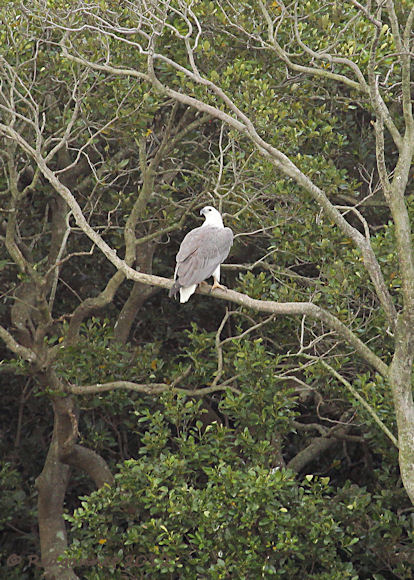
There is a pair of White-bellied Sea Eagles that feature as stars of the Discovery Centre’s webcam, building a nest nearby each year and raising their chicks under thousands of watchful eyes. The bird perched in the mangroves across the Parramatta River was possibly one of the pair which should be returning to their duties later this year. It was time to rest my weary legs and I took the time to try to get a long-distance shot of the eagle.


A Brown Hawk flew past and flushed a White-faced Heron that had been picking it way along the shore towards me.
The ferry timetables did not suit me at this time of day, so I ended up on the bus which runs between the wharf at Google Earth ref; and Strathfield Railway Station (a couple of stops closer to the city on the same line as Concorde West).

Birds seen; 42
Black Swan 15, Pacific Black Duck 20, Grey Teal 60, Chestnut Teal 180, Australian Grebe 4, Little Black Cormorant 2, Pied Cormorant 6, Little Pied Cormorant 2, Australian Darter 4, Australian Pelican 8, Great Egret 1, White-faced Heron 12, Striated Heron 2, Rufous Night Heron 1, Australian Ibis 40, White-bellied Sea Eagle 1, Brown Goshawk 1, Purple Swamphen 12, Dusky Moorhen 16, Black-fronted Dotterel 12, Pied Stilt 135, Silver Gull 6, Crested Pigeon 4, Sulphur-crested Cockatoo 30, Rainbow Lorikeet 6, Superb Fairywren 35, Whiteplumed Honeyeater 2, Noisy Miner 15, Spotted Pardalote 2, Yellow Thornbill 4, Grey Butcherbird 1, Australian Magpie 15, Pied Currawong 5, Black-faced Cuckoo-shrike 4, Willie Wagtail 5, Grey Fantail 2, Magpie-lark 15, Australian Raven 4, Welcome Swallow 15, Common Myna 6, European Starling 40, Red-browed Firetail 12.

Visit the dedicated Australia Page for more from the Lucky Country including, Sydney Botanical Garden and Royal National Park