Sunday, 27 March 2011

High Resolution Images from February 2011

High Resolution Images from February 2011

The images in the main blog have been reduced in size to 600 pixels or less across to facilitate quick loading. It goes against all my sensibilities to reduce the resolution, so each month I shall select a few shots that warrant being seen in in hi-res.
These posts may take slightly longer to load, so please be patient.

The links will take you back to the original post


Northern Red Bishop, Pilanesberg, Johannesberg.


Australian Emerald, Sydney Botanical Gardens, Australia


Indian Robin, Kalindi Kunj Crescent, New Delhi

Other galleries can be found at the dedicated High Resolution page.


High Resolution Images from March 2011


High Resolution Pictures from March 2011

The images in the main blog have been reduced in size to 600 pixels or less across to facilitate quick loading. It goes against all my sensibilities to reduce the resolution, so each month I shall select a few shots that warrant being seen in in hi-res.
These posts may take slightly longer to load, so please be patient.

The links will take you back to the original posts.


Orange-headed Thrush from Chuen Lung Family Walk in Hong Kong.


Spotted Thick-knee from Strandfontein in Cape Town


African Oystercatcher from Miller's Point in Cape Town

Other galleries can be found at the dedicated High Resolution page.

Friday, 25 March 2011

Betty's Bay and Leopardskloof.

Surely this morning I would be able to go about my bird watching business without sinking into the sand or getting caught for hours in traffic. My destination was Sir Lowrie’s Pass in the Hottentot Holland Mountains. I wanted to look for Rock-jumpers and the like at the top of the pass and had made an early start. At 06.30, at the foot of the pass, a police roadblock was stopping traffic and diverting vehicles. The mountain was on fire!
 Leopardskloof at Harold Porter Botanical Gardens

After a quick change of plan, I decided to visit Betty’s Bay and Harold Porter Botanical Garden instead. I arrived too early for the gardens, but the small village at Betty’s Bay had plenty of birds, including the only other mainland penguin colony in Africa (the other being Boulders that I visited in the previous post). Cape Francolin were common around the roads of the village and the first Cape Weavers and Pied Kingfisher of the trip were found here too. The white, guano covered rocks were easily visible from the car park.
Down on the beach some Egyptian Geese sat on a small fence. Some Hartlaub’s Gulls and Great Crested Terns shared a breakwater with a Cape Cormorant. In the water was a Jackass Penguin. A sudden flurry announced the attack of a Peregrine Falcon as it swooped. It seemed to be aiming either for the cormorant or the penguin, but missed both and flew back to alight on the tall aerial to the right. It wasn’t possible to access the penguin boardwalk until 08.00, but 2 penguins, like naughty teenagers coming home late, found a way in via a shallow gap under the fence. A Cape Hyrax had come out onto the rocks to warm up in the early morning sun.
My hope was to visit Leopardskloof in Harold Porter Botanical Gardens and at 08.00, the gates opened and let me in. Leopardskloof was a fenced off area that needed permission and a key until recently, but now it is accessible to anyone during opening hours. It consists of a steep tract of coastal fynbos and a small section of coastal forest in a ravine with a stream running through and a waterfall at its head. The sides are precipitous and the rocks, though stable in the short-term, are plainly vulnerable over time.
To reach the kloof it is necessary to pass through the gardens to the top of the slope and cross the stream. Scum on the surface of the water under the bridge, had formed intricate patterns that could only have come from Africa.
The garden held Orange-breasted Sunbirds, Malachite Sunbirds and Some Alpine Swifts overhead.
A fire has taken much of the fynbos leading up to the ravine, but beyond the fence, all seems to be intact. A Sombre Bulbul called its strident alarm as soon as I came over a little rise.
 The trail leads into the forest and crosses the stream 3 times before reaching Steffina’s Gift. Small stones had been placed by a plaque dedicated to a benefactor who had sponsored a series of ladders that enabled access to the top of the ravine and the small waterfall. The top pool is surrounded on three sides by vertical cliffs and a lip of rock at my back made me feel as though I was in a well.
The climb up was not been arduous, but neither had it been productive. Only the bulbul and a couple of Cape White-eye had shown. I had stopped for a while after hearing what might have been the call of a Blue-mantled Crested Flycatcher but was not able to confirm it for a red tick. The way back down brought a Cape Batis, a couple of Olive Thrush and a few more white-eye. Leopardskloof had not lived up to the hype today, but it does have a good reputation and will be worth another look next time.
Back in the gardens a Familiar Chat flitted by, stopping only briefly. A pair of adult Verreaux’s Eagles were circling. They found some warm air, gained height fast and glided away, showing their distinctive silhouette.
Back at the penguin colony the boardwalk was busy I stopped to see if a pair of them would give a nice superimposed picture. It almost happened, but my main interest here was the cormorant roost at the point. Using the scope, I managed to pick out four species, Cape, White-breasted, Bank, and Crowned Cormorants. The first two species were easy to find close to the viewing spot. The other two preferred to be at the extreme edge of the point.
Out on the ocean, Cape Gannets approached a little closer to shore, but were still quite distant. They formed rafts when they weren’t fishing. On my way back to the car I added Sandwich Tern and White-throated Swallow, but the highlight of the day came in the shape of a Kittlitz’s Plover.
The little bird had scraped a little nest right beside the busy path that visitors use to access the penguin boardwalk and had to retreat from it whenever anyone passed. I stopped in the middle of the path and placed my bag strategically so that path users would have to use the far side of the path and not disturb the plover. This partly worked except that some people will still insist on walking in front of cameras, even if they have to step over bags to do it. More considerate people stopped to see what they might be disturbing before making a wider pass.
Its (his?) choice of site is surely a bad one and although there was a potential partner on the beach, it never showed any interest in a nest so subject to disturbance.
Betty’s Bay is on the coastal road between Gordon’s Bay and Hermanus (Google Earth ref; 34 22’22”S 18 53’ 38”E. The white guano-stained rock and the boardwalk are clearly visible on Google Earth). It would take about an hour from Somerset West.

Species seen; 37

Jackass Penguin 200, Cape Cormorant 200, White-breasted Cormorant 40, Bank Cormorant 20, Crowned Cormorant 8, African Sacred Ibis 20, Hadada Ibis 1, Egyptian Goose 2, Verreaux’s Eagle 2, Peregrine Falcon 1, Cape Francolin 20, Helmeted Guineafowl 10, African Oystercatcher 1, Kittlitz’s Plover 2, Cape Gull 4, Hartlaub’s Gull 35, Sandwich Tern 2, Great Crested Tern 5, Pied Kingfisher 1, Alpine Swift 6, White-throated Swallow 20, Cape Wagtail 15, Cape Bulbul 4, Sombre Greenbul 3, Olive Thrush 3, Familiar Chat 1, Fiscal Flycatcher 3, African Dusky Flycatcher 3, Cape Batis 4, Orange-breasted Sunbird 6, Malachite Sunbird 2, Southern Double-collared Sunbird 2, Cape White-eye 6, Common Starling 6, Red winged Starling 15, Cape Weaver 4.

Wednesday, 23 March 2011

Miller's Point and Boulders, Cape Town, South Africa

My slow start to the day had me running late and a trip down to The Cape of Good Hope would be all too brief to make it worth my while. Along the approach road, the M4, down the eastern side of the peninsular is a boat launching ramp called Miller’s Point, about 5kms south of Simon’s Town (Google Earth ref; 34 15’ 54”S 18 28’ 31”). Take the second entrance if coming from Simon’s Town.
Day-trippers are attracted by a sea pool that changes its water with the tide and offers salt water swimming without all that Great White Shark silliness. Gulls are attracted by the fishermen hauling their boats and catch from the sea. In turn, I was attracted by the gulls, but stayed for the Oystercatchers.

An attended car park is open until 18.00 after the sun had dropped behind the huge mass of rock to the west. Parking outside the secure car park is available at any time, but beware that trucks towing boats need a wide turning space.
Most obvious were the Cape Gulls. They are big, black-backed and abundant. Until recently, they were considered conspecific with the Kelp Gull. There were lots roosting in the car park, on the beach and on the ramp. Potentially it could be confused with Lesser Black-backed Gull, but the latter is an uncommon summer visitor only in the far northeast of the former’s range and has not been seen as far south as the cape. So there should be no cause for doubt, but are those yellow legs that I see behind the first bird?
Steps lead down onto a rocky coastline where an African Oystercatcher, Haematopus moquini, was calling hysterically at a couple who were walking nearby. It looked as if there was a pair which became increasingly upset and vocal as the couple walked in the sand above the high-tide mark. Perhaps there was a nest.
By coming from a different direction, the oystercatchers allowed me to get into a position to give a nice background to the picture. The bill and eye are very similar to the North American Black Oystercatcher, Haematopus bachmani, but the legs are pink instead of pale and this species is endemic to Southern Africa. 
A scan across False Bay brought rafts of Cape Gannet. A few were flying and occasionally stalling, and folding in their wings at the last second as they plunge dived (dove).
I began my homeward journey with a quick visit to the close by Boulders penguin colony (Google Earth ref; 34 11’ 52”S 18 27’ 12”E). The Jackass Penguins here are very easy to observe and will often shelter under cars, so be careful and check beneath your vehicle before you drive away. 
One individual was skipping back up the rocks to see his (?) other half. He had quite a jaunty step and was obviously looking forward to his assignation. Another couple had just been re-united at the top of the boulders and indulged in a touching, tender greeting before settling down for some preening and sunbathing in the last rays of the evening sun.
Passing Muizenberg, there was just enough light left to enjoy the waves coming ashore at the beach there. Hartlaub’s Gulls were waiting for scraps from the fishermen and I was able to see the faint grey collar and lavender rinse that often gets burnt out in strong light. 

Species seen; 10

Jackass Penguin 12, Cape Gannet 400, Cape Cormorant 400, African Oystercatcher 2, Cape Gull 600, Hartlaub’s Gull 20, Common Tern 3, Cape Wagtail 2, Karoo Prinia 1, White-necked Raven 2.


Miller's Point, Cape Town,  South Africa

Monday, 21 March 2011

Kirstenbosch Botanical Gardens, Cape Town, South Africa

Today, I had all day to kill in Cape Town. An early start should have seen me at Kirstenbosch Botanical Gardens on the morning slopes of Table Mountain for opening time, but the rest of the suburbs had risen before me and were in front of me on the motorway into the city. I have not experienced any significant traffic in South Africa before and I was dismayed to see the day start without me as the sun’s first rays hit the top of the mountain and gently slid down into the gardens as I watched from behind a gravel lorry on the N2. The 40 minute journey took nearly 3 hours.
The gardens are truly beautiful and my frustrations slipped quickly away once I had paid my entrance fee and began seeing some birds. Cape Francolin was ticked in the car park and a couple of Egyptian Geese sat atop the café near the turnstile of the top car park. Helmeted Guineafowl fussed with their chicks on the first of the many lawns and a young Verreaux’s Eagle soared with the massif behind it.
I wanted to move uphill to the protea and fynbos section of the gardens, but was drawn by bird calls and found a mixed flock feeding at the bottom of the slope. Cape White-eyes made up the majority with Cape Canary and Sombre Greenbul making most of the noise.
A tiny Muscicapa showed well in the sun and this time I paid more attention to the head. No streaks today, so this one must be a Dusky Flycatcher, though the underparts still look very pale to my tastes.
The protea and fynbos section of the garden is towards the top of the slope. Fynbos is the unique heath-like habitat that characterises the environment of much of the cape. It is very species rich with representatives from the grass or reed-like Restios, the heathy Ericas, the pincushion Leucospermums, and the magnificent Proteas. Such beautiful habitat and the high endemism make for a very rewarding birding experience.
Please take the bracketed section below with a pinch of salt. I am leaving it in just to cause confusion and divide opinion. It is probably a load of old toot, but it shows the dangers of over simplification. According to Gordon Lindsay Maclean, 'Roberts Birds of South Africa', the breeding season for Orange-breasted Sunbirds is from February until November, peaking between May and August. How very Northern Hemisphere! So the stuff about eclipse plumage (not discussed in Roberts), is almost certainly rubbish too.

(My first bird amongst the Ericas was an Orange-breasted Sunbird. The one above was still sporting his summer togs. Sunbirds along with male ducks go through a transitional stage known as eclipse plumage. I am still trying to determine whether the individual below is a juvenile or an adult male passing through his eclipse stage).
(It has the long central tail feathers, so I am plumping for an eclipsing adult but am prepared to take advise from anyone who can offer it.
Ducks lose all their flight feathers and their ability to fly during eclipse, not so the sunbirds from what I saw.)
(A Southern Double-collared Sunbird retained his flashy plumage and was still calling as though the summer was barely started rather than waning into the middle of March).
See above; the breeding season for Southern Double-collared Sunbirds is from April until November.
He was very faithful to a particular shrub and a female came out to join him in defending the bush. Their frequent sorties back and forth made me suspect that they may have a late brood deep in the fynbos.
On the highest tier the Cape Sugarbirds looked down from their lofty perches. Height is important for a sugarbird I am tempted to think. A small bush on a high slope seems to outrank a tall bush lower down, so the proteas at the top of the gardens are the most popular. This male was splendid with his long tail and had some red staining on his head from his habit of flower dipping.
A patch of Restios was very prolific with small flocks of Orange-breasted Sunbirds on the seedy stems. A Cape Robin-chat cowered in the low growth and this female Cape Sugarbird must have chosen the background especially for the bokeh.
Trying to take pictures of swifts is a pointless task unless of course it is a warm afternoon, and there is a patch of soft, freshly mown grass in light shadow to lie back on. A flock of about 40 Alpine Swifts were feeding above gardens and I lay back to enjoy them with a small piece of carrot cake. After watching for a while, I noticed that they would occasionally stop flapping in their pursuit of insects and cruise for a moment or two. Perhaps they had just caught something to eat and were swallowing it, but it gave a moment of predictability and a chance to get one in the camera sights. I still maintain that the effort taken outweighs the reward, but it is the only picture I have ever managed of an Alpine Swift (actually, there are two pictures in one).
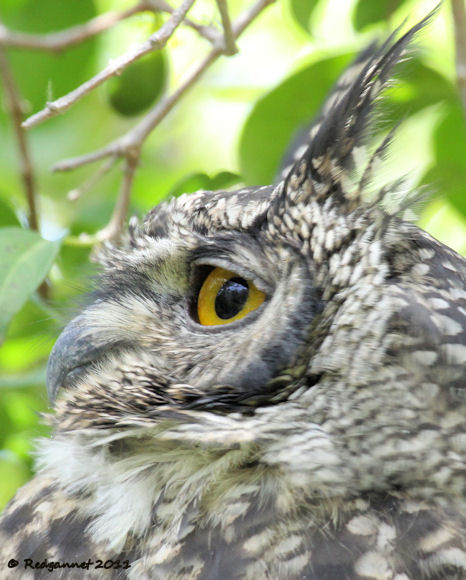
An area of large trees along a stream is known as The Dell. It is in a deep depression at the centre of the gardens. I was still on my way down and stopped at a bench overlooking the well wooded Dell. I am not given to superstitions, but I do have one slightly weird practice; if ever I sit on a bench dedicated as a memorial to someone, I will acknowledge that person. The bench was in memory of a Rob James and I nodded to him as I sat down and asked if he had seen anything. At that very moment, my eye fell on a large shape in a tree.
Sitting out in the open, entirely exposed, was a Spotted Eagle Owl. “Ooh, look Rob.” I was conscious that I was having a conversation with a bench, but strangely, it didn’t seem inappropriate. I called the attention of another couple with binoculars who looked like birders and within a few moments, a crowd had gathered to see the owl.
A passing gardens guide told me that the owls (note plural, for the mate was further along the branch in a leafier spot) were often to be found in and around The Dell and that they had nested in the large tree just behind Rob’s bench. To my amazement, the owl allowed the crowd to come within about 3 meters to take pictures with their phones. Whilst I tutted to start with, the owl seemed so non-plussed that I couldn’t resist the opportunity.
A very classy restaurant near the main gate was filled with very classy customers in suits, and shiny shoes. I wanted to stop in for a drink, but a Malachite Sunbird caught my eye just outside. It was feeding from low flowers right by the restaurant’s veranda and I had to get down low on the path to get a good angle. I couldn’t help noticing the diners regarding me suspiciously as I sprawled across the fancy brickwork. Actually this happens quite a lot, but I felt uneasy joining them for lunch afterwards, so straightened my birding silks, brushed myself down and called it a day at the gardens.

Kirstenbosch Botanical Gardens are sited on the eastern slopes of Table Mountain, off the M63 Rhodes Drive (Google Earth ref; 33 59' 16"S 18 26' 08"E). The gates open every day from 08.00 until 19.00, but close one hour earlier during the austral winter from April to August.
If the gate is not yet open, early arrivals can explore the small area of forest on the right as they approach the upper car park.
The entrance fee is RSA 37 (@ RSA 11 =£1). Toilets, gift shop and cafe are all available.
Most of the birds below could have been seen in a couple of hours if I didn't keep stopping for pictures and carrot cake.
Species seen; 32


Hadada Ibis 6, Egyptian Goose 8, Jackal Buzzard 3, Verreaux’s Eagle 1, Cape Francolin 20, Helmeted Guineafowl 20, Red-eyed Dove 2, Ring-necked Dove 3, Spotted Eagle Owl 2, African Palm Swift 2, Alpine Swift 40, Speckled Mousebird 5, Black Saw-wing 1, Cape Bulbul 6, Sombre Greenbul 8, Olive Thrush 5, Cape Robin-chat 5, Karoo Prinia 3, Fiscal Flycatcher 4, African Dusky Flycatcher 8, Cape Batis 1, Orange-breasted Sunbird 20, Malachite Sunbird 3, Southern Double-collared Sunbird 15, Cape White-eye 20, Cape Sugarbird 15, House Crow 2, Pied Crow 4, Red-winged Starling 20, Cape Canary 15, Brimstone Canary 1.


Kirstenbosch Botanical Gardens, Cape Town, South Africa