Showing posts with label Sydney. Show all posts

Monday, 27 May 2013

Uloola Trail, Royal National Park, Sydney, May 2013

Royal National Park can be found south of Sydney Airport. The Uloola Trail runs into the park from Waterfall train station which can be seen at Google Earth ref; 34 8 6.32S 150 59 43.75E. The trail runs for nearly 6kms through eucalypt woodland mixed with coastal heath and scrub. At the end of the trail is a waterfall which can be dry during the summer.


During the hot months this can be a hard walk with no facilities and no water, but the Austral summer is over and the mild weather was extremely pleasant for birding today. The cooler morning brought a slight mist and a grey sky which made the early pictures a little dull, but the Rainbow Parakeets brightened them up somewhat.

The trailhead is signed from the station car park on the east side of the tracks. It is a narrow path at the start, but opens out onto a meadow which may be the local Aussie Rules oval during the season. From here it joins the wider trail that is wide enough for vehicles, though a barrier prevents public access by car.

Birds were seen almost immediately. Yellow-faced Honeyeaters were especially common in the gum trees, often accompanying other birds in mixed flocks or escorting the Red Wattlebirds about their business. Wattlebirds are also honeyeaters and feed on nectar using their long brushy tongues, so I wondered why the Yellow-faced Honeyeaters felt the need to keep such close tabs on them. They also include insects as part of their diet, but I can find no mention of them being a potential threat to other birds.
The mixed flocks contained Striated Thornbill, Scarlet Myzomela, White-naped Honeyeaters and Eastern Spinebills.

Silver-eyes often made up part of the mixed flocks, but were also seen in their own single-species flocks.

As the trees gave way to heath and scrub, New Holland Honeyeaters became the predominant species. They responded quite well to “pishing” but were not easily approachable during the earlier part of the morning.

As the day wore on, they appeared to become less wary and I was able to watch them as they hawked for small insects that flew above them.
Eastern Yellow Robins and Yellow-tailed Black Cocakatoos were seen in the more thickly wooded areas, with Aussie Ravens, Sulphur-crested Cockatoos and Pied Currawongs recorded as flyovers.

The birds were so prolific today that I moved very slowly along the trail. It very quickly became obvious that I was not going to make it as far as the waterfall and back in time to catch my homeward flight. Thus, without a definite target to achieve, I could afford to dawdle and enjoy.
Birds seen; 15
Yellow-tailed Black-cockatoo 2, Sulphur-crested Cockatoo 5, Rainbow Lorikeet 40, Eastern Spinebill 25, Yellow-faced Honeyeater 200, Red Wattlebird 25, Little Wattlebird 1, Scarlet Myzomela 4, New Holland Honeyeater 130, White-naped Honeyeater 15, Striated Thornbill 25, Pied Currawong 2, Golden Whistler 1, Australian Raven 2, Eastern Yellow Robin 2, Silver-eye 80.
Waterfall Station is about an hour south of Sydney on the South Coast, Illawarra Line. This line passes through the city and I caught it from Town Hall.
There is a local train which stops at all the small stations en-route. The express train is much quicker.
The fare was Aus$9 for a day return ticket. There are no facilities along the trail, but toilets and a cold drinks machine are available at the station.

Sunday, 26 May 2013

Bi-Centennial Park, Sydney, May 2013

I don’t know how I previously missed this little short cut from Powell’s Creek Park into Sydney’s Bi-Centennial Park. A small bridge leads from the northernmost tip of Powell Creek Park, crossing the creek’s western fork into Bressingham Park. A grassy plateau looks down onto playing fields to the southwest and the creek to the east. 


A Black-shouldered Kite watched over the rough grass, on the lookout for any small thing that moved. A path passes beneath the motorway and into Bi-centennial Park at Google Earth ref; 33 51 2.46S 151 4 52.46E. From here, it may be as well to explore the freshwater Lake Belvedere to the west, but I didn’t quite have my bearings and continued north towards the mangroves.


A small flock of Galahs fed on grass stalks, but it is probably too late now for the 10,000 Birds Pink Weekend. Noisy Miners called from the tops of mangroves by the path, upset by a pair of Australian Ravens that had just passed over.


I was heading north, towards the lagoon, but had to pick up the pace through the mangroves as a large group of school children were gathering and I wanted to stay ahead of them.


I was slowed by a Willie Wagtail, Yellow Thornbills and a Spotted Pardalote.


There were plenty of Grey Teal and Chestnut Teal on the lagoon. I sometimes struggle to separate Grey Teal and Chestnut Teal, but today they appeared obviously different. Perhaps this was a non-breeding male, but it stood out distinctly from the light-faced greys. 


Australian Pelican, Black Swan and Australian Grebe were also present in smaller numbers. With a field guide, I might have tried to make a Hoary-headed Grebe, but in their winter gear, I wasn’t confident.


From the hide at the northern end (Google Earth ref; 33 50 8.87S 151 4 43.77E) I could look out over the lagoon and count the Pied Stilt, Black-fronted Dotterel and Superb Fairywrens.


Homebush Bay was used in the past as a wrecking site for old boats. The rotting hulks are still there and usually provide a good roosting spot for cormorants and gulls, but there were only very few today.


From here, I retraced my steps along the path that runs bedside the lagoon and cut right onto the Badu Mangrove boardwalk. The boardwalk has never been terribly productive for birds, but the freshwater ponds that lie at the far end are usually interesting (Google Earth ref; 33 50 40.32S 151 4 35.95). Royal Spoonbills can often be found here and sure enough, one flew in to join another that was preening on a small island.


At the southern end of the freshwater pond path open lawns lead up and over a small rise. The lawns are usually a reliable place to find Masked Lapwings. Thence to Lake Belvedere, where cormorants and Australian Darters were still tending young in their nests. Four species of cormorant were seen here with Welcome Swallows, Dusky Moorhen and Pacific Black Duck. In the trees by the car park a flock of Little Corella made my third cockatoo species of the day.


Birds seen; 46

Black Swan 3, Pacific Black Duck 2, Grey Teal 120, Chestnut Teal 50, White-eyed Duck 1, Australian Grebe 5, Hoary-headed Grebe 2, Little Black Cormorant 5, Great Cormorant 6, Pied Cormorant 40, Little Pied Cormorant 8, Australian Darter 6, Australian Pelican 6, Great Egret 2, White-faced Heron 7, Little Egret 2, Australian Ibis 1, Royal Spoonbill 2, Australian Kite 1, Brown Goshawk 1, Purple Swamphen 15Dusky Moorhen 35, Eurasian Coot 350, Red-kneed Dotterel 1, Black-fronted Dotterel 8, Pied Stilt 120, Silver Gull 30, Spotted Dove 10, Galah 7, Little Corella 35, Rainbow Lorikeet 15, Superb Fairywren 35, White-plumed Honeyeater 2, Noisy Miner 8, Red Wattlebird 1, Spotted Pardalote 2, Yellow Thornbill 20, Australian Magpie 6, Pied Currawong 2, Black-faced Cuckoo-shrike 3, Australian Figbird 1, Willie- Wagtail 2, Grey Fantail 2, Magpie-lark 3, Australian Raven 2, Welcome Swallow 15, Silver-eye 20.


For Bi-Centennial Park, take the Northern (red) Line towards Epping and get off at Concorde West (Google Earth ref; 33 50 52.69S 151 5 7.10E). Exit to the west and follow Victoria Ave for 250m. Pass under the motorway and “Voila!”

For previous posts from Bi-Centennial Park, follow the links below;

http://redgannet.blogspot.com/2009/05/plover-or-dotterel.html

http://redgannet.blogspot.co.uk/2012/02/bi-centennial-park-sydney-australia.html

http://redgannet.blogspot.co.uk/2012/06/bi-centennial-park-sydney-june-2012.html

Visit the dedicated Australia Page for more posts from Sydney including North Heads and the Sydney Botanic Gardens.

Sunday, 19 May 2013

Powell's Creek Park, Sydney, May 2013

Powell’s Creek Park can be visited at the same time as Sydney’s Bi-Centennial Park (Olympic Park). It encloses a much smaller area, but often provides the missing species that might otherwise have been seen in the bigger preserve.


The approach (turning south from Victoria Ave) brought White-faced Heron, Masked Lapwing and a Magpie Lark that sat out very boldly. On the water, I was concerned to see that it was very quiet, but many of the birds had collected at the far end. Black Swans, Grey Teal and Chestnut Teal were roosting in the early morning light. The temperature in Sydney was on the turn this May morning and the birds may have been basking in the early sun to drive off a slight chill.

The sighting which gave me the most pleasure was the Red-kneed Dotterel, a bird that I had not seen for many years.

New Holland Honeyeaters and Yellow-Thornbills were seen in the path-side trees and a Great Egret flushed from the near bank..

At the top end of the reserve is a small patch of woodland that quickly became the main focus for my camera (Google Earth ref; 33 51 21.56S 151 4 57.77E). A Golden Whistler called strongly, but I was reluctant to put its ID down on paper until I could get to a field guide and confirm it.

There was no such problem with the Red-browed Firetails which had gathered in a small flock to sunbathe amongst the dewy fronds of grass.

A Grey Fantail and a flock of Silver-eyes passed through at the same time and the copse appeared to be full of birds.

At Google Earth ref; 33 51 8.59S 151 4 54.98E, is a small bridge crossing the creek. This leads to Bressingham Park and then under the motorway to Bi-centennial Park.
Birds seen; 28

Black Swan 2, Grey Teal 60, Chestnut Teal 15, Great Egret 1, White-faced Heron 1, Dusky Moorhen 3, Eurasian Coot 12, Masked Lapwing 3, Red-kneed Dotterel 3, Spotted Dove 5, Crested Pigeon 4, Sulphur-crested Cockatoo 2, Rainbow Lorikeet 10, Superb Fairywren 15, Noisy Miner 6, New Holland Honeyeataer 2, Yellow-Thornbill 6, Australian Magpie 2, Pied Currawong 2, Golden Whistler 1, Grey Fantail 2, Magpie-lark 2, Australian Raven 2, Welcome Swallow 6, Silver-eye 8, Common Myna 6, European Starling 6, Red-browed Firetail 25.


Take the Northern (red) Line towards Epping and get off at Concorde West (Google Earth ref; 33 50 52.69S 151 5 7.10E). Exit to the west and follow Victoria Ave for 250m. A sign will direct you left (south) to Powells Creek which you will find over a small bridge on the right after 500m.

Wednesday, 15 May 2013

SYD/SIN/QRS

The call came in from the airport standby desk (I do so look forward to our little chats). They wanted me for the Australia trip. Two nights in Singapore on the way down, one in Sydney and another two in Singapore on the way home was the gist of the itinerary.


I had anticipated that I may be used to operate to India or USA and had the corresponding field guides. Space in the suitcase is limited and going to SYD via SIN without a field guide to either, was going to be a challenge. So while I plough through some identification issues and reacquaint myself with my family, here is a quick summary to be going on with.

Sungei Buloh is Singapore’s Premier birding reserves. It is a series of managed ponds and mangroves at the top of the island looking across to Malaysia.

The post from Singapore’s Botanic Gardens will naturally feature a quick stop via Heliconia Walk.

A visit to Kent Ridge Park was intended as an oding expedition, but the highlight was a pair of White-crested Laughingthrushes.

In Sydney, my trip to Bi-Centennial Park and Powell’s Creek Park was so good that despite their closeness, they may end up as two posts.

The Oloolu Trail in Royal National Park, south of Sydney, is a eucalypt and coastal heath habitat that produced as many honeyeaters as I have ever seen.

Finally, an accidental turn and a fortuitous discovery brought a snake and my only red letter bird of the trip in the form of a Blue-eared Kingfisher at Singapore Quarry.


All the links will be made as the posts are published, but first, some sleep.

Wednesday, 20 June 2012

Powerful Owls in Sydney Botanical Gardens, June 2012

Sydney’s Royal Botanical Gardens were bathed in sunshine for a very quick surgical strike in search of a pair of Powerful Owls. They proved to be very easy to find given that I had completely failed on two previous attempts.


Look for bat wings and possum tails scattered on the ground among the plentiful pellets, then just look up. Start your search in the ficus tree as the driveway splits, just before the Governor’s Mansion. Below is the male. The female preferred another ficus tree just across the driveway.


Mission accomplished, I moved on and took the long way back via the ponds where a Black Cormorant was roosting in the trees on one of the small islands. A black plastic sack stuck in one of the branches may have been another attempt by the gardens to save its trees.


In the past Australian Ibis and at least two species of cormorant nested on the little islands in the pond The ibis appear to have reduced significantly in number over the last few years and I have seen very little nesting behaviour on my recent visits.


I continued across the lawns towards the gap in the wall into the herb garden. Just here, another of Australia’s night birds, the Tawny Frogmouth was seen in a very open position.

Birds seen; 11
Maned Duck 4, Chestnut Teal 3, Little Black Cormorant 5, Australian Ibis 15, Dusky Moorhen 8, Masked Lapwing 4, Silver Gull 6, Powerful Owl 2, Tawny Frogmouth 1, Noisy Miner 5, Welcome Swallow 3.

For more posts from Sydney's Royal Botanical Gardens, follow the links below;
http://redgannet.blogspot.com/2009/05/cockatoos-at-dusk.html
http://redgannet.blogspot.com/2011/02/sydney-botanical-gardens.html

Visit the dedicated Australia page for more from the Sydney area including Bi-Centennial Park, North Heads and Royal National Park.

Monday, 18 June 2012

Bi-Centennial Park, Sydney, June 2012


Sydney was sporting an autumnal look as the southern winter approaches. It was cool enough to have the locals reaching for their jackets, but 12C is a perfect temperature for an overweight sweaty bloke who was planning a bit of a hike. 


I started from Concorde West as usual, but was planning to cover more ground today and return by ferry from the wharf on the Parramatta River. As usual, birds were seen before even leaving the station with Pied Currawong, Noisy Miner, Australian Raven and Rainbow Lorikeet seen before passing under the road bridge at the end of Victoria Ave. A flock of 30 Sulphur-crested Cockatoos flew raucously over and alighted on the large aerial just inside the park.


Yellow Thornbills, Spotted Pardalotes, Grey Fantails, and Superb Fairywrens formed a mixed flock to welcome me into the scrub along the path that passes the freshwater ponds. 


A Purple Gallinule reflected in the pond that it shared with a few Chestnut Teal and a Pacific Black Duck.


The water level in the lagoon was as high as I have seen it before. There was not a wide variety of birds to be seen this morning, though Chestnut Teal, Grey Teal and Black-winged Stilt were plentiful. A few Black Swans drifted carelessly across the surface with one taking time to show off the flight feathers that so often get missed on the closed wing.


At the far end of the lagoon, I stopped in at the hide for a while. The high water had covered the mud which is usually enjoyed by the tiny Red-kneed Dotterels and it had concentrated the Black-winged Stilts around the small island that they shared this morning with the Australian Pelicans.
On Homebush Bay behind, a few scuttled boats provided roosting spots for the missing Dotterels as well as Anhinga, Silver Gulls and Pied Cormorants.


Beyond here, I was venturing into new territory. I had arrived in Sydney early this morning and the rest of the day was mine, so I had no time restrictions and was able to continue across the Bennelong Parkway bridge at Google Earth ref; 33 50 05S 151 04 33E. A Rufous Night Heron roosted in the mangroves overlooking the side channel here and a Striated Heron watched patiently from the barrage. 
I took the path through the Olympic archery ranges before cutting across Hill Road into the Narawang Wetlands which had been my main purpose for this morning’s visit. The marshes here are man-made, managed for Bell Frogs with a boardwalk passing through much of the system. There are shallow and deep pools with lots of reeds, rushes and water vegetation, but not much by way of birds. 


A few Superb Fairywrens were seen among the rushes and some Australian Grebes dived and disappeared into the reeds at my approach, but most of the action came from the higher trees around the edges. Black-faced Cuckoo-shrikes were seen perched in the topmost branches and a Grey Butcherbird sat out proud on a snag.
My secondary target for the day was a visit to Birdlife Australia Discovery Centre. The gates from the wetlands leading into Newington Armory were closed, so I had to take the long way round via the gaol. The public displays were closed when I arrived, but the friendly and helpful staff opened it up for me to have a quick look. After a quick glance at my waistline, they warned me that the gap in the fence was quite narrow and then pointed me towards the exit of the armory. Sure enough, for a chap with a pie dependency, it was a bit of a squeeze to get out. By the river here there is another wetland with viewing gaps cut into a screen through which good numbers of Chestnut and Grey Teal could be seen, but more locked gates that looked as if they did not open very often for casual viewing, blocked further penetration into the area.


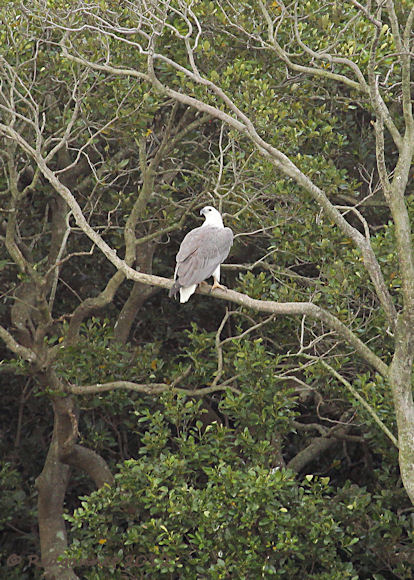
There is a pair of White-bellied Sea Eagles that feature as stars of the Discovery Centre’s webcam, building a nest nearby each year and raising their chicks under thousands of watchful eyes. The bird perched in the mangroves across the Parramatta River was possibly one of the pair which should be returning to their duties later this year. It was time to rest my weary legs and I took the time to try to get a long-distance shot of the eagle.


A Brown Hawk flew past and flushed a White-faced Heron that had been picking it way along the shore towards me.
The ferry timetables did not suit me at this time of day, so I ended up on the bus which runs between the wharf at Google Earth ref; and Strathfield Railway Station (a couple of stops closer to the city on the same line as Concorde West).

Birds seen; 42
Black Swan 15, Pacific Black Duck 20, Grey Teal 60, Chestnut Teal 180, Australian Grebe 4, Little Black Cormorant 2, Pied Cormorant 6, Little Pied Cormorant 2, Australian Darter 4, Australian Pelican 8, Great Egret 1, White-faced Heron 12, Striated Heron 2, Rufous Night Heron 1, Australian Ibis 40, White-bellied Sea Eagle 1, Brown Goshawk 1, Purple Swamphen 12, Dusky Moorhen 16, Black-fronted Dotterel 12, Pied Stilt 135, Silver Gull 6, Crested Pigeon 4, Sulphur-crested Cockatoo 30, Rainbow Lorikeet 6, Superb Fairywren 35, Whiteplumed Honeyeater 2, Noisy Miner 15, Spotted Pardalote 2, Yellow Thornbill 4, Grey Butcherbird 1, Australian Magpie 15, Pied Currawong 5, Black-faced Cuckoo-shrike 4, Willie Wagtail 5, Grey Fantail 2, Magpie-lark 15, Australian Raven 4, Welcome Swallow 15, Common Myna 6, European Starling 40, Red-browed Firetail 12.

Visit the dedicated Australia Page for more from the Lucky Country including, Sydney Botanical Garden and Royal National Park

Sunday, 12 February 2012

Bi-Centennial Park, Sydney, Australia, January 2012

I chose to visit Bi-centennial Park this morning. Just 30 minutes on the train from Sydney city centre, it is the site of the Olympic park used for the Sydney 2000 games. There is fresh water habitat here as well as the brackish water of the mangroves. Rain added to the freshwater percentage today and I spent the morning juggling with tripod, camera, binoculars and an umbrella.


To lessen the awkwardness, I made a bee-line for the hide at the bottom of the freshwater lake at Google Earth ref; 33 50 08S 151 04 44E in the hope that I could sit out the rain. Along the way Superb Fairywrens, Royal Spoonbills and Glossy Ibis delayed me. I passed along the eastern side of the freshwater lake as quickly as possible, noting Black Swan, Chestnut Teal and White-headed Stilt as I went, but hardly stopping as the rain was getting quite heavy now.


Two hours later the rain began to die back and I was at last able to move on. It had been an entertaining wait with Black-fronted Dotterel, Australian Pelicans and Masked Plover seen from the hide. There was no sign of the Australian Avocets or the Pink-eared Ducks that can often be seen from here though.


Back out on the path a small flock of finches held a couple of Red-browed Fire-tails and a Double-barred Finch. Great Pied Cormorants, Australian Darter and White-faced Heron roosted on massive posts and the hulks of scuppered boats in the mangrove inlet.


Having missed the Buff-banded Rail yesterday, I was pleased to get a picture of one today albeit hurried and poorly lit.


There is a boardwalk that cuts through the mangroves and comes out at a deeper pond which is a reliable spot for Australian Grebe. It also produced a Purple Swamphen today.


I was as wet as I was likely to get by now, so I took a quick look around Belevedere Lake (Google Earth ref; 33 51 04S 151 04 35E). Great Pied Cormorants, Little Pied Cormorants and Australian Anhinghas were nesting on the islands here with plenty of the Australian form of the Common Coot and Dusky Moorhens on the water.

Powell’s Creek can be visited very quickly on the way back to the railway station at Concorde West. It is another small wetland, which brought distant views of the Sharp-tailed Sandpiper, but a closer look at a Royal Spoonbill. The tennis nets played host to the small flock of Crested Pigeons.


Birds seen; 36
Australian Grebe 1, Australian Pelican 12, Pied Cormorant 25, Little Pied Cormorant 4, Australian Darter 8, White-faced Heron 4, Australian White Ibis 30, Glossy Ibis 2, Royal Spoonbill 3, Black Swan 3, Australian Wood Duck 6, Grey Teal 60, Chestnut Teal 200, Pacific Black Duck 30, Buff-banded Rail 2, Purple Swamphen 4, Dusky Moorhen 20, Australian Coot, 15, White-headed Stilt 35, Masked Lapwing 8, Black-fronted Dotterel 12, Sharp-tailed Sandpiper 5, Silver Gull 20, Spotted Dove 8, Crested Pigeon 4, Welcome Swallow 5, Silver-eye 3, Noisy Miner 4, Magpie Lark 3, Pied Currawong 30, Australian Raven 6, Common Myna 10, Common Starling 20, Red-browed Firetail 3, Double-barred Finch 1.

For previous post from Bi-centennial Park and Powell Creek and for directions from the city, follow the link below;
http://redgannet.blogspot.com/2009/05/plover-or-dotterel.html

Visit the dedicated Australian page for more posts from Sydney including; Sydney Botanical Gardens, Manly North Heads and Royal National Park