Sunday, 12 February 2012

Bi-Centennial Park, Sydney, Australia, January 2012

I chose to visit Bi-centennial Park this morning. Just 30 minutes on the train from Sydney city centre, it is the site of the Olympic park used for the Sydney 2000 games. There is fresh water habitat here as well as the brackish water of the mangroves. Rain added to the freshwater percentage today and I spent the morning juggling with tripod, camera, binoculars and an umbrella.


To lessen the awkwardness, I made a bee-line for the hide at the bottom of the freshwater lake at Google Earth ref; 33 50 08S 151 04 44E in the hope that I could sit out the rain. Along the way Superb Fairywrens, Royal Spoonbills and Glossy Ibis delayed me. I passed along the eastern side of the freshwater lake as quickly as possible, noting Black Swan, Chestnut Teal and White-headed Stilt as I went, but hardly stopping as the rain was getting quite heavy now.


Two hours later the rain began to die back and I was at last able to move on. It had been an entertaining wait with Black-fronted Dotterel, Australian Pelicans and Masked Plover seen from the hide. There was no sign of the Australian Avocets or the Pink-eared Ducks that can often be seen from here though.


Back out on the path a small flock of finches held a couple of Red-browed Fire-tails and a Double-barred Finch. Great Pied Cormorants, Australian Darter and White-faced Heron roosted on massive posts and the hulks of scuppered boats in the mangrove inlet.


Having missed the Buff-banded Rail yesterday, I was pleased to get a picture of one today albeit hurried and poorly lit.


There is a boardwalk that cuts through the mangroves and comes out at a deeper pond which is a reliable spot for Australian Grebe. It also produced a Purple Swamphen today.


I was as wet as I was likely to get by now, so I took a quick look around Belevedere Lake (Google Earth ref; 33 51 04S 151 04 35E). Great Pied Cormorants, Little Pied Cormorants and Australian Anhinghas were nesting on the islands here with plenty of the Australian form of the Common Coot and Dusky Moorhens on the water.

Powell’s Creek can be visited very quickly on the way back to the railway station at Concorde West. It is another small wetland, which brought distant views of the Sharp-tailed Sandpiper, but a closer look at a Royal Spoonbill. The tennis nets played host to the small flock of Crested Pigeons.


Birds seen; 36
Australian Grebe 1, Australian Pelican 12, Pied Cormorant 25, Little Pied Cormorant 4, Australian Darter 8, White-faced Heron 4, Australian White Ibis 30, Glossy Ibis 2, Royal Spoonbill 3, Black Swan 3, Australian Wood Duck 6, Grey Teal 60, Chestnut Teal 200, Pacific Black Duck 30, Buff-banded Rail 2, Purple Swamphen 4, Dusky Moorhen 20, Australian Coot, 15, White-headed Stilt 35, Masked Lapwing 8, Black-fronted Dotterel 12, Sharp-tailed Sandpiper 5, Silver Gull 20, Spotted Dove 8, Crested Pigeon 4, Welcome Swallow 5, Silver-eye 3, Noisy Miner 4, Magpie Lark 3, Pied Currawong 30, Australian Raven 6, Common Myna 10, Common Starling 20, Red-browed Firetail 3, Double-barred Finch 1.

For previous post from Bi-centennial Park and Powell Creek and for directions from the city, follow the link below;
http://redgannet.blogspot.com/2009/05/plover-or-dotterel.html

Visit the dedicated Australian page for more posts from Sydney including; Sydney Botanical Gardens, Manly North Heads and Royal National Park

Friday, 10 February 2012

Sydney Botanical Gardens, Sydney, Australia, Jan 2012

From Singapore, our itinerary continued to Sydney, Australia. From our slip hotel, within the carry of the short boundary at SCG,  is the wonderful Sydney Botanical Gardens and it was a pleasure to be accompanied by my beautiful colleague MS. It was amusing to find someone who walks even slower than me and who is even more easily distracted than I am.


Fuelled by carrot cake and with a plan to find Tawny Frogmouths and Buff-banded Rail, we hoped to be back at the hotel within a couple of hours, but with two such unfocussed amblers, we were still there by mid-afternoon.


The resident Sulphur-crested Cockatoos flew down to the grass close by and gave us a good look, while the Masked Lapwing posed and showed off its wing spurs. I was surprised to learn that these spurs have a moulting process wherein the topmost layer of horny covering is dropped to reveal a similar, but shorter spur beneath.


The Grey-headed Flying Foxes are still in residence despite the best efforts of the rangers to move them along. The bats are protected and cannot be physically relocated, nor chased or scared away. The rangers' have deployed various methods to deter the bats from ruining valuable trees as they roost, but to no avail.


Garden Orb Spiders spun their huge webs across paths and between trees. Of all the toxic creatures that you might find in Australia, especially in the same backyard as the Redback and the Funnel-web Spiders, this horrific looking one is actually pretty innocuous.


A Buff-banded Rail darted out onto the path as we admired the spider, but was too quick for a photo. It appeared again further down the path, but still managed to elude the camera. The Tawny Frogmouths were nowhere to be seen. The ranger network had lost track of them over the last couple of months.


Noisy Miners were, as ever, noisy and abundant. Unlike the mynas, the miners are honeyeaters and feed at flowers using their brush-like tongues to collect nectar. Note that they are also important pollinators as you can see by the deposits on the head of this bird.


Beyond the shop and the cafe are the ornamental ponds which often contain large mullet and eels. Little Pied Cormorants, Little Black Cormorants and Australian White Ibis nested in the stunted palms of the small islands.


MS enjoyed a spectacular close encounter with a couple of Laughing Kookaburras which landed in a tree close to her and allowed the closest approach that I have ever experienced with a wild kingfisher.


A pair of Dusky Moorhens had built a nest on the plank of wood which was there to help small animals escape from the sheer-sided walls surrounding a small ornamental pond. If it had been subject to planning regulations, it would have been condemned, but the couple had managed to raise a chick in it and were lavishing their attention on it. One of them tried maintaining the nest by moving a few twigs around, but it was still a rubbish effort. It made for a very endearing family snapshot nevertheless.


As we eventually left the gardens, an Eastern Water Dragon posed for us in the palm area near the greenhouses.


Birds seen; 19

Little Black Cormorant 3, Little Pied Cormorant 6, Australian White Ibis 50, Australian Wood Duck 2, Chestnut Teal 1, Pacific Black Duck 10, Buff-banded Rail 2, Dusky Moorhen 15, Masked Lapwing 6, Sulphur-crested Cockatoo 5, Rainbow Lorikeet 3, Laughing Kookaburra 3, Welcome Swallow 30, Noisy Miner 50, Magpie Lark 1, Australian Magpie 2, Pied Currawong 2, Australian Raven 2, Common Myna 3.

For more posts from Sydney Botanical Gardens, follow the links below;
http://redgannet.blogspot.com/2009/05/cockatoos-at-dusk.html
http://redgannet.blogspot.com/2011/02/sydney-botanical-gardens.html

Visit the dedicated Australasian page for more posts from Sydney and Beyond, including; Bi-centennial Park, Royal National Park and North Heads.
Sydney Botanical Gardens, Sydney, Australia,

Wednesday, 8 February 2012

Day of days at Paser Ris, Singapore, Jan2012.

Any day that brings 3 species of kingfisher before breakfast is already a good one, but this visit to Paser Ris Park in Singapore just kept on getting better and better.


After years of missed opportunities, I remembered to get out my camera to allow it to acclimatise to the heat and humidity before I needed it. Even so, the condensation still lingered as I approached the bridge over the gutter on Sungei (River)Tampines (Google Earth ref; 01 22 36.20N 103 57 10.01E). Normally this would result in a ruined picture, but this morning was one of those rare, blessed days when everything was going right and the mistiness actually enhanced the photo a little don't you think?

Just beyond the platform a brown body was ‘porpoising’ through the water. Monitor lizards usually adopt a more serene, serpentine style. This swimmer was frenetic and there were three of them.
Otters!  Smooth Otters have only recently started to be seen regularly in Singapore, but can easily travel across the Straits of Johor from Malaysia. They continued upstream towards me, chasing each other, frolicking and playing until they ended up almost beneath my feet.

They scampered in and out of the water, revealing the true intent of their playfulness. One caught a fish and a squabble ensued when a second approached and snatched the fish away. Another fish was caught and the group settled down to feed.
Stillness returned to the river as they slipped away downstream leaving half of the fish uneaten and the Common Kingfisher returned to his post to target smaller prey. 
Back in the world of the birds, Black-naped Orioles, Asian Glossy Starlings and Pink-necked Green Pigeons seemed sedentary and mundane by comparison. But this was to be a great day and news reached me at the top of the viewing tower that a Mangrove Pitta had recently been seen in the park and may still be found along the boardwalk. A Mangrove Pitta, any pitta in fact, would be a family tick and a good scratch for an itch that I have never managed to reach.
Along the un-railed part of the wooden walkway, where the tide only reaches at its highest of highs, a couple of Singaporean cameras were set up in the hope that the pitta might show today. They very kindly pointed out the areas where it might make an appearance, but added that it was mostly seen early in the morning or later in the afternoon. I was in no hurry today and was able to afford the luxury of stopping with them for a while. As we waited, the chat turned to a Spotted Wood Owl that lived in the park. It had two chicks which were out of the nest now and were usually to be found beyond the close by herb garden.
The pitta seemed reluctant to show as the morning warmed up, so I took some directions and headed out towards the herb garden. As I searched through the trees on the beach side of the plot, Asian Brown Flycatcher, Sunda Woodpecker, and an overflying White-bellied Sea-eagle were seen. Another birder in the park noticed me looking blankly up and turned me round to point out a large dark mass in the shade at the top of one of the thinly leaved trees.

This was the adult Spotted Wood Owl, but we were unable to locate the youngsters. A couple of other birders had found a good vantage point and brought news that the pitta had been seen again.

I hastened back to the boardwalk and found that the other birders had moved along, obviously satisfied.  I carefully stalked up and down the walkway in the hope that it might still be showing, but to no avail. Cursing my luck, I was about to move on when something caught my eye. It shouldn’t have, as it was motionless and not obviously different to its surroundings, but a quick look through the binoculars into a tangle of low branches and high roots brought my first ever sighting of a Mangrove Pitta.
I habitually use red to note the first sighting of a species, but I think that there should be something even more dramatic to register the first member of a family. So much for the contention that pittas are more easily seen early in the morning or later in the afternoon, this was now 10 minutes to midday. It was crouched, unmoving, on the ground beneath the tangle of branches and roots. A small gap just allowed me to get a picture, though nothing like the shots that the other birders had managed earlier.
The day was becoming increasingly hot, humid and oppressive.  Zebra Doves fed quietly in the dry areas of shade. I decided to move on thinking that the day had surely given everything that it had to offer, when the tiniest movement caught my eye.


A tiny snake slithered back into the fronds of a low, shaded palm but paused for a moment to look back and top off a most remarkable morning.

Birds seen; 31
Grey Heron 40, Little Egret 1, Striated Heron 2, Black-crowned Night Heron 6, Brahminy Kite 1, White-bellied Sea-eagle 1, White-breasted Waterhen 2, Common Sandpiper 2, Spotted Dove 6, Zebra Dove 5, Pink-necked Green Pigeon 8, Long-tailed Parakeet 3, Asian Koel 3, Spotted Wood-owl 1, Black-capped Kingfisher 1, Collared Kingfisher 15, Common Kingfisher 1, Dollarbird 1, Sunda Woodpecker 1, Mangrove Pitta 1, Pacific Swallow 25, Yellow-vented Bulbul 3, Common Tailorbird 2, Ashy Tailorbird 1, Arctic Warbler 1, Asian Brown Flycatcher 1, Plain-throated Sunbird 2, Black-naped Oriole 10, House Crow 6, Asian Glossy Starling 30, Javan Myna 50.

Mammals seen; 1  Smooth Otter 3.

An earlier post with a map and directions for Paser Ris Park can be found at the top link below:
http://redgannet.blogspot.com/2009/05/singapore-paser-ris-park.html
http://redgannet.blogspot.co.uk/2012/02/return-to-paser-ris-singapore-feb-2012.html
http://redgannet.blogspot.co.uk/2012/06/venus-transit-and-paser-ris-singapore.html

Visit the dedicated Asia page for more posts from Singapore including Sungei Buloh, Central Catchment Area, and Botanical Gdns.

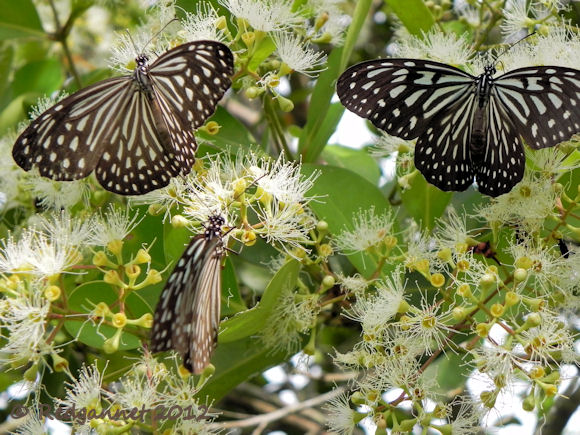
If anyone out there can suggest a name for the snake, spider and butterflies, I would be thrilled.
Thanks.

Tuesday, 7 February 2012

Taking a break, Mote Park Feb 2012

In a perfect world there would be enough time in the day to write up the posts from Singapore and Australia as well as going for a walk through the park in the snow. With so many pictures to sort through from last week, I felt that the best thing to do would be to go out and take even more.
I made it as far as the Little Owl who was not showing when I reached its oak, but came to the front of its hole in response to the sun breaking through the cloud.

Two male Goosanders (Common Mergansers), had been reported from Mote Park Lake, so on the way to meet my son, I dropped in for a quick look. They were on the south side of the lake and I had chosen to traipse along the north shore, so they were a little distant, but quickly recognisable. Another birder had reported a couple of Smew females that had taken off and could not be relocated. A Water Rail flicked away into the far corner of Old Pond as I approached, but showed a bit better on my return journey.

On the bank leading down towards the watersports launch jetty, a European Golden Plover was seen to pull a large worm from the grass from which the snow had been removed to build a snow fort.
Birds seen; 25
Little Grebe 1, Mute Swan 12, Canada Goose 8, Eurasian Teal 3, Mallard 8,Common Pochard 15, Tufted Duck 35, Goosander 2, Water Rail 2, Common Moorhen 2, Common Coot 4, European Golden Plover 1, Black-headed Gull 120, Common Woodpigeon 40, Little Owl 1, Grey Wagtail 1, Northern Wren 2, Song Thrush 1, Common Blackbird 3, European Robin 1, Blue Tit 3, Eurasian Jay 3, Eurasian Magpie 6, Eurasian Jackdaw 3, Carrion Crow 15.
Visit the dedicated UK page for other sites around Kent.

Monday, 6 February 2012

Sungei Buloh, Singapore, January 2012

Sungei Buloh is Singapore’s premier dedicated nature reserve and wetland. It is ironic that the bus from Kranji MRT Station continues on to the reserve only at weekends, but on this Sunday morning, I chose to alight a mile short where the bus normally turns round and heads back.


The Singaporean chapter of the Big Lens Club were pointing their tackle at a tree in Kranji Beach Battlefield Park (Gogle Earth ref; 01 26 20N 103 44 15E). I pressed the button and jumped from the bus to see what they had found. It was a Brahminy Kite, posing as if it had nothing better to do with the day.


Rather than walk the remaining mile on a morning that was already oppressively hot, I wasted some time until the bus passed again by watching a Pied Triller in the car park. Also seen here were Collared Kingfisher, Striated Heron, Common Sandpiper and Asian Glossy Starling.


At the entrance to the visitor centre (Google Earth ref; 01 26 42N 103 43 48), more cameras were arranged as a battery pointing at an Olive-backed Sunbirds’ nest. The pair had been building for a couple of weeks at this point and they were just adding the final touches before the female began laying.


The tide was low as I crossed the bridge into the reserve. A tide of 3.2 meters was expected at 15.00, but I cannot say how that compares to average high tides.  More than two dozen viewing hides, screens and towers circle the managed mangrove wetland and the freshwater ponds.


My intention to head for the freshwater area beyond the mangrove boardwalk was thwarted, as usual, by my weakness for distraction. A crocodile was basking on a sand bar and a large monitor lizard kept its distance as it passed.


At hide 2D, Little Egrets, a Great Egret, Lesser Sand Plovers, and a couple of Marsh Sandpipers were all outnumbered by Common Redshank. I had intended to leave the waders until the tide pushed more of them into the reserve, but they were such a pleasure to watch and the hide was comfortable and cool. A narrow rivulet runs just in front of the hide and gave the redshank somewhere to bathe.


The sun had climbed high now and the heat and humidity was sapping. By the time I reached the freshwater area most sentient life had crawled off to sleep in the shade and nothing was moving there except for some mad dogs, this Englishman and a daft Blue-tailed Bee-eater. Pink-necked Green Pigeons were common, feeding in fruiting trees near the boardwalk. 


The tide eventually pushed the birds off the mud and beaches along the Straits of Johor and up into the reserve. A large flock of Whimbrel joined Common Greenshank and Pacific Golden Plover in the managed areas. A Milky Stork that is often seen at the reserve is said to be an escapee, but sometimes more than one is seen. On this occasion a singleton must be assumed to be the fugitive and will not count towards the year list (unless things get tight towards the end).


The best sighting of the day was a Yellow Bittern which put on a show at the freshwater pond back at the visitor centre by the entrance. It suspended itself between two reeds as it watched for prey in the weeds and water beneath.


As I watched the bittern a movement in the weeds provoked some excitement and I readied myself for a crake or somesuch to emerge. The movement was caused by the most abundant of Singapore's Rallids however, a White-breasted Waterhen.

Birds seen; 31

Grey Heron 4, Purple Heron 1, Great Egret 1, Little Egret 40, Striated Heron 3, Yellow Bittern 1, Milky Stork 1, Brahminy Kite 1, White-bellied Sea Eagle 1, White-breasted Waterhen 6, Pacific Golden Plover 40, Lesser Sand Plover 25, Asiatic Whimbrel 150, Common Redshank 60, Marsh Sandpiper 4, Common Greenshank 60, Common Sandpiper 4, Spotted Dove 4, Pink-necked Green Pigeon 12, Stork-billed Kingfisher 1, Collared Kingfisher 6, Blue-tailed Bee-Eater 2, Pacific Swallow 35, Pied Triller 1, Common Tailorbird 2, Ashy Tailorbird 1, Plain-backed Sunbird 2, Olive-backed Sunbird 4, Black-naped Oriole 6, Asian Glossy Starling 25, Javan Myna 30.

For a previous post and directions to Sungei Buloh, follow the links below;
http://redgannet.blogspot.com/2009/05/singapore-dragons-and-dragonflies.html

Visit the dedicated Asia page for more posts from Singapore, including Paser Ris, Botanical Gardens and Central Catchment Area.
l