Wednesday, 4 December 2013

Mayfield and Charleston Sloughs, San Francisco, November 2013

Tomorrow was the third Thursday of November (Thanksgiving, for those of you without a North American connection) and I was under a strict timing schedule to get the bike back to the shop and allow the guys there to close up and get home to their families on the eve of the holidays.


I had already explored the sloughsand marsh areas around the Lucy Evans Boardwalk and Interpretation Centre, but time was not my friend today.  Mayfield and Charleston Sloughs passed in a bit of a blur, which is a terrible shame because there were thousands of birds.


Notably, lots of Canvasbacks; as many as I have ever seen in one place. Waders were pushing further from the shore now as the tide ebbed, but a Western Sandpiper seemed to be in two minds and stayed close, holding a lovely pose.


A few other birds stayed close to the edge of the slough (do sloughs have banks or shores I wonder). Single Dunlins looked oddly large and individual dowitchers were impossible to tell apart. I was really getting the hang of Least Sandpipers today with some really close up views.


I had another chance to get a look at the Northern Harrier and missed a stunner as the bird bore down on me with its eyes fixed firmly on the weak point in my neck. I have lost a bit of weight perhaps, but not that much surely! I couldn’t get the focus as it sized me up, but eventually got it as the bird realised that it probably wouldn’t be able to carry me off unless I lost a few more pounds.


Surf Scoters, Common Goldeneye and Bufflehead on Shoreline Lake rounded out my list of ducks.
On the slough beyond the lake, a small flock of Eared Grebe caught my attention. They appeared to be “porpoising”, diving and resurfacing, heading towards me. It struck me as an odd means of moving, but as they approached, I noticed that as one dived, another surfaced, giving the impression of a single fluid motion.


Rather than a small flock of 15 or so, there were around 60 with most of them either diving beneath the surface, or swimming very low in the water. Was it cooperative feeding behaviour I wonder, or looking out for each other?


Birds seen;32

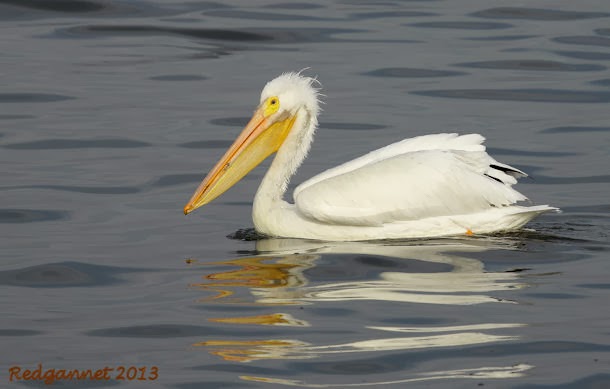
Canada Goose 30, Gadwall 6, American Wigeon 35, Mallard 25, Cinnamon Teal 4, Northern Shoveler 800, Green-winged Teal 25, Canvasback 150, Surf Scoter 5, Bufflehead 3, Common Goldeneye 3, Ruddy Duck 1200, Pied-billed Grebe 2, Eared Grebe 60, Double-crested Cormorant 4, American White Pelican 1, Snowy Egret 2, Black-crowned Night Heron 8, Turkey Vulture 1, Northern Harrier 1, American Coot 80, American Avocet 100, Willet 10, Western Sandpiper 4, Least Sandpiper 120, Ring-billed Gull 6, Herring Gull 12, Anna’s Hummingbird 3, Black Phoebe 1, American Crow 4.
Nuttall’s Woodpecker, Yellow-rumped Warbler and Lesser Goldfinch were also seen as I headed home along North Shoreline Blvd.


If you want to head out from here, North Shoreline Blvd runs from Shoreline Lake at Google Earth ref; 372554.75N 122 5 10.11W. It runs for 5kms, crossing Highway 101 and meeting up with the Caltrain tracks at Central Expressway. Mountain View Caltrain Station is just 500 m southeast (left). San Francisco Station at the bottom of Fourth Street is about 1 hour and 10 minutes from here.

Alternatively you can head out from Terminal Blvd to the west of Shoreline Lake. From Terminal Blvd at Google Earth ref; 37 26 0.61N 122 6 0.17W, San Antonio Road runs south for 3kms, crossing the Highway 101 to the San Antonio Caltrain Station at San Antonio and Alma (Google Earth ref; 37 24 26.94N 122 6 26.93W). A day-ticket on Caltrains cost US$ 14 AS AT December 2013.


Visit the dedicated USA and Canada Page for more posts from San Francisco, including; Sutro Baths and Point Reyes.

Tuesday, 3 December 2013

Boston, Boston, let it be Boston.

Standby starts tomorrow.
A surge of Snowy Owls are sweeping southwards along the east coast, with  Boston's Logan Airport being one of the prime sighting areas.
Let it be Boston!

Monday, 2 December 2013

Palo Alto Baylands, San Francisco, November 2013

A full day in San Francisco was mine to exploit as I saw fit. My first reaction was to look at hiring a car but, recalling how expensive it is to park a car in the city and how vigilant the parking attendants are, I fell back on old posts to remind me of the possibilities that were mine through the medium of public transport.


CalTrains leave from San Francisco Station at the bottom of Fourth Street (Google Earth ref; 37 46 35.96N 122 23 41.54W), just a few blocks from the hotel and with an 8-hour body-clock head start, the 06.11 was a breeze. I had hired a bike the night before and strapped it into the bike compartment for the hour or so ride to California Avenue (Google Earth ref; 37 25 44.22N 122 8 29.23W). From here, it is about 4-5kms to the Palo Alto Duck Pond and The Lucy Evan’s Baylands Interpretative Center. 


American Robins, California Towhees, Ruby-crowned Kinglets, Anna’s Hummingbirds, Yellow-rumped Warblers and Cedar Waxwings enlivened the ride until I arrived at just before 08.00. The top of the tide was 07.50, so there were plenty of birds pushed up onto the roosting areas.


One of these spots was immediately beneath the approach path for the local airport and a small prop plane came into land and put a fun-sized mixed flock of American Avocet, Willet and Marbled Godwit to flight.


I wanted to move quickly on to the boardwalk to see if any rails had been pushed up out of the marsh by the high tide. It was predicted to reach 2.3m this morning, but as it turned out, 2.3m is not quite enough. The tide tables show that it does get higher than this with 2.9 and 3m tides due over the following week. I guess that would inundate most of the marsh and the rails would be up on the boardwalk. Timing.


The surge had forced a few Least Sandpipers up onto the edge of the marsh and they were very cooperative, gleaning and bathing very close to the platform at the end of the boardwalk. A small mixed flock of Dunlin and Western Sandpiper joined them and they all looked anxious to get back to the mud as soon as the water receded.


This would likely be a while, so I returned to the slough and the duck pond to watch large numbers of Northern Shovelers and Canvasback.


On the western side of the pond was an unlikely pair of branch-fellows. A White-tailed Kite perched slightly above a Cooper’s Hawk.


The duck pond held more shovelers (actually if I mention any bird associated with the water, even if my writing tone sounds a little moist, make a mental note that there were lots of shovelers in view at the same time. That will save a lot of repetition), Mallard and a few Ring-billed Gulls. The Boneparte Gulls were seen on the slough but were reluctant to come onto the (fresh water?) of the duck pond.


The water should have receded a bit by now and a few birds were flying out from the roosts to make first tracks in the fresh mud.


Rail Alley, a wide ditch in the marsh that passes beneath the boardwalk already had some very rail evoking prints, but the bird was not to be seen. Out on the bay, the water was fantastically still and a Brown Pelican nearly stalled as it flew over and suddenly spotted something near the surface.


Clarke’s Grebes kept a respectable distance from the platform, but the Least Sandpipers were content to feed near the margins and leave the tide-chasing to the other species. A Song Sparrow sat in the good light a waited for me to trip over my tripod before firing off a couple of shots.


As I returned to fetch my bicycle to continue on towards Mayfield and Charleston Slough, I happened to turn back and notice a Northern Harrier making a perfect flypast of the platform and boardwalk. Timing.


Birds seen; 57

Canada Goose 35, Gadwall 4, Mallard 25, Cinnamon Teal 2, Northern Shoveler 800, Northern Pintail 30, Green-winged Teal 55, Canvasback 60, Lesser Scaup 2, Ruddy Duck 4, Pied-billed Grebe 1, Clark’s Grebe 4, Double-crested Cormorant 12, Brown Pelican 2, Great Egret 1, Snowy Egret 4, Turkey Vulture 1, White-tailed Kite 2, Northern Harrier 1, Cooper’s Hawk 2, Peregrine Falcon 2, American Coot 65, Black-bellied Plover 2, Black-necked Stilt 35, Greater Yellowlegs 2, Willet 25, Long-billed Curlew 3, Marbled Godwit 35, Western Sandpiper 3, Least Sandpiper 25, Dunlin 3, Short-billed Dowitcher 25, Boneparte’s Gull 8, Ring-billed Gull 15, Western Gull 1, Glaucous-winged Gull 1, Mourning Dove 2, Anna’s Hummingbird 2, Black Phoebe 3, American Crow 12, Common Raven 2, Bushtit 4, Bewick’s Wren 1, Ruby-crowned Kinglet 2, American Robin 25, Northern Mockingbird 1, Cedar Waxwing 30, European Starling 6, Yellow-rumped Warbler 1, California Towhee 2, Song Sparrow 5, White-crowned Sparrow 2, Golden-crowned Sparrow 6, Dark-eyed Junco 1, Red-winged Blackbird 2, Brewer’s Blackbird 3, House Finch 5.

 From here, I had to move quickly to return my bicycle. I took the route out past Mayfield and Charleston Slough.


From Terminal Blvd at Google Earth ref; 37 26 0.61N 122 6 0.17W, San Antonio Road runs south for 3kms, crossing the Highway 101 to the San Antonio Caltrain Station at San Antonio and Alma (Google Earth ref; 37 24 26.94N 122 6 26.93W). A day-ticket on Caltrains cost US$ 14 AS AT December 2013.

For more posts from Palo Alto, use the links below;
Visit the dedicated USA and Canada Page for more posts from San Francisco, including; Golden Gate Park and the Nudist Beach

Saturday, 23 November 2013

Sultanpur Bird Sanctuary, New Delhi, India, Nov 2013

How many birds can you shake a stick at? Sultanpur Bird Sanctuary just kept on giving today with hardly a moment when a new bird wasn’t trying to grab my attention and make it onto the list. The final tally rounded out at 78(-ish) with 2 red-letter species for my all-time roll.

The day started with the usual hassle of trying to find a driver that knows the way. Confusion arises as there is a New Delhi suburb called Sultanpur, whereas Sultanpur Bird Sanctuary is over 50kms and an hour’s drive further on beyond the urban sprawl. Vinod Kumar drove today and we spent 15 minutes before we left trying to make absolutely sure that we were going to the right place, then another 20 minutes waiting at a gas station to fill up for the journey. Despite his lack of knowledge of the countryside beyond the city, Vinod was reassuringly enthusiastic in his use of the horn and displayed an admirable sense of urgency once we were up and running.


We arrived shortly after 07.30 with the sun freshly risen and a slight mist which never quite burned away. The gates were locked and we found that the opening times have been changed. They would not open until 09.00 today and not at all on Tuesdays. This is a new timetable and I was lucky not to have been caught out. Immediately next door is The Rosy Pelican, a tea shop and gardens where I spent a productive hour or so waiting for the sanctuary to open. They have made an unusual selection in choosing a pin-up to advertise their birdy credentials, but there was plenty to see here.


Black-rumped Flamebacks were easy to find. The male, on the right, has a complete red crest while the female, has a bi-coloured black and red crest. Oriental White-eyes flitted through the alien eucalypts and small Phylloscopus warblers teased me with their similarities to each other and aberrant markings when compared to the field guide.


I managed to pin down a constant clicking to the Red-throated Flycatcher and the Greenish Warbler was identified by his rising two-syllable call “chaoo-ee”. Rose-ringed Parakeets were plentiful and approachable. They pair up at this time of year to search for nesting sites, so these two, with the collared male on the right, may have been a bonded couple.


At 09.00 I wandered around to the main gate and stopped to take a quick look at a drab bird in the acacias on the far side of the road. I was on the lookout for a Large Grey Babbler and there was a small flock of them feeding in the trees and on the ground. This is a bird which was absent from the field guide that I used during my formative years of Indian birding and it didn’t stand out from the plate in my new book, so I had never thought to look for it until I noticed it mentioned on an eBird submission for Sultanpur. Separating it from the similar Jungle Babbler was to have been the target task of my day. Mission accomplished!


 A bird guide pointed out a Spotted Owlet just inside the gate which took the pressure off. One lifer, one owl; already a great day. I headed left along the track that skirts the north-eastern corner of the lake. The water is slightly obscured by trees and undergrowth, but most of the action was on the other side of the path where Black Redstarts, Lesser White-throats, Common Tailorbird and Hume’s Warbler were seen. A Common Hawk Cuckoo dropped down before I could get a decent look, but was more approachable on the return journey.


Alarm calls betrayed more small warblers with Blythe’s Reed Warbler and a small flock of Common Chiffchaff keeping an eye out for the young Shikra prominently perched on a dead snag.


A female Nilgai and her two calves splashed across the shallow water towards one of the islands. They wander freely around the sanctuary, but are wary and during the day, they like the security offered by the small islands of the lake.


A spit gives a good opportunity to get closer to the colony of nesting Painted Storks that has been breeding here for many years. It would also allow for good views of the waterfowl if only the mist would lift. The weather can be an issue here sometimes with thick fog hampering viewing during winter mornings. Today it was a bit hazy, and kept the contrast of the photos low, but the storks and their large, greyish young were easy enough to see at about 80 meters beyond the end of the spit.


The Sanctuary management has provided small mounds across the lake for roosting waterfowl. From the end of the spit, lots of ducks could be seen on the open water and there were plenty of Greylag Geese on the flat banks to the south. I was a bit surprised that I had only seen a very few wading birds. Black-winged Stilt are usually easy to find.


One Common Redshank showed its white wing pattern as it flushed from close to the bank, but when I came to look at a small group of leggy birds on a small hump, I saw the longer bill and light stripe above the eye that indicated a Spotted Redshank amongst the White-tailed Lapwings and stilts.


In all, I had only walked a very short distance and scanned across about 50 acres of water, weedy bank and light scrub woodland, but had taken around four hours to do it. Vinod would be waiting to take me back to New Delhi soon, so I had to start thinking about heading home. Back at the gate, I couldn’t resist a very quick foray beyond to see if I could see the cranes that I thought I had heard earlier. I was lucky to run into Sanjay, a naturalist at the sanctuary who pointed out a Brook’s Leaf Warbler which I would have struggled with on my own.


He also knew of a pair of Indian Scops Owls that roost in the gardens, close to where the taxi was parked.


A few of the birds in the list below were seen from the road as we approached the reserve, or as we drove home. They were close enough to include as part of the Sultanpur list, but are italicised for clarity. Lesser Spotted Eagles do not appear as I was unable to confirm them through the mist at distance. I am given to believe that the area around the sanctuary can be very productive, so if you arrive early, it is well worth searching the environs until the gate opens.


Birds seen; 78

Greylag Goose 120, Comb Duck 15, Ruddy Shelduck 15, Gadwall 12, Eurasian Wigeon 6, Mallard 2, Indian Spot-billed Duck 80, Northern Shoveler 10, Northern Pintail 25, Green-winged Teal 60, Common Pochard 8, Grey Francolin 4, Indian Peafowl 6, Little Grebe 4, Painted Stork 150, Great Cormorant 5, Little Cormorant 60, Oriental Darter 2, Grey Heron 4, Purple Heron 3, Great Egret 5, Intermediate Egret 2, Little Egret 2, Cattle Egret 8, Indian Pond Heron 6, Black-headed Ibis 40, Red-naped Ibis 5, Black Kite 6, Crested Serpent Eagle 1, Eurasian Marsh Harrier 1, Shikra 1, Tawny Eagle 1, Eurasian Kestrel 1, White-breasted Waterhen 3, Purple Swamphen 20, Eurasian Moorhen 120, Eurasian Coot 80, Red-wattled Lapwing 4, White-tailed Lapwing 2, Black-winged Stilt 5, Spotted Redshank 1, Common Redshank 1, Eurasian Collared-dove 2, Yellow-footed Pigeon 2, Rose-ringed Parakeet 80, Common Hawk Cuckoo 1, Greater Coucal 2, Indian Scops Owls 2, Spotted Owlet 1, White-throated Kingfisher 2, Green Bee-eater 12, Indian Roller 4, Eurasian Hoopoe 2, Indian Grey Hornbill 1, Black-rumped Flameback 6, Black Drongo 6, Rufous Treepie 1, House Crow 10, Barn Swallow 6, Red-vented Bulbul 1, Common Chiffchaff 8, Brooks’s Leaf-Warbler 1, Hume’s Warbler 2, Greenish Warbler 15, Blythe’s Reed Warbler 1, Common Tailorbird 2, Yellow-bellied Prinia 6, Plain Prinia 2, Lesser Whitethroat 5, Oriental White-eye 35, Large Grey Babbler 20, Jungle Babbler 25, Oriental Magpie Robin 1, Red-throated Flycatcher 15, Black Redstart 6, Bank Myna 2, Common Myna 6, Purple Sunbird 1.


Sultanpur Jheel or Bird Sanctuary can be found approximately 30 Kms to the southwest of New Delhi’s Indira Ghandi International Airport at Google Earth ref;28 28 4.73N 76 53 30.19E

It is open from 09.00 until 16.30, 6 days a week. It is closed on Tuesdays. There are toilets at the sanctuary and a tea shop in the gardens next door. Bring water.

It can still be productive to arrive early as the gardens next door at the Rosy Pelican are very good and the area around the sanctuary is said to have many birds, though I suspect that this may be a seasonal (probably winter) abundance.

Cost for a non-Indian national with a dirty great camera was IR 65. A guide offered me his services at IR 1000 (approx US$ 18), but I usually prefer to look out for myself.

A taxi will have to leave the city and cross the state line into Haryana. There used to be some permit issues in this respect, but there were no problems today. A private hire car can cross without any difficulties. Check with your driver.

A metered journey cost IR 2700 for the return trip and 4 hours waiting. There is a toll on the road of IR 100. A non-metered negotiated journey can be substantially less.

Previous posts from Sultanpur can be found at the links below;
http://redgannet.blogspot.co.uk/2009/10/sultanpur-new-delhi-india.html
http://redgannet.blogspot.co.uk/2012/01/sultanpur-national-park-new-delhi.html

Visit the dedicated India Page for more posts from New Delhi including Tughlaqabad FortKalindi Kunj and Merauli.

Sunday, 3 November 2013

Usery Mountain Park, Phoenix, Sept 13

Apologies for posting out of sequence. This one must have got lost somewhere.


I never give myself enough time to get a proper look at Usery Mountain Park (Google Earth ref; 33 28 44.79N 111 37 9.98W). Either it is saved for a last quick dash in the evening, or as today, as a last gasp attempt to find a Cactus Wren.
Anything with “cactus” in its name will surely find good habitat here with at least 5 representatives of the family just in this photo.


  The most famous and most obvious species is the Saguaro Cactus.

It is the Cholla that most people get pricked by on their first visit. It looks spiky enough to make you think that warnings to stay clear of it would be superfluous. There are a number of specieshere including the Chain Fruit Cholla which is also known as the “Jumping Cholla” as no matter how much room you think you gave it, it still tags you.

Today, I had almost no time at all, so I didn’t even get out of the car. A quick turn around the Buckthorn Campground brought the Cactus Wren, Verdin and Black-throated Sparrow before I had to race back to catch the flight home.