Saturday, 8 December 2012

Outside Ribera Norte, Buenos Aires, December 2012

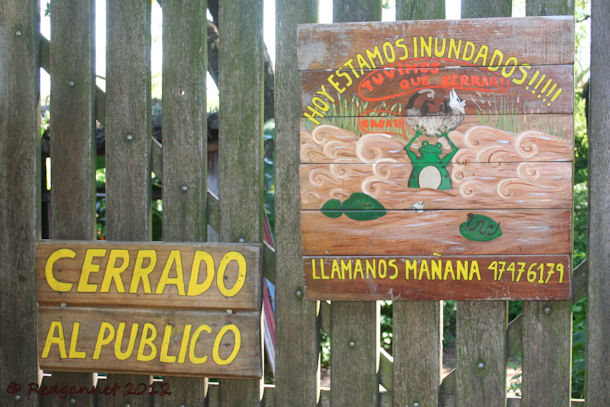
The Reserva Ecológica Ribera Norte is a charming and productive site, but is prone to flooding after rains when the gates remain firmly closed. A decision is made at 09.00 (opening time). A notice is hung to let visitors know and a number is displayed for updates. If you arrive and the reserve is not accessible, don’t despair there are still birds in the vicinity. My list from outside the reserve ran to 30 in 90 minutes as I waited for 09.00.


Ribera Norte is a small marsh close to the Rio Plata in the northern suburbs of Buenos Aires. As a wetland, it attracts water, sadly too much this week as it was closed due to flooding. I had arrived early and explored the surrounding area for a while before finding the notice on the gate (Google Earth ref; 34°28'12.38"S 58°29'46.01"W).  As I considered my position, a pair of Golden-crowned Warblers passed through to cheer me up.

Adjacent to the south-eastern side of the enclosed marsh, open ground and rank vegetation was quite productive. A Grayish Saltator joined a Tropical Kingbird at the top of a dead tree and a small group of Hooded Siskins were seen briefly at eye-level in a short fruit tree.
Beyond the private marina and horse stables to the north-west is a patch of open ground by two restaurants.  Cattle Tyrants and Tropical Kingbirds were seen here along with the expected Rufous Horneros and Chalk-browed Mockingbirds.


I was lucky enough to bump into a couple of other birder/photographers who put me onto the Parque Ecologico de Vincente Lopez which was within a short ride of Ribera Norte.
Birds seen;

Neotropic Cormorant 1, Cocoi Heron 15, Great Egret 20, Snowy Egret 1, Striated Heron 2, Chimango Caracara 1, Gray-necked Wood-rail 1, Southern Lapwing 6, Picazuro Pigeon 40, Eared Pigeon 60, Monk Parakeet 4, Gilded Hummingbird 1, Green-barred Woodpecker 3, Rufous Hornero 10, Cattle Tyrant 2, Great Kiskadee 15, Streaked Flycatcher 1, Tropical Kingbird 4, Brown-chested Martin 20, White-rumped Swallow 12, House Wren 2, Rufous-bellied Thrush 6, Chalk-browed Mockingbird 10, Golden-crowned Warbler 2, Grayish Saltator 1, Black-and rufous Warbling-finch 1, Saffron Finch 4, Rufous-collared Sparrow 4, Bay-winged Cowbird 10, Hooded Siskin 4.

To reach Ribera Norte, I rode the Tigre train from Retiro to Accassuso (Google Earth ref; 34°28'47.98"S 58°30'13.74"W). Bicycles are allowed in the back carriage of the train which sped up my arrival and made the run down to Vincente Lopez feasible.

For a previous post from inside Ribera Norte, follow the link below;

Visit the dedicated Central and South America page for more posts from Buenos Aires and beyond.


Thursday, 6 December 2012

Costanera Sur Reserve, Buenos Aires, November 2012

My new-found companion, Morton and I, continued into Reserva Ecológica Costanera Sur. We had walked 2km along the promenade in Buenos Aires to reach the main gate and Visitors’ Centre (Google Earth ref; 34°36'59.71"S 58°21'18.78"W), noting 37 birds along the way. I want to treat the inside and outside of the park separately, so the post for our approach along the promenade can be seen below, or here. We took a very quick look at the Visitors’ Centre, noting a Saffron Finch as we did so, then turned left and headed northwest(-ish) on a path that ran parallel to the promenade.


The path was lined with the Tipuana Tipu tree that had also lined the promenade and are so common throughout the city. Morton spotted a Bran-coloured Flycatcher and while he was trying to point it out to me, a Small-billed Elainia too.  Continuing on a theme he found a Streaked Flycatcher on the other side of the path.


What used to be lakes on the reserve had now silted up for the most part, so swathes of reeds reached out on both sides. Green-barred Woodpeckers were common and fed from the ground as well as in the trees that formed a covered avenue.
 
 
A streaky finch was bringing nesting material to line a nest cavity in one of the trees. Noticing the yellow shoulders we pencilled in Grassland Sparrow, but the streaks and the cavity-nesting must make it a Saffron Finch.
 
Towards the end of the straight, the path passes through a small area of Pampas Grass. Just beyond here, there is a secondary gate which recently appears to have become an official entrance and exit (at Google Earth ref; 34°35'56.65"S 58°21'44.70"W). To exit bear left (this is often a good place to find Gray-necked Wood Rail. We had seen one on the path just before reaching this spot), to continue, keep to the right.

 
We followed the path around to the right and headed towards the river. A Black-and-rufous Warbling-Finch sat for a moment. In a deep trench on the left we found a few Yellow-billed Teal and encountered this rather sizeable lizard.
 
Most of the common birds were living up to their reputation and were easy to see. Rufous Hornero, Rufous-bellied Thrush, Picazuro Pigeon and Eared Dove are all gimmes here. A brood of Chalk-browed Mockingbirds waited for their parents to bring food and were rewarded for their squealing.
 
The path now tracked along the bank of the Rio Plata and though there was not much to see out on the water, we both remarked on how many birds we were seeing inland on the reserve. Not just species, but lots of individuals too. Low in the grass by the path was a Grassland Yellow-Finch.
 

A few Brazilian Guinea-Pigs (Cuis) braved the edges of the path, but were quick to dive for cover as we approached.


Rufous-collared Sparrow and Black and Rufous Warbling Finches continued to be common along this stretch and Morton rounded out his mission to find lifer Flycatchers for me with a Yellow-browed Tyrant.
 

The day was wearing on and we took the quicker, diagonal route back to the Visitors’ Centre. The circuit had taken about 4 hours and had covered 4.5kms.We speeded up for the last section, unsure if there was a closing time at the gate, but a few birds were still able to slow us down. A Gilded Hummingbird sat nicely close to a viewing platform.
 
Birds seen; 37 
Yellow-billed Teal 2, Neotropic Cormorant 3, Great Egret 3, Snowy Egret 1, Southern Caracara 3, Chimango Caracara 2, Gray-necked Wood-rail 1, Picazuro Pigeon 30, Eared Dove 20, Nanday Parakeet 5, Monk Parakeet 10, Gilded Hummingbird 1, Green-barred Woodpecker 8, Rufous Hornero 15, Small-billed Elaenia 3, Bran-colored Flycatcher 2, Yellow-browed Tyrant 1, Great Kiskadee 15, Streaked Flycatcher 2, Tropical Kingbird 6, Red-eyed Vireo 1, Brown-chested Martin 20, White-rumped Swallow 15, House Wren 8, Masked Gnatcatcher 3, Rufous-bellied Thrush 15, Creamy-bellied Thrush 4, Chalk-browed Mockingbird 10, White-lined Tanager 1, Golden-billed Saltator 5, Black-and-rufous Warbling-finch 5, Double-collared Seedeater 4, Saffron Finch 8, Grassland Yellow-finch 1, Rufous-collared Sparrow 5, Bay-winged Cowbird 5, Hooded Siskin 6.
The bird list from the promenade was, by coincidence, also 37 birds. The reserve gates do not open until 08.00, so the early birder can use his time effectively by scouring the Laguna de los Coipos, the long thin rectangle of reeds overlooked by the promenade, marked as no.6 on the map below.


Costanera Sur Ecological Reserve covers more than 800 acres on the bank of the Rio Plata in Buenos Aires. It started as a magnificent promenade where the good people of BA could come to bathe. It lost favour as the water quality in the river deteriorated and swimming fell out of fashion. Landfill and reclamation separated the promenade from the riverbank and subsequent silting gave Nature the chance to colonise and flourish. The reclaimed area became a protected reserve and was awarded Ramsar status in 2005.


The promenade still exists, though it is now over half a mile inland. It makes a fine walk on a warm afternoon, adjacent to the Ave Int. Hernan M. Geralt. For 2kms, the wide pavement looks down on a stretch of marsh and reeds. A few years ago rains would raise the level sufficiently for open water to attract many species of duck, but the water is much reduced now. Only tiny areas at the south-eastern end remain free from reeds but are likely to silt up altogether in the future.
 
Two gates allow visitors into the reserve. One can be found at each end of the promenade, but the one at the southeastern end (Google Earth ref; 34°36'59.71"S 58°21'18.78"W) is the main gate by the Visitors’ Centre. The gate at the ferry terminal end of the promenade (at Google Earth ref; 34°35'56.65"S 58°21'44.70"W) is more of a back door and does not always open as advertised. The opening hours are from 08.00 until 18.00 during the winter and 08.00 until 19.00 during the summer. The reserve is closed on Mondays and Public holidays.
Masked Gnatcatcher
 
For previous posts from Costanera Sur and the vicinity, follow the links below;
 
Visit the dedicated Central and South America Page for more posts from Argentina including Ribera Norte and Parque Tres de Febrero

Wednesday, 5 December 2012

The Promenade, Costanera Sur, Buenos Aires, November 2012

A few mishaps held me up until midday when I arrived on the promenade at Costanera Sur, hoping to find some ducks. The only real chance of finding any was at the far (south-eastern) end, where there might have been a patch of open water.


The north-western end, close to the ferry terminal, was drier and larger plants, bushes and even a few small trees had colonised.  Picazuro Pigeons were common, but appeared redder than I recalled from a recent trip to Brazil.

On the road side of the promenade is a splendid line of golden-blossomed Tipa trees (or Crying Trees).  Rufous-bellied Thrush and Spot-winged Pigeon were seen in the first tree and Morton was seen under the second. Monk Parakeets and Black-headed (Nanday) Parakeets called and passed over in small flocks. Morton had arrived on the same flight as me and we joined forces to see what we could find.

House Wrens were very common and looked as if they might be maintaining nests in small holes in the brickwork of the wall that runs the length of the promenade. Masked Yellowthroats called from the tufts of Pampas Grass and we quickly found my first lifer of the afternoon. We tentatively identified it as a Golden-browed Warbler, but closer inspection suggested a Crested Doradito without its crest raised.

The area beyond the wall was becoming damper with reeds taking over almost exclusively. This seemed to suit many species of Icterid including Chestnut-winged Blackbird, Unicoloured Blackbird and Yellow-winged Blackbird.

Most of our attention was being directed towards the area beyond the wall, but the promenade itself was very productive. Black and Rufous Warbling-Finches flew back and forth across the wall between the reeds and the orange-blossomed trees and a Campo Flicker was seen digging about around the tree roots. It perfectly matched the fallen blossoms.

Above us, Brown-chested Martins and White-rumped Swallows chased small insects and saw off a Roadside Hawk that passed over. Chimango Caracaras and Southern Caracaras did not come very close, but they are quite distinctive in flight.
 
The pavement was popular with Eared Doves and Guira Cuckoos even patronised the street cafes that operate along promenade.
 
Eventually, we happened upon a small patch of water that had been completely covered by floating weed. Morton was walking along the lower level close to the water which had been the bathing terrace of years gone by. I preferred the higher, but slightly more distant vantage of the promenade. Jacanas and a Spectacled Flycatcher were seen here and we managed to pick out a few Speckled Teal.
 
I want to treat the promenade as a separate entity to the reserve beyond the gate. The reserve has specific opening times and the gates are kept firmly closed until 08.00. The promenade is available for birding at any time and early risers or time restricted birders will find a lot to be going on with here. Morton and I continued into the reserve for the afternoon, but that will be described in a post of its own.
Narrow-billed Woodcreeper
Birds seen; 37
Yellow-billed Teal 6, Great Egret 3,Roadside Hawk 1,Southern Caracara 3,Chimango Caracara 3, Wattled Jacana 2, Picazuro Pigeon 25, Spot-winged Pigeon 2, Eared Dove 80, Nanday Parakeet 30, Monk Parakeet 25, Guira Cuckoo 15, Glittering-bellied Emerald 1, Campo Flicker 1,Narrow-billed Woodcreeper 1, Crested Doradito 1, Spectacled Tyrant 2, Brown-chested Martin 30, White-rumped Swallow 20, House Wren 20, Masked Gnatcatcher 2,Rufous-bellied Thrush 25,Creamy-bellied Thrush 1,Chalk-browed Mockingbird 6, European Starling 30, Masked Yellowthroat 5, Black-and-rufous Warbling-finch 8, Double-collared Seedeater 6, Red-crested Cardinal 2, Rufous-collared Sparrow 15, Unicolored Blackbird 1, Yellow-winged Blackbird 7, Chestnut-capped Blackbird 3, Bay-winged Cowbird 15, Shiny Cowbird 40, Hooded Siskin 4, House Sparrow 40.
Costanera Sur Ecological Reserve covers more than 800 acres on the bank of the Rio Plata in Buenos Aires. It started as a magnificent promenade, but lost favour as the water quality in the river deteriorated and swimming fell out of fashion. Landfill and reclamation separated the promenade from the riverbank and subsequent silting gave Nature the chance to colonise and flourish. Now an Ecological Reserve, it was given Ramsar status in 2005.

The promenade still exists and makes a fine walk on a warm afternoon, adjacent to the Ave Int. Hernan M. Geralt. For 2kms, the wide pavement looks down on a stretch of marsh and reeds. A few years ago rains would raise the level sufficiently for open water to attract many species of duck, but the water is much reduced now. Only tiny areas at the south-eastern end remain free from reeds but are likely to silt up altogether in the future.
Uni-coloured Blackbird
Two gates allow visitors into the reserve. One can be found at each end of the promenade, but the one at the southeastern end (Google Earth ref; 34°36'59.71"S 58°21'18.78"W) is the main gate by the Visitors’ Centre. The gate at the ferry terminal end of the promenade (at Google Earth ref; 34°35'56.65"S 58°21'44.70"W)is more of a back door and does not always open as advertised.

For more posts from Costanera Sur, follow the links below;
http://redgannet.blogspot.com/2011/05/costanera-sur-assessment-on-arrival.html
http://redgannet.blogspot.com/2011/05/costanera-sur-pre-departure-buenos.html

Visit the dedicated Central and South American Page for more from Buenos Aires including, Park Tres de Febrero and Ribera Norte.

Reserva Ecológica Costanera Sur
Friday, 30 November 2012

Mushrif Park, Dubai, November 2012


Bill Oddy used to enter “None” into his birding diary if he saw nothing at his local reservoir and Corey Finger can eke three posts out of not seeing a Virginia Warbler. So I hope you will forgive me for writing up a post in which I visited Mushrif Park and failed to see a Pallid Scops Owl.
Hundreds of doves, mostly Eurasian Collared-doves, were flying in to roost in the tops of the trees that line the approach road. Grey Francolins were calling from the areas beyond the fences on either side.


An Oriental Honey-buzzard circled above me as I passed the gate and paid my 3 Dirhams entry fee.
Most birds were preparing for the night, but a few Green Bee-eaters were taking advantage of the dying light to pick off a few insects that had been drawn out by the dusk.
 

The sun had dropped surprisingly quickly from the sky this evening and caught me on the hop. I had arrived at the turn-off to the park to hear the evening call to prayer as I alighted from the taxi at around 17.00. I had hoped to see an Arabian Babbler this evening, but the darkness was falling fast that my prime focus became the owl.
I made my way to the lawns opposite the mosque where the Pallid Scops Owl is said to hunt for insects by the lights of the toilet block. A group of British and Canadian birders were already in place with a similar intent, but none of us saw nor heard the owl.

 
Gray Francolin10, Oriental Honey-buzzard 1, Eurasian Collared-dove 400, Laughing Dove 50, Rose-ringed Parakeet 12, Pallid Swift 40, Green Bee-eater 10, White-eared Bulbul 6, Common Myna 6.

 
I caught the train to Rushadiya, beyond the airport and grabbed a cab from there. I had to rely on a lift back from the park as there is no taxi rank there. The turn in for the approach road Google Earth ref; 25°13'49.52"N 55°27'3.30"E is from a main, multi-carriageway road (Al Khawaneej Rd) with a central reservation. Catching a cab from here, without crossing 6 lanes of fast traffic in the dark, means hailing one driving in the wrong direction. There is a roundabout less than a mile along the road to make a turn.

For a previous visit to Mushrif Park, follow the link below;
http://redgannet.blogspot.co.uk/2011/10/approach-road-to-mushrif-park-is-lined.html
Visit the dedicated Middle East Page for more posts from Dubai including Safa Park and Ras al Khor

Thursday, 29 November 2012

Ras al Khor, Dubai, November 2012

I rushed to Ras al Khor straight from the flight in an attempt to get there just before high tide. The published time for high tide at Dubai Creek was 09.30. As it turns out, it takes an extra 45 mins to an hour for the tidal surge to reach the top of the creek and percolate through the mangroves. I arrived about 20 mins after the predicted high to find the water’s leading edge creeping past the hide. Even at its height, the water was not deep enough to reach the flamingos’ knees, but Kentish Plovers and Little Stint had to flee before its seeping approach.

 
The Greater Flamingos were clustered tightly together when I arrived, heads down, feeding about 20m from the hide. I realised that food had been put out for them and wondered if this is why they stay so faithful to this area. Despite this, I have no reason to suspect that they are not wild, free-flying birds.
 

After feeding, they split into 2 groups with a few striking out on their own, or in small groups. Immatures are only about half the size of a full grown bird, but there was also a big disparity in size between the adults.
 

In front of the hide, a causeway juts out into the shallow water and the two halves of the flock arranged themselves on each side. Some continued to feed with the traditional flamingo style, but most curled their necks over their backs and took to snoozing as the day warmed.

 
A scope is provided for the use of visitors to the hide and I used it to pick out some Whimbrel and Redshank on a distant Sandbank. A few Grey Heron and Great Egret were seen close to the hide, but better numbers were seen beyond the mangroves.


The causeway pushes about 250m (towards the east) out into the shallow water with the hide sited about 100 meters from the end. As the tide approaches, the small birds are pushed past the hide then tempted back as the water recedes. Viewing is better from the left (north) side in the morning before the sun passes through midday. Tide times could be important as the water recedes back past the mangroves. Birds chasing the freshly exposed mud will be out of range at low water. Get free tide predictions for around the world at Easytide.
 

Apart from the flamingos, numbers were quite low and fewer species were seen compared to a previous visit. I may have missed a raptor passing through as the flamingos suddenly stood alert, but relaxed once the threat was gone.


Two Common Redshanks caught my eye. Elsewhere and at a different time of year, I might suspect that one was a youngster begging for food from an increasingly impatient parent.

 
Great Egrets may be smaller than the Greater Flamingos, but they stand higher in the pecking order. Pink gave way to white as the egret passed through the flock looking for small fish and crabs. This individual may feature in an upcoming 10,000 Birds post.

Birds seen; 20

Gray Francolin 1, Greater Flamingo 800, Gray Heron 3, Great Egret 6, Black-bellied Plover 3, Kentish Plover 15, Common Ringed Plover 2, Common Sandpiper 3, Common Greenshank 2, Common Redshank 8, Whimbrel 8, Eurasian Curlew 3, Little Stint 40, Curlew Sandpiper 10, Eurasian Collared-dove 10, Laughing Dove 4, Crested Lark 2, Red-vented Bulbul 1, White-eared Bulbul 4, White Wagtail 2.
 
Black-bellied Plover
 

The  Flamingo Hide is on the southeast-bound carriageway of the Oud Metha Rd. The taxi will have to go past and turn back at the intersection with Muscat St.

(Shortly after the Emarat Petrol Station on the right, there is a large intersection. Ask driver to continue to the next junction and pull off onto Muscat St. The northwest carriageway of Oud Metha Rd. can be accessed from here.)
 
Getting a taxi for the return may be difficult. The Flamingo Hide is located at a lay-by on the motorway (Google Earth ref; 25°11'32.03"N  55°18'37.89"E). Very few empty taxis pass by here. On both of my visits I have had to rely on a generous driver offering me a ride to the nearest taxi rank or train station. For a quick visit (the flamingos can be seen and appreciated in 10 minutes assuming the tide is right), ask the taxi driver to wait.

 
 Follow the link below for a previous post from Ras al Khor;
 
Visit the dedicated Middle East Page for more posts from Dubai, including Safa Park and Mushrif Park
 
White-eared Bulbul