Showing posts with label Ras Al Khor. Show all posts

Friday, 15 February 2013

Ras al Khor, Dubai, Feb 2013


There are two hides as Ras al Khor that look out into the sanctuary. Having sampled both of them, I feel that the Mangrove hide (Google Earth ref; 25°11'9.19"N 55°19'45.57"E) has a wider range of species to be seen, but the Flamingo Hide (Google Earth ref; 25°11'33.75"N 55°18'44.32"E) allows closer views of the birds. The two hides open between 10.00 and 16.00. Birds can be seen from the lay-by at Mangrove without access to the hide; at Flamingo Hide it is not so easy.

To get to the Flamingo hide, it is necessary (from most of Dubai) to pass the Mangrove Hide first, so make that your first call and soak up a few species before moving on for the close up view of the Greater Flamingos at the Flamingo Hide. At Mangrove Hide today were Northern Shovelers, Eurasian Spoonbills, Western Reef Herons and Greater Spotted Eagles.

Waders included Kentish Plover, Black-tailed Godwit and a Common Snipe. Unfortunately the birds were rather distant, but the security guard in the hide provides a scope to allow visitors to view them.

Birds seen at Mangrove Hide; 16

Northern Shoveler 60, Northern Pintail 8, Green-winged Teal 4, Greater Flamingo 250, Grey Heron 3, Great Egret 4, Western Reef-Heron 15, Eurasian Spoonbill 35, Greater Spotted Eagle 4, Kentish Plover 6, Common Ringed Plover 15, Black-winged Stilt 45, Black-tailed Godwit 3, Little Stint 15, Common Snipe 1, Black-headed Gull 1

1.5 miles clock-wise around the lagoon brings you to the Flamingo Hide. The causeway reaches further out into the reserve here and the Greater Flamingos are fed just in front of the hide. They had been fed earlier and were roosting when I arrived at 11.00. The tide had peaked early this morning and was a distant memory now. Many of the wading birds had followed it out, but a few lingered within spotting scope distance. This hide also has a security guard who offers free use of his scope to anyone who would like to use it.

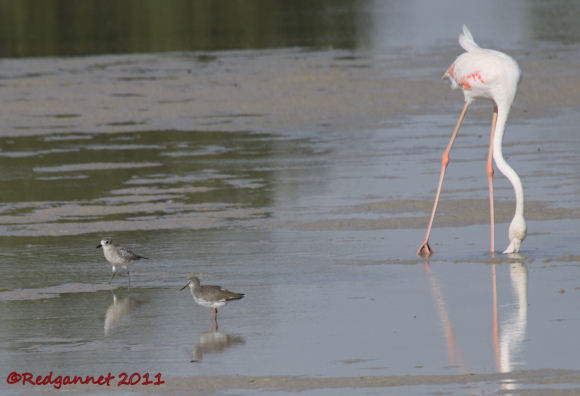
A single Eurasian Curlew probed the mud in good light to the north of the hide. Grey Plovers could be seen a long way off as could a couple of Common Redshank and a Terek Sandpiper. After a short while a flock of Kentish Plovers and Little Stint flew in as if they had been flushed from somewhere else.

Birds seen at Flamingo Hide;

Greater Flamingo 600, Black-bellied Plover 2, Greater Sand Plover 1, Kentish Plover 20, Common Ringed Plover 35, Terek Sandpiper 1, Common Sandpiper1, Common Greenshank 1, Common Redshank 5, Eurasian Curlew 1, Little Stint 60, Curlew Sandpiper 8, Green Bee-eater 1, Crested Lark 2.

If you want to visit both hides, you must resign yourself to a full circumnavigation of the lagoon (actually, unless you run across a six lane motorway, you are likely to have to do the best part of a circle anyway). Although it is only 1.5 miles between the two hides, the roads have central reservations and it is not possible to turn into the lay-by unless you are travelling clockwise around the lagoon. To make the full circle is about 11.5 miles. It may prove difficult to find a taxi from the hide back to the city, so if you arrive by cab, ask him to wait. The only other option is to use a private car.


Visit the dedicated Middle East page for more posts from Dubai, including; Mushrif Park and Safa Park.

Thursday, 29 November 2012

Ras al Khor, Dubai, November 2012

I rushed to Ras al Khor straight from the flight in an attempt to get there just before high tide. The published time for high tide at Dubai Creek was 09.30. As it turns out, it takes an extra 45 mins to an hour for the tidal surge to reach the top of the creek and percolate through the mangroves. I arrived about 20 mins after the predicted high to find the water’s leading edge creeping past the hide. Even at its height, the water was not deep enough to reach the flamingos’ knees, but Kentish Plovers and Little Stint had to flee before its seeping approach.

 
The Greater Flamingos were clustered tightly together when I arrived, heads down, feeding about 20m from the hide. I realised that food had been put out for them and wondered if this is why they stay so faithful to this area. Despite this, I have no reason to suspect that they are not wild, free-flying birds.
 

After feeding, they split into 2 groups with a few striking out on their own, or in small groups. Immatures are only about half the size of a full grown bird, but there was also a big disparity in size between the adults.
 

In front of the hide, a causeway juts out into the shallow water and the two halves of the flock arranged themselves on each side. Some continued to feed with the traditional flamingo style, but most curled their necks over their backs and took to snoozing as the day warmed.

 
A scope is provided for the use of visitors to the hide and I used it to pick out some Whimbrel and Redshank on a distant Sandbank. A few Grey Heron and Great Egret were seen close to the hide, but better numbers were seen beyond the mangroves.


The causeway pushes about 250m (towards the east) out into the shallow water with the hide sited about 100 meters from the end. As the tide approaches, the small birds are pushed past the hide then tempted back as the water recedes. Viewing is better from the left (north) side in the morning before the sun passes through midday. Tide times could be important as the water recedes back past the mangroves. Birds chasing the freshly exposed mud will be out of range at low water. Get free tide predictions for around the world at Easytide.
 

Apart from the flamingos, numbers were quite low and fewer species were seen compared to a previous visit. I may have missed a raptor passing through as the flamingos suddenly stood alert, but relaxed once the threat was gone.


Two Common Redshanks caught my eye. Elsewhere and at a different time of year, I might suspect that one was a youngster begging for food from an increasingly impatient parent.

 
Great Egrets may be smaller than the Greater Flamingos, but they stand higher in the pecking order. Pink gave way to white as the egret passed through the flock looking for small fish and crabs. This individual may feature in an upcoming 10,000 Birds post.

Birds seen; 20

Gray Francolin 1, Greater Flamingo 800, Gray Heron 3, Great Egret 6, Black-bellied Plover 3, Kentish Plover 15, Common Ringed Plover 2, Common Sandpiper 3, Common Greenshank 2, Common Redshank 8, Whimbrel 8, Eurasian Curlew 3, Little Stint 40, Curlew Sandpiper 10, Eurasian Collared-dove 10, Laughing Dove 4, Crested Lark 2, Red-vented Bulbul 1, White-eared Bulbul 4, White Wagtail 2.
 
Black-bellied Plover
 

The  Flamingo Hide is on the southeast-bound carriageway of the Oud Metha Rd. The taxi will have to go past and turn back at the intersection with Muscat St.

(Shortly after the Emarat Petrol Station on the right, there is a large intersection. Ask driver to continue to the next junction and pull off onto Muscat St. The northwest carriageway of Oud Metha Rd. can be accessed from here.)
 
Getting a taxi for the return may be difficult. The Flamingo Hide is located at a lay-by on the motorway (Google Earth ref; 25°11'32.03"N  55°18'37.89"E). Very few empty taxis pass by here. On both of my visits I have had to rely on a generous driver offering me a ride to the nearest taxi rank or train station. For a quick visit (the flamingos can be seen and appreciated in 10 minutes assuming the tide is right), ask the taxi driver to wait.

 
 Follow the link below for a previous post from Ras al Khor;
 
Visit the dedicated Middle East Page for more posts from Dubai, including Safa Park and Mushrif Park
 
White-eared Bulbul

Friday, 14 October 2011

Ras Al Khor, Dubai, UAE. Oct 2011

It is strange that I have resisted making a visit to Ras Al Khor Wildlife Sanctuary in Dubai until now. I spent a thoroughly pleasant couple of hours there in this second week of October and looking back, it is difficult to pin down a reason for my previous reluctance. Getting there and back was slightly awkward, but at least it was open.

Here are a couple of facts for the visitor before we start. I want to highlight these as they are important but not well documented. The Sanctuary is open from 09.00 until 16.00 daily, but is closed on Fridays. It is possible to see birds from outside the perimeter fence, but that would be a sad alternative to a place in one of the hides during opening hours.


The roads surrounding the sanctuary are busy 4-lane motorways with no crossing points in case you find yourself on the wrong side. Taxi drivers are not all acquainted with the sanctuary and it is not signposted, so for their information, the southern tip of the lagoon is marked by the interchange of Oud Metha Road (Route 66) and Ras Al Khor Road (Route 44). Use the Emarat petrol station on the south-bound carriageway of Oud Metha Road as a marker for the Flamingo Hide on the opposite side (Google Earth ref; 25 11 34N 55 18 44E).


Ras Al Khor is a 620 hectare complex of intertidal mudflats, lagoons and mangroves at the top end of Dubai Creek. It is internationally acknowledged with its RAMSAR Wetlands Site status and provides a staging post for migrating and wintering birds with up to 20,000 birds present at its peak season during the winter. There are 3 hides; Mangrove Hide is accessed from Ras Al Khor Road, Lagoon Hide which has been closed recently due to construction work around it and Flamingo Hide which is described in this post.


I found myself at the petrol station on the wrong side of the motorway and had to skip smartly across 8 lanes and a central barrier to get to Flamingo Hide. I had missed the tide by a combination of over-sleeping, having to shop for sun-block and by selecting a taxi driver that had not heard of Ras Al Khor. As it was, the water had retreated a little, but the Greater Flamingos were still close enough to the hide to give good views.

Other birds around the hide included Little Stint, Lesser Ringed Plover and Common Redshank. Further out, Black-bellied Plovers and a couple of Eurasian Curlews could be seen. A friendly security guard has charge of a spotting scope which he encourages visitors to use but this is packed away by 15.45 in anticipation of his knocking off time. Through the scope it was possible to see Greenshank, Whimbrel and a larger congregation of assorted waders in the distance.

Overhead a Eurasian Marsh Harrier patrolled the lines of mangroves hoping to catch a smaller bird unawares. An Osprey flew by but looked as if it was heading for deeper water to hunt.
For the most part, the sanctuary was very quiet apart from the rumble of traffic behind us. I shared the hide with the guard and a gentleman, Shafaat, who had come to the hide seeking solace and inspiration from the natural setting. A few other visitors popped in as we watched, but few stayed very long. We were reticent to leave at 16.00 when the guard began his locking up preliminaries. The flamingos appeared to know that it was chucking out time and began approaching the hide and moving towards the road along the screen that covers visitors’ approach to the hide.
There is a drinking water fountain in the hide, but no toilet facilities which may explain some accounts of security guards (who have been on duty for at least 7 hours with no relief) being slightly grumpy come closing time. Our guard today was very pleasant I would like to add.


To get to Ras Al Khor, I took the Metro train to World Trade Centre. From outside the nearby World Trade Centre Hotel , bus number 61 leaves from the stop (Google Earth ref; 25 13 38N 55 17 24E) on the 2nd Za’abeel Rd. I wasn’t sure of the schedule and took the opportunity to hail a cab which immediately turned round and took me the other way, taking half an hour to complete what should have been an easy five minute ride (Tip for next time; bring the name of the place you are visiting, that would have been useful in the increasingly hot backseat of the cab. There are two Emarat petrol stations on Oud Metha Rd. If you can’t see mangroves or flamingos, you are at the wrong one).
My plans for the afternoon had not got as far as figuring out a way to get home from Ras Al Khor, but I was very lucky that Shafaat lived close to a Metro station and very kindly offered me a lift. In other circumstances, I would have had to rely on flagging a taxi down on the busy motorway. Bus number 61 has a stop at the petrol station across the road, but that will take you in the wrong direction. It would have been my fall back plan to board this bus, wrong way or not and take the return journey back to the Metro station at World Trade Centre. If anyone has any other suggestions, they will be gladly received.

Species seen; 19

Grey Heron 2, Greater Flamingo 400, Osprey 1, Eurasian Marsh Harrier 2, Grey Plover 6, Little Plover 4, Kentish Plover 3, Whimbrel 1, Eurasian Curlew 2, Common Redshank 25, Common Greenshank 1, Terek Sandpiper 2, Common Sandpiper 1, Little Stint 25, Gull-billed Tern 3, Eurasian Collared Dove 3, Crested Lark 2, White Wagtail 1, White-eared Bulbul 1.

Other Redganet posts from Dubai can be found via the links below and through the dedicated Middle East Page.

The excellent and comprehensive UAE Birding can be found via this link.