Something
was missing. I couldn’t put my finger on it straight away, but something was
different. It took a while, but then it suddenly occurred to me that the rain
had stopped. Could Britain’s wettest drought since records began be over? The
sun appeared momentarily and the sound of lawn mowers began almost immediately
after. The Great Outdoors beckoned and I followed, choosing Oare Marshes which has recently been
hosting a Grasshopper Warbler according
to the Kentos website.

I arrived too late in the day to stand a real chance of seeing the warbler but just in case, I hung around for a while by the scrub along the path leading to the West Hide. There were plenty of Common Whitethroats as well as Linnets and Chaffinches. The Grasshopper Warbler has a distinctive song, said to be like the sound made by a fishing reel, but sadly it kept itself to itself today and was not seen.

A pair of Eurasian Coot had two chicks which followed the parents around and kept me entertained while I waited.

The West Hide can be found at Google Earth ref; 51 20 40N 00 53 04E . A Whimbrel had flown over as I approached and it was standing right in front of the hide as I opened the shutter. On a small island in the lake overlooked by the hide was a Eurasian Oystercatcher and a pair of Common Shelduck preened on the bank. The only Northern Lapwing of the day was seen to the west of the hide.

I had returned to the road and started to walk in a clockwise circle around the East Flood. A Little Egret landed very close and began to fish without being worried by my proximity.


The Phragmites reed beds along the shore path were alive with Reed Buntings and Reed Warblers singing and a Cetti’s Warbler popped out of a bramble thicket behind the seawall hide to swear at passers-by.

A brisk wind across the east side of the flood kept the birds low in the reeds and only a Sedge Warbler in the shelter of a small dog rose was seen clearly.

The Reed Warblers proved to be very camera shy, staying down amongst the cover so that the auto focus could not catch them.
I arrived too late in the day to stand a real chance of seeing the warbler but just in case, I hung around for a while by the scrub along the path leading to the West Hide. There were plenty of Common Whitethroats as well as Linnets and Chaffinches. The Grasshopper Warbler has a distinctive song, said to be like the sound made by a fishing reel, but sadly it kept itself to itself today and was not seen.
A pair of Eurasian Coot had two chicks which followed the parents around and kept me entertained while I waited.
The West Hide can be found at Google Earth ref; 51 20 40N 00 53 04E . A Whimbrel had flown over as I approached and it was standing right in front of the hide as I opened the shutter. On a small island in the lake overlooked by the hide was a Eurasian Oystercatcher and a pair of Common Shelduck preened on the bank. The only Northern Lapwing of the day was seen to the west of the hide.
I had returned to the road and started to walk in a clockwise circle around the East Flood. A Little Egret landed very close and began to fish without being worried by my proximity.
The tide
was at its lowest point so most of the waders that had not been struck by the
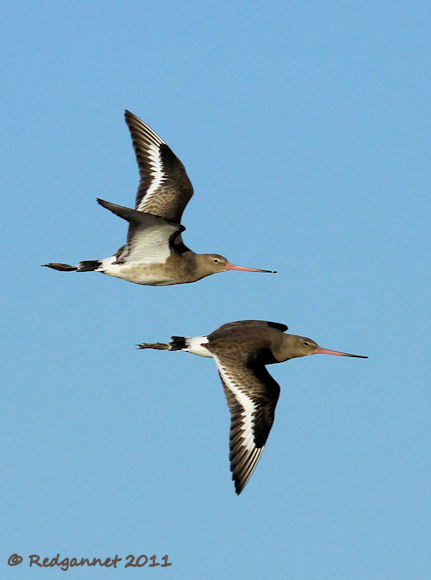
urge to move north would have been out on the mud of the estuary. A few Black-tailed Godwit in their summer
finery remained on a small spit reaching out into the water.
The Phragmites reed beds along the shore path were alive with Reed Buntings and Reed Warblers singing and a Cetti’s Warbler popped out of a bramble thicket behind the seawall hide to swear at passers-by.
A brisk wind across the east side of the flood kept the birds low in the reeds and only a Sedge Warbler in the shelter of a small dog rose was seen clearly.
The Reed Warblers proved to be very camera shy, staying down amongst the cover so that the auto focus could not catch them.
Birds
seen; 48
Graylag
Goose 25, Mute Swan 4, Common Shelduck 40, Gadwall 2, Mallard 6, Northern
Pintail 3, Common Pochard 8, Tufted Duck 10, Ring-necked Pheasant 1,
Great-crested Grebe 1, Great Cormorant 7, Grey Heron 3, Little Egret 5, Common Buzzard
1, Eurasian Kestrel 2, Eurasian Hobby 1, Eurasian Moorhen 1, Eurasian Coot 8,
Northern Lapwing 1, Eurasian Oystercatcher 6, Pied Avocet 16, Common Redshank
3, Whimbrel 3, Black-tailed Godwit 45, Black-headed Gull 35, Herring Gull 4,
Common Tern 7, Common Wood-pigeon 15, Eurasian Collared-dove 3, Common Swift 6,
Green Woodpecker 1, Eurasian Magpie 5, Rook 2, Carrion Crow 30, Barn Swallow
15, Common House Martin 4, Cetti’s Warbler 2, Sedge Warbler 3, Eurasian Reed
Warbler 4, Greater Whitethroat 7, Northern Wheatear 2, Eurasian Blackbird 4,
European Starling 35, Reed Bunting 6, Chaffinch 5, European Greenfinch 1,
Eurasian Linnet 10, House Sparrow 5.

There are more posts from Oare Marshes at the links below;
http://redgannet.blogspot.co.uk/2011/12/oare-marshes-november-2011.html
http://redgannet.blogspot.com/2009/04/kicking-my-heels.html
http://redgannet.blogspot.co.uk/2009/12/glossy-ibis-at-oare-marshes.html
Visit the dedicated UK page for more posts from the area, including, Mote Park and Harmondsworth Moor.




 I headed for Oare Marshes at Faversham on the Thames Estuary.
 I set out from the car park along the path that runs beside the estuary, heading towards the Sea Wall hide. The estuary to my left was just approaching high slack water.
 The light is much preferable in this direction although the sun was weak in the early December morning. Looking back across the eastern floods I was watching the island covered in Godwits when suddenly everything took to the air.
  Is there a term for the sudden take-off of all the birds? We use expressions like “something has put the birds up”, or the like, but is there not an onomatopoeic word like a “whoomph” or an indication of panic like a “flapper”?
 it’s long, curved bill easily visible. It was flying north towards Sheppey. There are a few ibis around at the moment with a handful staying over at Dungeoness currently.
 I continued on the path leading along Faversham Creek as far as the outflow where a Rock Pipit watched from the rail.
 I returned the way I had come to take advantage of the dropping water level and watched the birds flying over on to the freshly exposed mud. Redshanks were first out. Soon there were Dunlin and Black-tailed Godwits too.
  A Ruddy Turnstone picked amongst the seaweed on the rock by the seawall.