Showing posts with label Mexico. Show all posts

Saturday, 27 July 2013

Parque Nacional de Tlalpan, Mexico, July 2013

It was Saturday morning and the Parque Nacional de Tlalpan was likely to get very busy. Even at the crack of dawn, there is great activity on the jogging track here, but one can usually leave that quickly behind by heading uphill. The rarified air of Mexico does not incline me to jog and it would appear that most people prefer the flat track at the park entrance. The higher elevations were a test for me at walking pace and a few hardy runners made it up the slopes, but on the whole, it was much quieter.


The Grey Silky Flycatcher had eluded me so far on this trip and I was hoping to catch it here, but it was not to be found. I veered right, (that’s mostly west) at the entrance and headed up the main road. Very soon there is a sharp bend in the road with a small garden and a kids’ playground.


A Rufous-backed Thrush was my first bird. It looked like a young one. It was quickly followed by a dashing White-eared Hummingbird. A family of Bullock’s Orioles lured me into the bushes on an obscure track which came out by a small shrine. Curve-billed Thrashers and Canyon Towhees were seen here before I found myself back on the road and heading uphill again. A track leads right from the next junction and can often be productive. This morning it brought a Black-headed Grosbeak. 


 The trail turns down a slope, then a left turn continues the climb. The excitement came from a song that I could not place. The bird was being awkward and staying out of sight, but was singing confidently close by. It started with a couple of scratchy peeps then tumbled down the scale (thanks to www.xeno-canto.org  for allowing me to use the recording as a link). After what seemed like ages, I finally tracked him down and was rewarded with a lifer in the form of a Rusty-crowned Ground-sparrow .


 Just beyond this a Blue-throated Hummingbird gave me a good view and another excuse for the red pen. This came as a shock as I am sure that I have seen them before. Bewick’s Wrens were common and vocal today and the Rufous-capped Warblers still respond well to a good pish.


A slightly hysterical call alerted me to an Acorn Woodpecker (thanks again to www.xeno-canto.org).


The roller coasters were running today and the Bewick’s Wrens appeared to have incorporated the sound of the ratchet pulling the cart up the first incline into their song.


The track follows the wall of the Six Flags Amusement Park, but I decided to cut back down a path that leads back to the main road. An area that looks as if it may once have been an orchard (Google Earth ref; 19 17 38.63N 99 12 3.93W) gives a fine view back over the city and brought a Cinnamon-breasted Flower-piercer, more Rufous-capped Warblers and a Rufous-crowned Sparrow.


 Further down a Rufous-capped Brush-finch put in a very shy appearance.


Back at the bottom of the hill a patch of bougainvillea brought another flower-piercer, and a great view of a Berylline Hummingbird feeding from the flowers.


Birds seen; 22

Blue-throated Hummingbird 1, Broad-billed Hummingbird 5, Berylline Hummingbird 3, White-eared Hummingbird 2, Acorn Woodpecker 1, Western Scrub-jay 2, Barn Swallow 8, Bushtit 3, Bewick’s Wren 12, Rufous-backed Robin 1, American Robin 1, Curve-billed Thrasher 3, Rufous-capped Warbler 6, Cinnamon-breasted Flower-piercer 2, Rufous-capped Brush-finch 3, Rufous-crowned Sparrow 1, Rusty-crowned Ground-sparrow 1, Canyon Towhee 10, Black-headed Grosbeak 2, Bronzed Cowbird 3, Bullock’s Oriole 6, House Finch 6, House Sparrow 1


Take the subway to Universidad and take a 5 minute (Pesos 20) cab from there. It is worth having a mental map of the area as some taxi drivers cannot find this very popular park. Ask for the intersection of Zacatapetl and Calle Camino Santa Teresa.

For previous posts from Tlalpan, follow the links below;

Visit the dedicated South and CentralAmerica Page for more posts from Mexico.

Thursday, 25 July 2013

Desierto de los Leones, Mexico, July 2013

Judging by the popularity of the name around here, my money is on Carlos for the new heir to the throne. Unlikely, I grant you, but not out of the question.

The taxi driver, Carlos, dropped me short of the convent on this visit to Desierto de los Leones. I had no idea how short; nor did he, as neither of really knew where we were. I managed to pinpoint the location on Google Earth when I got home and found that it was less than a kilometre away (cut and paste these coordinates into Google Earth  99°19'3.77"W 19°18'31.74"N).


A small bird had flown across the road in front of us and the mountain shelter at the sharp bend looked like a good place to jump out. Birds were apparent immediately with calls and songs ringing through the misty forest. A Spotted Towhee was the first bird seen followed closely by an Olive Warbler and a Mexican Chickadee.
 

I back-tracked along the road for a short way and a party of birds came down to investigate my pishing. They are very responsive here. There was a steep, bushy bank on the upper side of the road and the party spent 15 – 20 minutes working their way along, gleaning insects from the underside of leaves as they went, seemingly unperturbed by the closeness of the large vehicles that brushed by.
 

Bushtits made up the bulk of the flock, but the stars were the Golden-browed Warbler and of course, the Red Warbler. The Golden-browed Warbler above looked rather tatty and dishevelled. It struck me that he wore the wide-eyed staring expression of new fathers everywhere.


The Red Warbler was not entirely red across its back. It appeared to have a bit of olive and cinnamon mixed in. I saw a juvenile bird later on with an all-over ginger look and grey cheeks.
These were two of my main target birds for the day. Both were inquisitive and responded very well to pishing. I was able to approach quite closely and took most of these pictures from the middle of the road. I had to set priorities between missing the opportunity of close encounters with these beautiful birds and getting knocked down by the traffic.
 

I usually mug up on the subtleties of identification during a break on the plane ride, but had forgotten to bring my field guide on this occasion. I tentatively put down a Tropical Parula, which I have seen here before, but once I got back to the book, the eyebrow very clearly made it a Crescent-chested Warbler. Actually, it was a relief not to have to carry the bulky book around at the dizzying altitude of nearly 10,000 ft.

The jangly, descending call of the Brown-backed Solitaire (another target species) was heard all morning, but they can be tricky to see amongst the pines. One was singing full voice from very close to the road and I spent a long time trying to find it, eventually tracking it down to a very high perch, almost into the low clouds.

The sun came out occasionally and made life very pleasant, but the morning had been quite chilly. I would definitely recommend a warm top at any time of year up in the mountains during the early hours.
 

At the convent, restaurants have sprung up to serve traditional Mexican fare. Carlos, the waiter, led me to a table from which I could see Yellow-eyed Juncos feeding in the grass.
The first roll of thunder came as I started up the trail above the convent. For those with a low haemoglobin count, or a restricted lung capacity, horses are for hire in the car park.


A ranger, Carlos, approached and warned me of the dangers of walking in the forest during a storm and advised that I stay out until it was over. I decided to head back down the mountain. My plan would have been to walk down the path that leads downhill from the left side of the convent, but that would take me through a different forested area with the same dangers during the storm. Not wanting to take any more risks, I waylaid a couple of student film-makers who looked as if they were headed for town and scrounged a lift from them. They very kindly dropped me in Mexico City where I was able to find my own way home.


Taxis do occasionally pass the convent and an irregular bus heads to the villages at either end of the road, but getting back home from Desierto de los Leones can be a little uncertain at times.

Birds seen; 14

Mexican Chickadee 10, Bushtit 60, Brown Creeper 4, Golden-crowned Kinglet 4, Ruby-crowned Kinglet 1, Brown-backed Solitaire 1, White-throated Thrush 1, American Robin 2, Olive Warbler 5, Crescent-chested Warbler 3, Golden-browed Warbler 8, Red Warbler 6, Spotted Towhee 4, Yellow-eyed Junco 3.


Visit the dedicated South and Central American page for more posts from Mexico including Xochimilco and ParqueNacional de Tlalpan

Tuesday, 23 July 2013

Parque Ecológico de Xochimilco, Mexico, July 2013

Here we are almost at the end of July and not a single post for the month yet. That’s what happens when birthdays, The Ashes and a new series of Breaking Bad coincide to take me away from the blog. Just as I think I may have a spare morning, I have to nurse Mrs Gannet through a hangover in celebration of the new Royal baby (“it’s a boy”, she tells me through tears laced with Chablis). I have lagged three trips behind and must be brief to catch up before another prince is born.


A visit to Parque Ecológico de Xochimilco allows a chap to have a relative lie-in as it does not open until 09.00. This morning I arrived at 09.15 and found the gates still firmly shut. After calling to a guard, he let me in and a sleepy gate attendant appeared and slouched across the forecourt to relieve me of 25 Pesos (@20 Pesos = £1). The visitor centre staff was more alert and quickly presented me with my complimentary camera permit which needs to be displayed in the park and returned before leaving.


I began by exploring the lake behind the visitors centre; Lago Acitlalin. A Great Egret hunted around the edges, Mexican Mallard floated in the middle and a few Ruddy Duck made a small raft on the far side.


Bridges cross little bays, but are beginning to show signs of age. From the first bridge, I saw a Green Heron on the bent over reeds, carefully watching for small fish.


The second bridge provided a nice perch for a Great Egret with a Pied-billed Grebe close in.


Lesser Goldfinches were common and obvious throughout the reserve, matched in numbers only by the House Finch and the Great-tailed Grackles.


A few Bronzed Cowbirds were seen and this one was startling with his red eyes and his hackles raised to greet a female flying in.


I made a quick circuit of the lake and noted many of the common species such as the Vermillion Flycatcher, Canyon Towhee and Song Sparrow, then headed up the path that runs along the bank of the larger lake (Google Earth ref; 19 17 45.82N 99 5 40.79W).


A Broad-billed Hummingbird chased around the blossoms of the trail-side shrubs before settling and allowing me a shot.


The large lake is known as Lago Huetzalin and many herons and egrets are usually seen here. Today, some White-faced Ibis and a Tricolored Heron added to their numbers.


A Great Egret had caught and was struggling with a large fish as a Black-crowned Night Heron looked on. I got the feeling that the night heron was aggrieved by the egret and wondered if it had been dispossessed of the fish. Once the egret managed to get the fish down its throat, the night heron returned to the spot to see if anything was left, but was disappointed. The egret looked full and smug.


Common Yellowthroats were seen around the marshy areas, a pair of Blue Grosbeaks passed quickly through and Curve-billed Thrashers were seen patrolling the edges of open spaces. 


I returned to the visitor’s centre via Lake Acitlalin and noted a few flycatchers on the way. A Sociable Flycatcher may be slightly beyond its normal range and may provoke the local eBird arbiter to shoot off an email, but the Tropical Kingbird and the Cassin’s Kingbird shouldn’t trouble him. A small concession sells cool drinks and spicy snacks. I stopped for a moment on the veranda to take a drink just in time to see a Broad-billed Hummingbird alighting on the showy plants (irises?) there.

Birds seen; 40

Mexican Mallard 8, Ruddy Duck 8, Pied-billed Grebe 5, Neotropic Cormorant 1, American White Pelica
n 3, Great Blue Heron 1, Great Egret 30, Snowy Egret 8, Tricolored Heron 1, Green Heron 5, Black-crowned Night Heron 6, White-faced Ibis 6, Common Gallinule 12, American Coot 40, Black-necked Stilt 15, American Avocet 8, Mourning Dove 2, Inca Dove 2, Monk Parakeet 2, Broad-billed Hummingbird 4, Beryline Hummingbird 5, Vermillion Flycatcher 10, Social Flycatcher 1, Tropical Kingbird 2, Cassin’s Kingbird 2, Barn Swallow 30, Bush Tit 2, Bewick’s Wren 7, House Wren 1, Curve-billed Thrasher 4, Common Yellowthroat 3, Canyon Sparrow 8, Song Sparrow 20, Blue-grosbeak 2, Red-winged Blackbird 10, Great-tailed Grackle 60, Bronzed Cowbird 6, House Finch 50, Lesser Goldfinch 50, House Sparrow 15.

Visit the dedicated South and Central America Page for more posts from Mexico including; Desierto de Los Leones and El Jardim Botanico.

Saturday, 10 September 2011

UNAM Botanical Gardens, Mexico City, Aug 2011

UNAM Botanical  Gardens is a very short taxi ride from Bosque de Tlalpan and a visit to both sites fits easily into a day. Students were jogging on the road and canoodling on the lawns which left me feeling somewhat intrusive with my binoculars and camera.


A few Inca Doves and a Blue Grosbeak found a bit of lawn space and a Western Wood Pewee hawked from a tall eucalyptus tree.
Grey Silky Flycatchers were fairly common, but I missed any thrushes that may have been around. Actually the only thrushes that I have seen on the whole trip were a small flock of Western Bluebirds on the volcano.
Along the main road through the gardens a brushy, scrubby area gave up a Wilson's Warbler, Black-and-White Warbler and a Black-headed Grosbeak. A Loggerhead Shrike waited to pounce from a feature plant in the cactus garden.

During my last visit to the gardens, I was required to obtain a permit to take photographs, but on this occasion, without my tripod, the requirement was waived. However the copyright is reserved for UNAM should they ever wish to use any of the pictures.


Even so, the couples were courting so vigorously that I preferred to leave them in peace and seek out the odonata of the rock pools.


Blue-faced Darners were very common again with a large and burgeoning population of Arroyo Bluets in the low vegetation.


Beyond the garden gates, a stand of eucalypts held some more Grey Silky Flycatchers and a pair of Bushtit.
I had entered from the southern end, the lecturers' car park, and left by the northern gate. On the main road, to the right, a bus stop services a student bus that runs via the Universidad Metro station. Taxis are a little hit and miss here, but one can usually be found after a short wait.


Species seen; 13

Inca Dove 10, American Barn Swallow 12, Grey Silky Flycatcher 8, Curve-billed Thrasher 1, Blue-grey Gnatcatcher 1, Bushtit 6, Loggerhead Shrike 1, House Finch 15, Black-and-white Warbler 1, Wilson's Warbler 1, Canyon Towhee 4, Black-headed Grosbeak 1, Blue Grosbeak 1.

 Canyon Towhee


More posts from in and around Mexico City can be found below;

UNAM Botanical  Gardens, Mexico City

Sunday, 4 September 2011

Parque Ecologico de Xochimilco, PEX, August 2011

In a lot of Redgannet posts there is an issue that either holds me up and makes me late, or prevents me from reaching my intended destination. Mostly the reason is beer, but this morning I was prevented from crossing the street to get to the Metro station by the national marathon and as far as the eye could see, were thousands of prime Mexicans on the hoof.


Once I arrived in Tasqueña I hired a taxi, the driver of which looked suspiciously like Muammar Gadaffi, but he found the Parque Ecologico de Xochimilco (Google earth ref; 19 17’ 49”N 99 05’ 40”W) without too much trouble. I obtained my camera permit from the Informacion Center and started out in a clockwise direction. On the first body of water, a Ruddy Duck was displaying by flicking his bill up and down against his chest. A Tricoloured Heron was up to its belly stalking fish and an American Coot was keeping a watchful eye on a tiny chick.


The parque was much busier on this Sunday at the end of August than it had been during my previous visit. The childrens' play areas had been mowed and people were cycling and walking, but there was still plenty of room for everybody.
A Green Heron was hoping that it's camouflage would render it invisible and it might have done were it not for the reflection on the water.


Most commonly seen birds today were the Great-tailed Grackles, Barn Swallows and Lesser Goldfinches, but the most common dragonfly, the Blue-faced Darner, was seen by the hundred all around the reserve.


Bridges crossing narrow necks of the lakes provided a perfect vantage point to try to get some inflight pictures.


Among the Canyon Towhees was this individual showing a marked degree of albinism.


I followed the path north and it seemed that the parque joined up with the working and tourist canals for which Xochimilco is famed. Out on the big water, Black-crowned Night Herons, Great and Snowy Egrets were fishing while Back-bellied Whistling Ducks and Mexican Mallards roosted on a small reed island. Far out in the centre, a flock of roosting Black-necked Stilts held a single American Avocet while some Wilson's Phalaropes spun circles on the water. A couple of Western Sandpipers found some mud closer to the shore until a Yellow-crowned Night Heron flushed them off after a particularly showy landing.


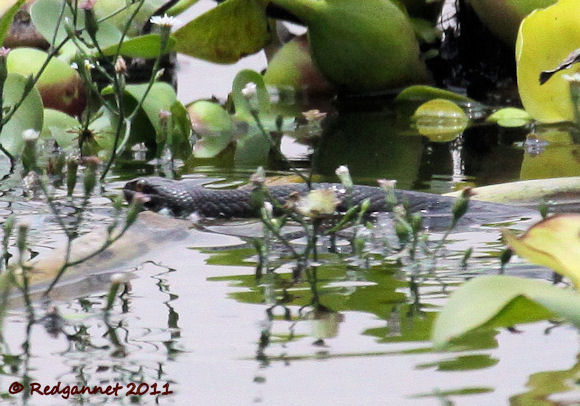
I had found a clear spot by the bank and sat watching the birds and the thousands of fish. A strange ripple on the water called my attention to a small snake that made a couple of sorties out into the water from the bankside vegetaion. It looked to be trying to catch fish from under the noses of the herons. It was a short thin creature perhaps 80cms at best.


I cannot even start to guess what the snake might be called, so as ever, I invite suggestions on a postcard please.


On the way back to the exit at the end of the day a cuckoo flew ahead of me, settling on a branch over the path. In the gloom of a cloudy afternoon, promising rain, it was difficult to see well, but the bill is quite substantial and it has a yellowish eyering. I believe it to be a young, black-billed, Yellow-billed Cuckoo.


There was a lifer today in the shape of a Black-backed Oriole. It was a decent view, but a lousy photograph as I was prostrate on the path at the time taking a picture of this ode for whom I do not yet have a name. Again,send those suggestions on a postcard please.We have a winner! Thanks to Jason for the ID of a Variegated Meadowhawk.


Species seen; 41

To find Parque Ecologico de Xochimilco (PEX), take the Blue line (Line 1) to the farthest point at Tasqueña. The taxi ride from here should cost less than 30 Pesos (at 20 Pesos = 1).
Pied-billed Grebe 2, Great Blue Heron 1, Great Egret 60, Tricoloured Heron 2, Snowy Egret 15, Green Heron 10, Yellow-crowned Night Heron 2, Black-crowned Night Heron 6, White-faced Ibis 3, Black-bellied Whistling Duck 6, Mexican Mallard 12, Ruddy Duck 4, Cooper’s Hawk 1, Common Moorhen 15, American Coot 25, Black-necked Stilt 60, American Avocet 1, Kildeer 2, Spotted Sandpiper 2, Western Sandpiper 2, Wilson’s Phalarope 15, Mourning Dove 30, Common Ground Dove 4, Inca Dove 2, Yellow-billed Cuckoo 1, Vermillion Flycatcher 4, Cassin’s Kingbird 2, American Barn Swallow 4, Marsh Wren 4, Curve-billed Thrasher 1, House Sparrow 20, House Finch 30, Lesser Goldfinch 60, Yellow Warbler 1, Common Yellowthroat 1, Canyon Towhee 15, Song Sparrow 8, Blue Grosbeak 15, Red-winged Blackbird 1, Great-tailed Grackle 30, Black-tailed Oriole 1


(Google earth ref; 19 17’ 49”N 99 05’ 40”W Anillo Perifericao (Blvd; Adolfo Ruiz Cortines)


Other posts from in and around Mexico City may be found below;

Parque Ecologico de Xochimilco, PEX, August 2011