Showing posts with label Johannesberg. Show all posts

Thursday, 31 July 2014

Suikersbosrand, Johannesberg, South Africa, July 2014

This tour of Suikersbosrand was much more relaxed than my previous visit, except for the last 30 minutes when I realised that I had not allowed for the time change and the park was about to shut. Despite some nice views of Eland, Bontebok, Black Wildebeest and Zebra, the hot-spot of the visit was the picnic site where an ants’ nest was attracting birds to feed.


Just inside the park gate is a small pond on the left at Google Earth ref; 26 27 48.57S 28 13 17.34E. It is the northern end of a larger damp patch and had some floating weeds that allowed some White-backed Ducks to rest without being blown into the bank by the strong wind.
This was a good start to the day, but I shan’t trouble you with the photograph which will remain in my private collection of shaky, blurry, out-of-focus record shots.
I had come straight from the airport and stopped at the visitor centre car park to get changed out of my uniform. Here I was able to note Grosbeak Weaver, Southern Grey Sparrow and Mountain Wheatear as I tried to wriggle into my safari silks.


As is often the case, the start of the circuit was quiet. The high grass often obscures the view and a chap is limited to birds that flush from the edges of the road; in this case, Cinnamon-breasted Buntings, Orange-throated Longlaws and Ring-necked Doves. Stonechats clung to grass stems and sturdier perches close to the road.


I seldom see mammals before the dam at the bottom of the circuit and Southern Anteating Chats usually appear beyond the water.
A few herds of antelope were seen on the approach to the Holhoek Picnic Site at Google Earth ref; 26 32 26.03S 28 13 34.08E. This rest stop is situated at the bottom of an acacia-covered slope and was easily the hottest spot in the park and should not be missed by birders in Suikersbosrand. 


Stone tables and chairs are set out for picnickers and an ants’ nest was overflowing from the base of one of the chairs. This attracted Mocking Cliff-Chats, Cape Robin-chats, Cape Rock-Thrushes and Fiscal Flycatchers to feast on the insects.


This is where I spent most of my time found over 20 species without moving from the picnic table, including the Ashy Tit which was gleaning on the rough bark of a tree there.


A Piping Cisticola picked through the short grass and Rufous-vented Warblers searched for insects through the branches of low bushes.
The light was growing dim now and I had to press on to reach the park gates by chucking out time at 18.00. It was dark by the time I reached the gate just at the top of the hour and a movement caught my eye as the security guard came from his office to see me out. A pair of Barn Owls roost in the thatched roof of the security post and one made a pass through the gate a couple of times before landing on the roof.


Bird list for Suikersbosrand; 53

White-backed Duck 10, Yellow-billed Duck 8, Helmeted Guineafowl 30, Swainson’s Francolin 14, Little Grebe 5, Long-tailed Cormorant 1, Cattle Egret 1, Sacred Ibis 8, Hadada Ibis 3, African Spoonbill 1, Black-shouldered Kite 1, Black Crake 1, Eurasian Moorhen 3, Red-knobbed Coot 15, Blacksmith Plover 2, Ring-necked Dove 8, Laughing Dove 4, Barn Owl 2, Speckled Mousebird 8, Black-collared Barbet 2, Common Fiscal 8, Fairy Flycatcher 1, Ashy Tit 1, Black-fronted Bulbul 20, Bar-throated Apalis 2, Piping Cisticola 1, Tawny-flanked Prinia 2, Rufous-vented Warbler 7, Fiscal Flycatcher 13, Kalahari Scrub-Robin 3, Cape Robin-Chat 10, Cape Rock-Thrush 2, Stonechat 40, Southern Anteater Chat 15, Mocking Cliff-Chat 2, Familiar Chat 12, Mountain Wheatear 25, Capped Wheatear 12, Common Myna 2, Cape Wagtail 1, African Pipit 2, Orange-throated Longclaw 4, Cinnamon-breasted Bunting 5, Black-throated Canary 8, Southern Grey-headed Sparrow 4, Yellow-throated Petronia 15, White-browed Sparrow-Weaver 1, Cape Weaver 1, Southern Masked-Weaver 8, Red Bishop 3, Long-tailed Widow 1, Grosbeak Weaver 1, Green-winged Pytilia 2.


 A visit to Suikersbosrand will typically describe a circuit of 60kms. The drive is on a one-way road, so the full circuit must be completed once started. The picnic site at Holhoek is about half-way round. The park opens from 07.00 and visitors are required to leave by 18.00. An entrance fee of RSA 20 will give you all day in the park if you wish.


Suikersbosrand can be accessed from the N3 heading south from Johannesburg. Take the R550 west and the north entrance is signposted after 6kms at Google Earth ref; 26 26 16.32S 28 13 10.84E
A previous visit to Suikersbosrand can be seen at the link below;

Visit the dedicated African page for more sites in South Africa.


Birdwatching, Birding, Safari, South Africa.

Tuesday, 16 July 2013

Walter Sisulu Botanic Gardens, Johannesberg, South Africa, June 2013

Mrs Gannet is a shopper and she is able to intensify her pleasures by sending me on little errands “to keep me out of mischief”. Vicarious shopping: Does she not realise that any moment spent in Africa, but not in the bush is time poorly spent? Anyway, I had to keep a close eye on the time during a quick visit to Walter Sisulu Botanic Gardens. I arrived shortly before opening time and took a quick sweep of the car park.


Laughing Doves, Red-eyed Doves and Ring-necked Doves made up the usual Streptopelia hat-trick. An African Olive (Rameron) Pigeon brought a bit of Colombidae variety.


The lawns just through the entrance gate were notable for bringing the common Vanellus threesome with Blacksmith Lapwing, Crowned Plover and African Wattled Lapwing living crown by wattle. Is there not competition for the same nesting and feeding resources between these species?


They seemed aloof from each other, yet tolerant of each other’s presence. Mind you it is the winter season in South Africa at the moment. If you have any plover experience, it would be interesting to know how well these species get on in close proximity during the breeding season.
 

The Sasol-sponsored hide can be found overlooking a small dam at Google Earth ref; 26 5 5.25S 27 50 36.68E. A brick path leads over the bridge and through the scrub, leading towards the hide. I stopped to look at some Speckled Mousebirds and allowed the quickstrap-style shoulder sling to take the weight of the camera for a moment. There was a sudden, sickening loss of pressure on my shoulder followed by a crunch as the camera hit the bricks. The UV filter saved the day by taking the force of the blow and protecting the lens glass, but smashed and buckled into the body of the lens in the process. It is time to give up on these magic rings. The shoulder sling has a locked karabiner on the strap clipped to a closed ring screwed tightly into the camera body. It should be secure but has failed on a couple of occasions now and I am a loss to explain how they come apart. It is like the magical split rings trick, but more expensive.
 

The camera was still useable and an African Darter sat up well and nicely lit at the hide. Weavers fed in the reeds close by and I am putting them down as Village Weavers, though I had become slightly pre-occupied with camera and could not be bothered to give them too much attention in their winter garb.
 

The one pictured above is possibly a Golden-crowned Bishop. Given the streaky crown and yellowish buff supraloral stripe, that is my best bet. A tiny Malachite Kingfisher warranted far more notice when it came to perch in the shade of the hide, just below me.
 

The gardens are noted for a delightful waterfall and a pair of Verreaux’s Eagles that nest on the cliff there each year. The eagles were not seen today, but the nest can be seen to the left of the waterfall. A camera sponsored by Africam watches the eagles during their nesting cycle and can be viewed at this link. The eaglecam is offline during the winter but there are other cameras strategically placed at waterholes that regularly host large mammals and bush radio to help hone your bird sound recognition skills if you are planning a trip to South Africa.


There were more lapwings on the lawns around the waterfall including a young Blacksmith Lapwing. Kurrichane Thrushes were also seen pulling worms and insects from the ground softened by regular sprinkling.


The exit takes you through a small botanical nursery that is called home by a Bokmakerie  which was easy enough to spot on the bricked path without its clear whistling call. Thank you to www.xeno-canto.org for their permission to embed the recording.


Birds seen; 28

Helmeted Guineafowl 8, Little Grebe 1, African Darter 1, Hadada Ibis 1, Gabar Goshawk 2, Blacksmith Plover 6, Crowned Lapwing 4, Wattled Lapwing 5, Rameron Pigeon 3, Red-eyed Dove 4, Ring-necked Dove 8, Laughing Dove 3, Grey Go-away-bird 2, Speckled Mousebird 14, Malchite Kingfisher 1, Crested Barbet 1, Black-collared Barbet 1, Cardinal Woodpecker 1, Black-backed Puffback 2, Bokmakerie 1, Common Fiscal 5, Pied Crow 9, Common Bulbul 15, Cape Robin-chat 2, Kurrichane Thrush 3, African Pied Starling 4, White-breasted Sunbird 2, Cape Sparrow 15.

Cape Robin-chat
 
For a previous post from Walter Sisulu Botanical Gardens, see the following link;
http://redgannet.blogspot.co.uk/2011/02/walter-sisulu-botanical-gardens.html

Visit the dedicated African Page for more posts from Johannesberg including Pilanesberg NP, Marievale and ZaagkuildriftRoad.

Sunday, 7 July 2013

Pilanesberg NP Part 2, Johannesberg, South Africa, June 2013

I am having trouble with Blogger and wonder if the original Pilanesberg post is too big. So I have cut it into two parts hoping that the text and photos can live together in harmony rather than trying to push each other off the page.


 This is Part 2.
Part 1 can be found at this link and contains the bits about the close encounter with White Rhinos and a visit to the hide at Mankwe Dam.


I had enjoyed a glorious couple of hours at the hide at Mankwe Dam before reluctantly moving on to the Pilanesberg Centre. There is a restaurant and gift shop at the old colonial building in the centre of the park. A salt lick and a small waterhole make this an attractive spot for animals to call in too. This morning the air was filled with dust from an active Wildebeeste herd.


A strong fence is designed to keep the Elephants from getting too close and damaging  the building or perhaps a diner. It makes a good perch for many birds including the Marico Flycatchers which were making the most of the flies often to be found in the proximity of Wildebeeste.


Fork-tailed Drongos and Yellow-billed Hornbills also found the cable to be a fine place to perch for a while.


Out on the short grass and dust in front of the verandah, Kalahari Scrub-robins shared space with Sabota Larks.

Red-faced Mouse-birds kept watch from a low acacia bush as Giraffes approached from the distance.


From mid-morning, the excitement slowed a little. A highlight was a bone-sucking Giraffe. Was this an attempt to increase its calcium intake *(see below)? Porcupines need a lot of calcium to produce their spines and are known to gnaw bones to get it. A second giraffe was salivating spectacularly and appeared not to be able to close its mouth. I suspected that it was also chewing a bone and was concerned that I might have to step in with the Heimlich manoeuvre at any moment.


*Nicely hedged huh? if in doubt ask, a rhetorical question that no-one knows the answer to.
After a few minutes on the internet it became clear that the answer was not as obvious as one might think. Many people went with Calcium deficiency, but a few insisted that the giraffes were in search of Phosphorus.
Giraffes need the two elements to build their unique skeleton. It is especially important for young giraffe as they grow, but there is also a daily requirement that must be fulfilled. The Calcium needs can be mostly achieved through browsing, but it is unclear where the giraffes find enough Phosphorus to maintain the required levels. Osteophagia was assumed to be the answer, until....

"Can Osteophagia provide Giraffes with Calcium and Phosphorus?" - A study by Bredin Skinner and Mitchell, 2008.

In their study, Bredin, Skinner and Mitchell assessed how much Calcium and Phosphorus could likely be obtained by sucking and ingesting bones. They concluded that the amount of minerals that may be digested into the system was negligible. So I ask the question again, "why were they sucking bones? 

A Springbok stood for pictures along the northern shore of the dam.


It is winter in South Africa at the moment, but the day still reached a respectable 20C. The nights are chilly, but the warmth of midday was enough to encourage the animals to seek a little shade and a few moments rest. I passed around the northeastern part of the park and was returning towards Mankwe Dam along the main road from Manyara Gate.
Capped Wheatear
A Black-tipped Mongoose crossed the road. Since I was introduced to the superstition in India, I have held that a mongoose sighting will bring good luck. A second mongoose a few moments later promised an exciting afternoon, if you believe that kind of thing.
I wanted to follow the winding road that passes through some likely looking kopjes; great Leopard habitat. It was still early afternoon and the chances of finding Leopards at this time of day were slim, but I was hoping that my mongooses might swing things in my favour.
I scoured the kopjes around the first two bends and was almost put off at the third when the road became very rough and I wondered if it would be passable.


 With a bit of a run-up, I made it up the slope just as the Leopard stepped off the road on the next curve. I was thrown into a quandary. Should I stop and watch, or drive closer and risk spooking it? I took a rotten shot through the windscreen as it moved across the corner and headed out of sight.
It took a cursory look over its shoulder as I caught up, then crossed a tiny patch of sunlight before melting into the bushes and rocks of the kopje.

Suddenly the road condition was unimportant and I quickly reversed. The rutted, winding road doubled back on itself and I hoped to see the cat again as it came out of the kopje on the other side. I waited quietly for ages and checked the dust in the road for prints. Nothing. I was the only car to have passed this way for about 30 minutes, so her tracks would have been obvious in the deep dust. She must have decided that it was too early to be up and settled down in the shade of the rocks for a nap.

Timing is everything. On safari as well as when you are birding a moment taken here or there can put you in the right place at the right time through no skill or knowledge on your part, just luck.
Was a Leopard worth 2 mongooses, or did I still have one to use up?

If I had not stayed for a while hoping to see the cat again I would have sailed past Sheena and her tiny baby before they came into sight over a rise. The herd of Elephants were feeding on their way to the dam. The large female with the radio collar is known as Sheena and her baby had been born just one week earlier.


It looked very confident for such a young age and played excitedly with the other calves. His mother appeared very relaxed and they nonchalantly passed my car within a tail’s swish.
While the older calves used their trunks to throw dust over their backs, the tiny one had not yet mastered control of his trunk and was unable to follow their example. Instead, he launched himself into the drift of dust at the side of the road and wriggled. That was worth his weight in mongooses.

A researcher arrived and told me the family history and pointed out various members of the herd.

The rest of the evening could not live up to the afternoon, except for watching from the Eagle’s Nest picnic site (on the hillside at Google Earth ref; 25 16 10.92S 27 7 35.85E) as the elephants continued towards the dam, meeting up with a few more as they went.


Some Zebras became very bold as the sun sank behind the hilltops in the west and the light began to fade.

It was dark by the time I reached the Bakubung Gate again at 18.00. It was only then that I realised that I had not ventured to the west of the road at all. The whole day had been to the east and I had not even covered half of the park.


Kudu
Pilanesberg

Birds seen; 78

Ostrich 1, White-faced Whistling Duck 4, Egyptian Goose 8, Spur-winged Goose 3, African Black Duck 5, Yellow-billed Duck 2, Helmeted Guineafowl 12, Crested Francolin 20, Natal Francolin 8, Little Grebe 25, White-breasted Cormorant 20, Long-tailed Cormorant 10, African Darter 4, Hamerkop 1, Grey Heron 3, Great Egret 1, Little Egret 1, Sacred Ibis 200, African Spoonbill 1, Osprey 1, African Fish-Eagle 3, Brown Snake-Eagle 1, Verreaux’s Eagle 3, Black Crake 2, Blacksmith Plover 10, Three-banded Plover 7, Black-winged Stilt 3, African Jacana 1, African Snipe 2, Red-eyed Dove 15, Ring-necked Dove 6, Laughing Dove 4, Grey Go-away-bird 35, African Palm-swift 2, Red-faced Mousebird 20, Malachite Kingfisher 2, Giant Kingfisher 1, Pied Kingfisher 7, Lilac-breasted Roller 2, Eurasian Hoopoe 1, Southern Yellow-billed Hornbill 2, Black-collared Hornbill 1, Cardinal Woodpecker 1, Crimson-breasted Gonolek 2, Fork-tailed Drongo 6, Pied Crow 5, Sabota Lark 5, Pearl-breasted Swallow 5, Common Bulbul 40, Rock-loving Cisticola 2, Tawny-flanked Prinia 2, Rufous-vented Warbler 4, Arrow-marked Babbler 7, Marico Flycatcher 7, Kalahari Scrub-robin 3, Red-backed Scrub-robin 3, White-throated Robin-chat 5, White-browed Robin-chat 3, Stonechat 2, Familiar Chat 2, Capped Wheatear 1, Groundscraper Thrush 1, Kurrichane Thrush 3, Common Myna 2, Cape Glossy Starling 15, Red-billed Oxpecker 8, Cape Wagtail 6, African Pied Wagtail 1, African Pipit 1, Golden-breasted Bunting 5, Yellow-fronted Canary 25, Cape Sparrow 15, African Petronia 1,  Southern Grey-headed Sparrow 4, Village Weaver 5, Common Waxbill 20, Blue-breasted Cordonbleu 6, Green-winged Pytilia 1.

Mammals seen;

African Elephant, White Rhinoceros, Leopard, Brindled Wildebeeste, Impala, Zebra, Steenbok, Giraffe, Hippopotamus, Springbok, Black-tipped Mongoose, Baboon, Warthog, Ground Squirrel, Dassie, Reedbuck, Waterbuck, Eland, Kudu, Mountain Reedbuck.


For previous posts from Pilanesberg, follow the links below;


Pilanesberg NP Part 1, Johannesberg, South Africa, June 2013

I am having trouble with Blogger and wonder if the original Pilanesberg post is too big. Is anyone else having trouble editing their posts so that the published post resembles the draft version? Anyway, I have cut it into two parts hoping that the text and photos can live together in harmony rather than trying to push each other off the page.

This is Part One.
Part Two can be found here and includes the bit about the Leopard and the baby Elephant.

“I adore Pilanesberg National Park”. There, I’ve said it.


This visit gave me even more to wax lyrical about. As if more than 500 square kilometres of acacia scrub, rocky, rolling hillsides, kopjes, dams and grassland, aren’t enough, today I broke my Leopard jinx and found my first Pilanesberg Panther. It was not the greatest leopard sighting ever, but I let out an involuntary whoop and perhaps just a bit of wee.


It was a great day all round with 6 separate Elephant sightings including a tiny week-old calf, very close encounters with White Rhinos and a glorious morning spent at the hide at Mankwe Dam.


I arrived at the park’s southern Bakubung Gate (Google Earth ref; 525 20 22.36S 27 3 48.50E), completed the formalities by 06.45 and headed straight up the main tarmac road that passes through the park and exits at the Bakgatla Gate in the northeast.

The light was still very low, but the sun just began to light the tops of the mountains as I stopped to look at the first dam on the left. Many Sacred Ibis had roosted here over night and were just beginning to stir. Yellow-billed Ducks and African Black Ducks made a quick circuit before skimming back onto the water. My first mammal of the day was a young Kudu.


I was surprised by how common the Grey Lourie (or Go-away-bird) was this visit. They seemed to be a constant presence and this one set the standard for a morning of very close approaches.


As I stopped to check my favourite kopje for leopards, a Glossy Starling dropped into the bush beside me and began gorging itself on the berries.


No leopards yet, but just around the corner were a pair of White Rhinos that taxed the minimum focus range of my camera. They were accompanied by a couple of Red-billed Oxpeckers and a Fork-tailed Drongo which will make a separate post for www.10000birds.com in the near future.

It was breath-taking to hear them chomping on the dry grass and snorting when a stiff stalk poked the sensitive membranes up a nostril.


I had turned off the main road and was headed down towards the hide on Mankwe Dam. A tiny Cardinal Woodpecker flushed from a roadside snag as a Steenbok watched from close by.


The hide was alive this morning. Three species of Kingfishers, African Snipe, Jacana and Three-banded Plover were seen before I even reached the entrance.


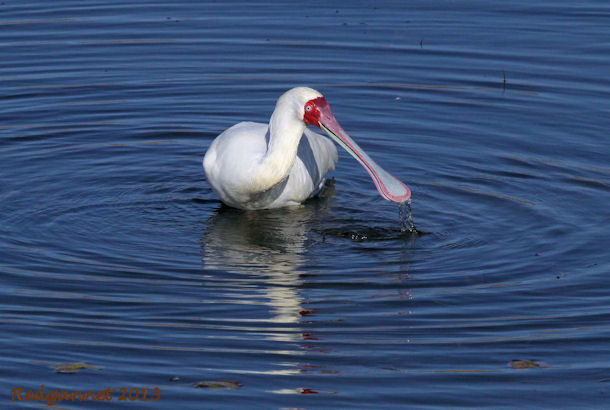
From inside the hide I was able to watch the African Spoonbill as it scythed through the water, the shallows allowed me to watch the African Darter going about its business underwater and the African Snipe had come closer in to make a better subject.


Where to put all the photos?


Did I mention the Kingfishers yet?


Malachite Kingfishers ambushed their prey from low perches amongst the reeds.


Pied Kingfishers hovered above their target, but rested on open snags until they spotted a potential meal.


There was so much going on that I was very reluctant to leave and barely made it to the car park before the Arrow-marked Babblers caught my attention.


Part Two can be found here and includes the bit about the Leopard and the baby Elephant. 


Birds seen; 78

Ostrich 1, White-faced Whistling Duck 4, Egyptian Goose 8, Spur-winged Goose 3, African Black Duck 5, Yellow-billed Duck 2, Helmeted Guineafowl 12, Crested Francolin 20, Natal Francolin 8, Little Grebe 25, White-breasted Cormorant 20, Long-tailed Cormorant 10, African Darter 4, Hamerkop 1, Grey Heron 3, Great Egret 1, Little Egret 1, Sacred Ibis 200, African Spoonbill 1, Osprey 1, African Fish-Eagle 3, Brown Snake-Eagle 1, Verreaux’s Eagle 3, Black Crake 2, Blacksmith Plover 10, Three-banded Plover 7, Black-winged Stilt 3, African Jacana 1, African Snipe 2, Red-eyed Dove 15, Ring-necked Dove 6, Laughing Dove 4, Grey Go-away-bird 35, African Palm-swift 2, Red-faced Mousebird 20, Malachite Kingfisher 2, Giant Kingfisher 1, Pied Kingfisher 7, Lilac-breasted Roller 2, Eurasian Hoopoe 1, Southern Yellow-billed Hornbill 2, Black-collared Hornbill 1, Cardinal Woodpecker 1, Crimson-breasted Gonolek 2, Fork-tailed Drongo 6, Pied Crow 5, Sabota Lark 5, Pearl-breasted Swallow 5, Common Bulbul 40, Rock-loving Cisticola 2, Tawny-flanked Prinia 2, Rufous-vented Warbler 4, Arrow-marked Babbler 7, Marico Flycatcher 7, Kalahari Scrub-robin 3, Red-backed Scrub-robin 3, White-throated Robin-chat 5, White-browed Robin-chat 3, Stonechat 2, Familiar Chat 2, Capped Wheatear 1, Groundscraper Thrush 1, Kurrichane Thrush 3, Common Myna 2, Cape Glossy Starling 15, Red-billed Oxpecker 8, Cape Wagtail 6, African Pied Wagtail 1, African Pipit 1, Golden-breasted Bunting 5, Yellow-fronted Canary 25, Cape Sparrow 15, African Petronia 1,  Southern Grey-headed Sparrow 4, Village Weaver 5, Common Waxbill 20, Blue-breasted Cordonbleu 6, Green-winged Pytilia 1.


Mammals seen;

African Elephant, White Rhinoceros, Leopard, Brindled Wildebeeste, Impala, Zebra, Steenbok, Giraffe, Hippopotamus, Springbok, Black-tipped Mongoose, Baboon, Warthog, Ground Squirrel, Dassie, Reedbuck, Waterbuck, Eland, Kudu, Mountain Reedbuck.


For previous posts from Pilanesberg, follow the links below;


Visit the dedicated Africa Page for more from South Africa, Including; Mount Sheba and Kruger NP.