Sunday, 20 June 2010

LA River, Los Angeles

 June brings a phenomenon called the marine layer to Los Angeles.
A thick blanket of cloud depresses temperatures along the coast until the sun burns it off later in the morning.
The LA River drain looked very gloomy under the clouds. The birds were very sparse too.
A few Black-necked Stilts clucked at my intrusion and a single American Avocet looked very lonely.
This picture was taken later in the day when the light was better and the birds looked happier. On my last visit, a naked woman skipped across the drain for my entertainment ( http://redgannet.blogspot.com/2009/08/come-on-in-waters-great.html ), but there was no such show today to lift my spirits.
The hirundines had arrived since my last visit. Cliff Swallows were most abundant, and their nests were already empty with new prospective tenants sizing up their suitability.
Barn Swallows were less numerous with Nothern Roughwing Swallows only numbering a couple of dozen.
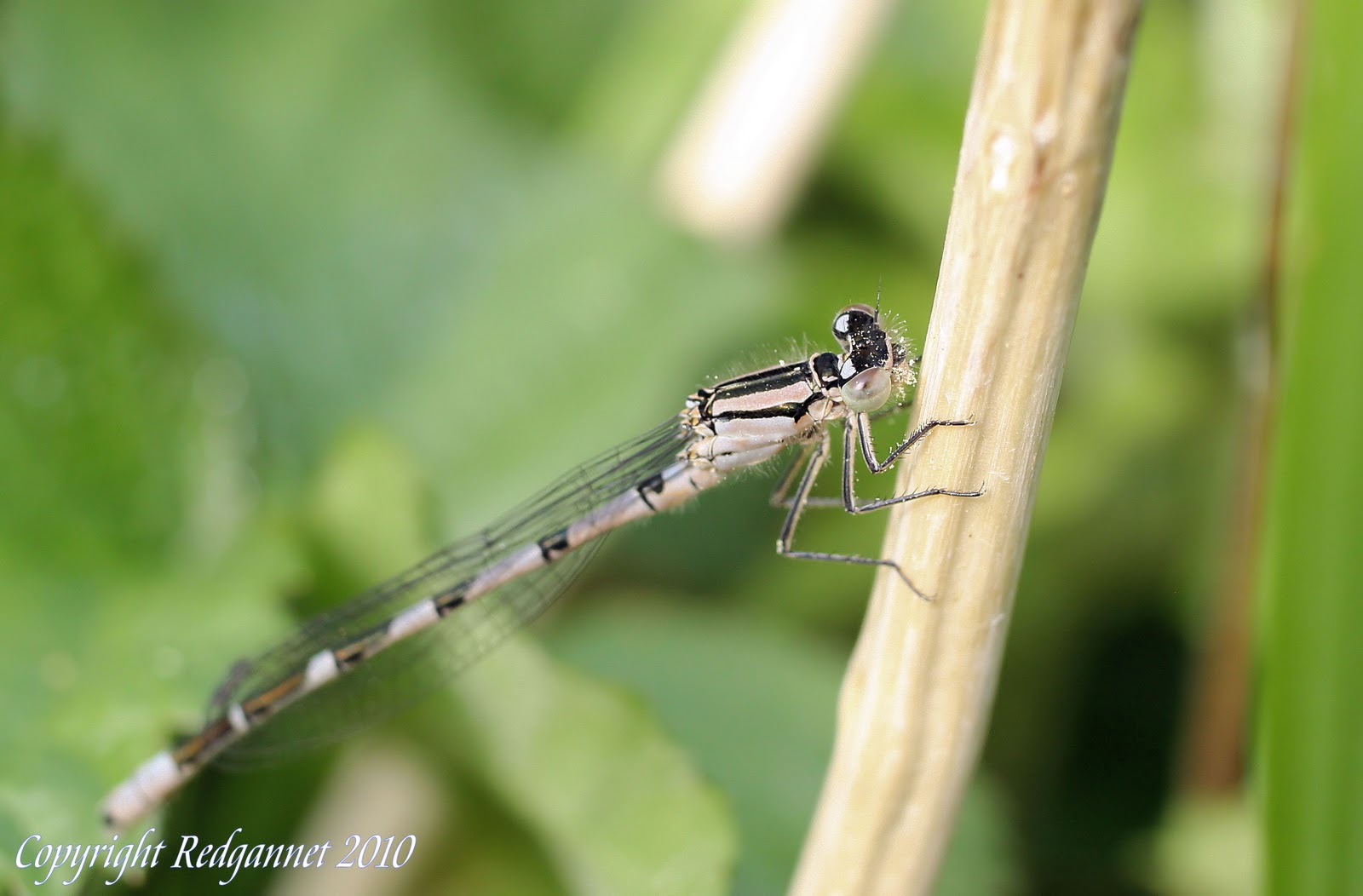
A Pacific Forktail was up early. The time was barely 07.30 and cool, so it was quite sluggish and let me approach quite close. The blue dots on it’s back are the distinctive trait of this species. I was looking forward to some dragonfly spotting later on in Dominguez Gap.
A cycle trail runs along the left edge of the drain as you face downstream. On the other side of the path is a strip of freshwater wetland. This is a restoration project which caught my attention on my previous visit. There were so many dragonflies that I almost forgot that I was supposed to be writing a bird blog.
In the Tule beds, Song Sparrows were calling and an African Weaver had found a home from home. I did not see any males, but I am led to believe that they are probably Northern Bishops.
A second weaver-like bird had me vascillating between alien and Icterid. I cannot decide what this one is. 
A Pied-billed Grebe had hidden her young in the edge of the rush bed while she hunted for food for them, but like youngsters the world over, they would not stay put and preferred to come out into the open to see what was going on.
A couple of guys on bicycles stopped to say hello on their way downstream. On their return they mentioned that there were plenty more birds further along. Sure enough, the further downstream I progressed, the more plentiful the birds were becoming. There was still not the selection that I enjoyed before, but the sun had burned through the June bloom now and I was more inclined to take pictures.
A small group of stilts appeared to be having a game of “it” (or “tag” if you prefer). It was probably behaviour associated with breeding and/or territory, but for all the world, they looked as though they were having fun.
Down the embankment on the left, beyond the end of the wetland strip, the habitat had become very dry. Some recently fledged Barn Swallow chicks were sitting on a chain-link fence being fed by their parents. They went frantic each time a parent bird approached and vied to be the one to receive the beak-full of food thrust down their throat. I noticed that the young birds did not scream at every passing swallow, which made me think that they were able to recognise their own parents at quite a distance. 
Back on the drain the number of birds was increasing. A few of the stilts had built nests out of wet weed. They will augment this low nest with more weed to raise the level of the nest above any rising water level.
The nesting materials looked green and wet from where I was. Surely this would be cold for the eggs, but it seems to work. This precocious chick was fending for itself while the parents foraged nearby.
I realised that a few avocets must be breeding as well when they began trying to shoo me off the path. Each time I took a few steps, a pair of avocets rose from a dry patch of ground in the drain and flew at me as if to intimidate me. They flared just in front of me and flew across the face of the Sun as though they could buffet me with their shadows. I moved along to get beyond their threat zone, but not without lingering long enough to fire off a few shots.
One of the positive aspects of the drain is that the trail along the top of the embankment puts the viewer at a good height for watching flying birds.

Now I had reached Willow Avenue where the concrete gives way to a less constructed waterway. From here it is shaped by the tides of the Pacific though only in respect of waterlevel. It is still encased in stone. Each road bridge over the river has access onto the road and thence to Pacific Coast Highway or Long Beach Avenue from where it is possible to catch a bus back to Long Beach.
A common sight along the river are the California Ground Squirrels. When you see how cute the youngsters are it makes you wonder why everybody doesn't have one. Then I was reminded that they have a reputation as plague carriers. But still, they are cute aren't they?

Bird species; 27

Pied-billed Grebe 3, Great Blue Heron 2, Great Egret 1, Snowy Egret 3, Green Heron 3, Black-crowned Night Heron 4, Mallard 100, Cooper’s Hawk 1, Red-tailed Hawk 4, American Coot 8, Black-necked Stilt 400, American Avocet 80, Kildeer 15, Boneparte’s Gull 1, Caspian Tern 14, White-throated Swift 1, Black Phoebe 2, Northern Rough-winged Swallow 25, Barn Swallow 60, Cliff Swallow 200, Bushtit 4, American Crow 12, Common Raven 2, House Finch 20, Common Yellow-throat 4, Song Sparrow 12, Red-winged Blackbird 6.
The next morning was thick with cloud again, so I elected to leave my camera at the hotel while I searched out and investigated a green splodge on the transit map. I was regretting that decision as I walked into a gem of a nature reserve called the Eldorado (perhaps I should I say nugget) Nature Centre.
From the outside it looks thickly forested with a fence and “no trespassing” signs. But when you reach the gate it becomes welcoming and very picturesque. It is open from 08.00 ‘til 17.00 every day except Mondays. The gate is locked promptly at closing time whether you are out or not. A well staffed visitor centre was catering for some groups of school children.
It is located in the wider expanse of Eldorado Regional Park and can be found on Spring Street just over the River.
The reserve looks to be popular with local people who walk it’s trails. There are 3 trails in the hundred acre wood, the paved quarter-mile trail, the 1 mile and the 2 mile trails. They weave a way along a stream that connects two delightful lakes.
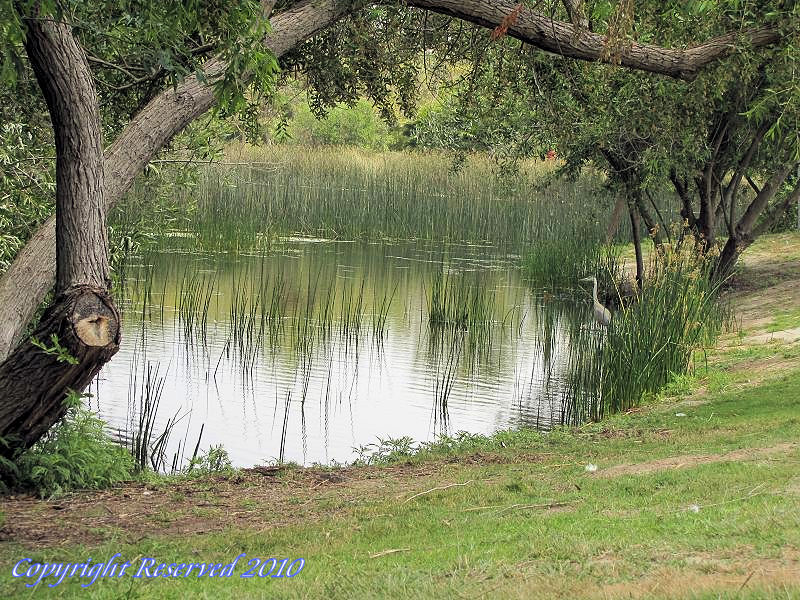
I had already had a good look at a Golden-crowned Warbler and an Allen’s Hummingbird before I met Jerry, a trail steward. I was positively cursing not having brought the camera when he told me of some Great Horned Owl fledglings to look out for further along the path and kindly walked with me to make sure I didn’t miss them. We found three chicks from an original brood of four. The other chick had died when it’s wing became snagged in the fork of a tree.
In his capacity as trail steward, Jerry is possessed of intimate details along it’s length. He was able to tell me about the wildlife in the reserve and show me Hummingbird nests. Some had fledged, but a couple still held chicks.
Thank you to Jerry for the pictures to accompany the latter part of this post and for introducing me to the
In 'N Out Double Double burger.

Bird Species; 14

Double-crested Cormorant 2, Cooper’s Hawk 2, Forster’s Tern 1, Mourning Dove 4, Great Horned Owl 3, White-throated Swift 1, Anna’s Hummingbird 2, Allen’s Hummingbird 2, Northern Rough-winged Swallow 2, Barn Swallow 4, Cliff Swallow 15, Northern House Wren 1, Bushtit 40, Orange-crowned Warbler 3.

Friday, 11 June 2010

A big thank you

Today, someone proved to me that the spirit of honesty and integrity is still to be found in Britain. I do not know who you are and I doubt that you read this blog, but apart from the ad I took in the local paper, I have no other way of thanking and showing my appreciation to such a thoughtful person.
I had dropped my binoculars on the common at Thursley in Surrey, but only realised when I came to pack everything back into the car. I rushed back out onto the heathland trail boardwalk, hoping, but not expecting to find them where I had been watching 4 Hobbies hunting. I must confess to a little cynical suspicion of other walkers on the common, but I was proved wrong when I found the binoculars hung on a tree exactly where I pessimistically thought they would have been stolen from.
I have always maintained that you get a “better sort” of person in Surrey and I am delighted to have been proved right. Thank you.
Ps I saw some dragonflies too.
The River Wey near Dockenfield runs beneath Huntingford Bridge as a large stream, lined with alders and with cattle fields on either side.
Beautiful Demoiselles were abundant here, the males splendid in their blue/green sheen.  
The females bronzed, less noticeable than the showy males, but still a beautiful sight.
A Banded Demoiselle had caught one of the myriad of mayflies that formed spiralling clouds above the water.
This mayfly must have put up quite a fight as the demoiselle’s eye appears to be stove in.
At Thursley Common, we saw a Keeled Skimmer, some Four-spotted Chasers and a few Large Red Damselflies. The Hobbies were racing about probably hoping for dragonflies too, but did not stay around for long.
The concentration of odes was still quite low, so I guess they didn’t find much to keep them in the immediate area.


Thursday, 27 May 2010

Odonata make a comeback

To celebrate the return of dragonflies to this blog I would like to share my visit to Leybourne Lakes this week.
It is close to junction 4 on the M20 in Kent (Google Earth; 51.18’ 55”N 0. 26’ 05”E). I only explored a tiny bit of the area and managed to get myself stung to bits in the process. From the first bridge I could see some male Banded Demoiselles in the stream that flows from the west.
I later found a female, but could not get a picture of the males.
On the rough field to the north of the stream were Common Blue Damselflies by the hundred. Most of them were light-coloured, teneral males.
Some of them were taking their blue colouration, but retained a slight pinky blush to their complexion.
This female beautifully demonstrates her distinctive “torpedo” pattern.
They appeared to like it among the nettles and I am still suffering after rolling around to get these photos.
Blue-tailed Damselflies were present by the stream, but in low numbers still.
I only had one sighting of some Azure Damselflies with only these 4 individuals.
An Emperor Dragonfly whizzed past overhead.
In the rough grass, I found a 4-spotted Chaser who was reluctant to be approached and maintained a healthy distance from me.
A few birds showed, with a Common Whitethroat singing and feeding chicks in the hemlock on the bank of the stream.
A long-tailed Tit was seen in the climbing tree.
I moved on to another site hoping to get a glimpse of a Large Red Damselfly and was lucky enough to find this obliging specimen at Bluebell AC lake at junction 6 on the M20.

Species Seen;

Banded Demoiselle 14, Common Blue Damselfly 400, Blue-tailed Damselfly 8, Azure Damselfly 4, Large Red Damselfly 4, Emperor Dragonfly 1, 4-Spotted Chaser 2,

Wednesday, 26 May 2010

Millenium Park, Abuja, Nigeria

I started the afternoon angry and impatient after another run-in with hotel security in Nigeria. This time at the Transcorp Hilton Hotel in Abuja.
They had given me the run around about bird watching in the gardens of the hotel again and wasted an hour of my time before I gave up and crossed the road to Millennium Park instead (Google ref; 09 04’18N 07 24’50E).
In the early morning, the park would have been my first choice, but rain stopped play. As the day progresses, the park becomes busier and interested spectators increase exponentially. I accepted this as inevitable and the lesser of two irritants.
The main attractions of the park are two small rivers that converge here. I started to follow the northern of the two which flowed from the WNW. On the first bend was a substantial Village Weaver colony with a number of nests still in the approval stages.
Male weavers build the nests, but will often abandon their efforts if a female does not show enough interest. His materials may be recycled into his subsequent attempts until female approval is granted and rewarded in time honoured fashion. The males of the local race of Village Weavers have a chestnut nape.
Already I had attracted inquisitive onlookers and was feeling slightly exposed. A young man called Marvelox was becoming very persistent and eventually I accepted his company and his offers of help. The first thing he did was set me a quandary. The bird below had me puzzled for some time.
I eventually plumped for Northern Black Flycatcher, but the bill seemed very fine and the bird did not sit as upright as I would expect it to. Only after seeing the rictal bristles on super digital zoom did I accept it as the only real likelihood.
A pair of wonderful Bearded Barbets flew over and a young Grey-headed Kingfisher flew up into a tree nearby. One of his parents was in the adjacent tree wearing the red bill and chestnut waistcoat attained through seniority.
Another young man, Manuel joined us and both became keen spotters. Though obviously non-birders, they showed an interest and “watched my back” which was comforting though ironic since I had abandoned birding at the hotel after their insistence that I be accompanied.
A young Splendid Sunbird was feeding on small insects that used to call a banana flower home.
I almost dismissed a Senegal Batis as the Chinspot version until I checked my field guide for confirmation.
The stream harbours some fantastic insect life as well as the birds, including beautiful butterflies and extraordinary locust/hopper things. 
 A Yellow-bill and a Senegal Coucal showed briefly on the other side of the river.
My dragonfly blog has not been getting enough traffic to warrant it’s distinct identity so will return to being part of the bird posts. The “blogger floggers” who want me to “stick to the birds” will have to suck it up. Whose blog is it anyway?
As dusk approached, we returned downstream. Some Bar-breasted Firefinches waited until I had stowed the camera before emerging and then disappeared again as soon as I unshipped it. A sunbird gave me cause for thought right at the end. It was silhouetted against the fading sky and I can only hazard a guess at Copper Sunbird. All thoughts welcome as it would be a red crayon bird for me..
Warnings of personal security risks in Nigeria can discourage people from experiencing life beyond the coffee shop and gym. Young men such as Marvelox and Manuel show that Nigerians can be as welcoming as anyone else in the world. If an escort would give you more confidence to go further a-field, I can put you in contact with them.

Bird species; 29

Cattle Egret 50, Striated Heron 1, Yellow-billed Kite 15, Red-eyed Dove 8, Western Grey Plantain-eater 12, Yellowbill 1, Senegal Coucal 1, African Palm Swift 4, Grey-headed Kingfisher 6, Bearded Barbet 4, Red-shouldered Cuckoo-shrike 4, Common Bulbul 40, Yellow-throated Greenbul 2, African Thrush 12, Snowy-crowned Robin-chat 2, Northern Crombec 1, Northern Black Flycatcher 1, Brown-throated Wattle-eye 1, Senegal Batis 1, Splendid Sunbird 1, Yellow-billed Shrike 6, Northern Puffback 1, Fork-tailed Drongo 2, Piapiac 2, Pied Crow 1, Village Weaver 40, Bar-breasted Firefinch 2, Red-cheeked Cordonbleu 2, Bronze Manikin 1,

Other birds seen en-route and during my aborted walk at the hotel are included below to give a fuller picture of what might be found in a municipal park in Abuja and generally around the area on a May afternoon. Additional species brought my list total to 40.

Additional species;

Cattle Egret 25, Common Kestrel 6, Laughing Dove 3, Western Grey Plantain-eaters 8, Senegal Coucal 1, African Palm Swift 6, Little Swift 300, Yellow-fronted Tinker-barbet 1, Bearded Barbet 2, Common Bulbul 20, African Thrush 8, Brown Babbler 1, Yellow-billed Shrike 8, Northern Puffback 1, Fork-tailed Drongo3, Piapiac 7, Purple Glossy Starling 1, Grey-headed Sparrow 2, Village Weaver 20