Showing posts with label Vancouver. Show all posts

Monday, 23 February 2015

George C. Reifel Migratory Bird Sanctuary, Vancouver Canada, Feb 2015

GEORGE C. REIFEL MIGRATORY BIRD SANCTUARY is south of the airport (YVR International) at Vancouver. Unfortunately, there is no public transport that reaches the reserve. Ladner (5 miles) is served by buses from stations along the Canada Line train service and a cab can be used from there.


My dilemma, as ever, was timing. I wanted to be at the sanctuary during the late afternoon in order to see a Great Gray Owl as it warmed up for its evening hunt. Cabs and public transport were not reliable enough to get me back to the hotel for an early evening pick-up for my return flight, so a rental car was the best solution. Even so, I had brought all my luggage and uniform in case I had to make pick-up from the airport.


Not only was I lucky enough to be rostered a flight to Vancouver whilst a Great Gray Owl was being reliably seen, but I also stumbled across a Nature Vancouver bird walk and was kindly invited to join them. Thanks to John, Colin and Angela for their company and local knowledge and also to the chap, whose name I didn’t catch, who spotted the Northern Saw-whet Owls and the Great Horned Owl.
The gates at Reifel open at 09.00. The trees and bushes by the gate were quite productive with Downy Woodpecker, Northern Flicker, Golden-crowned Kinglet and a large flock of Pine Siskin as we waited.


If you arrive in the vicinity earlier, it is possible to visit a couple of local spots before heading onto Westham Island. LADNER HARBOR PARK brought Bald Eagles in good numbers, but then so did the parking lot outside Quizno’s Subs where 8 were seen circling overhead.
This Saturday morning, cars were queued along the road from the entrance and the parking lot filled immediately as people came to see the Great Gray Owl; a first for the sanctuary. The bird had been misplaced however and the reserve manager, Kathleen, was trying to relocate it in a restricted part of the reserve.


The large group on the Nature Vancouver walk was led by John and became strung out as we walked the trails of the reserve and bunched up again when Saw-whet Owls and Great Horned Owls were found.


The sanctuary consists of a few ponds and marsh overlooking the estuary where Trumpeter Swans could be seen in the far distance and Northern Harriers much closer in. Wildfowl were well represented with over a dozen species and Great Blue Herons were especially common.


A moment of added excitement almost brought an American Bittern which would have been a lifer for me. Unfortunately all I could make out was a clump of reeds that was denser and darker than the surrounding reeds. Try as I might, I could not turn it into a bittern, even though it appeared to change shape slightly.


Back at the visitor centre, word reached us that the Great Grey Owl had been re-found on the restricted section and that the manager was taking small groups to see it. I was astonished at how tolerant the owls in the reserve had been today. The Saw-whet and Great Horned Owls had been seen very close to a busy path and groups of people were jockeying to get a clear view. The Great Gray was even more accommodating as we passed just 4 meters beneath it and looked back into its startling yellow eyes.


The Sanctuary is situated in the north of Westham Island and forms a large land mass in the delta at the mouth of the estuary. It has well maintained trails which are always close to water. Mostly the water is fresh and observation has been made easy with verandas round the visitor centre, hides, platforms and a tower in the northern section. There is even a warming room for those chilly days. I didn’t get a chance to visit the display ponds, but a brief glimpse in passing made me think that the birds are very approachable there too and it would probably make a good photography area. Many of the birds are used to being fed and seed can be purchased from the gift shop. There are washrooms, but no food.


The gates open at 09.00, though in practice, they are often open a little earlier. Entry closes at 16.00 with visitors already on site given a further hour to clear the gates. There is an entry fee of Can$5 for non-members.
Buses 601 and 620 leave from Bridgeport Canada Line Station. They stop at the transit mall at Ladner (EB Clarence Taylor Cres FS Harvest Drive), 6.5 miles from the reserve gates.  606, 608 and C86 will get you 1.5 miles closer, but cabs will be increasingly difficult to find as you leave the town. Delta Surrey Green Cab operate in the vicinity. 604 943 1111

As if a 3-owl day with 2 lifers amongst them wasn't enough, I tried to top it out with a quick visit to Boundary Bay between 64th and 72nd Streets. A Northern Harrier showed well here, but no owls. But as I drove back to return the car and go to work (and I have to question what I have been doing to deserve such luck), 2 Short-eared Owls were seen chasing each other across a meadow by the freeway. 6 owls from 4 species. Fantastic days!

I must Credit Kathleen, the reserve manager for the Great Gray Owl tick. She graciously allowed access to what is usually a restricted area and she ensured that the bird was not put to undue stress. The Saw-whets and the Great Horned Owls were found by the nature walk advance guard and pointed out to me as we passed. The Short-eared Owls belonged to Lady Ridiculous Blind Luck and she teased me with them as I passed at speed. Thanks to you all.


Boundary Bay
If you cannot reach Reifel Bird Sanctuary, link to the dedicated USA and Canada page where you will find more sugestions for Vancouver.

Birds seen at George C. Reifel Migratory Bird Sanctuary.

Snow Goose (Chen caerulescens)
300
Canada Goose (Branta canadensis)
20
Trumpeter Swan (Cygnus buccinator)
6
Wood Duck (Aix sponsa)
5
Gadwall (Anas strepera)
4
American Wigeon (Anas americana)
60
Mallard (Anas platyrhynchos)
200
Northern Shoveler (Anas clypeata)
130
Northern Pintail (Anas acuta)
8
Ring-necked Duck (Aythya collaris)
1
Greater Scaup (Aythya marila)
1
Lesser Scaup (Aythya affinis)
2
Bufflehead (Bucephala albeola)
4
Hooded Merganser (Lophodytes cucullatus)
5
Great Blue Heron (Ardea herodias)
40
Black-crowned Night-Heron (Nycticorax nycticorax)
4
Northern Harrier (Circus cyaneus)
3
Cooper's Hawk (Accipiter cooperii)
1
Bald Eagle (Haliaeetus leucocephalus)
12
Red-tailed Hawk (Buteo jamaicensis)
2
American Coot (Fulica americana)
5
Sandhill Crane (Grus canadensis)
7
Glaucous-winged Gull (Larus glaucescens)
6
Great Horned Owl (Bubo virginianus)
1
Great Gray Owl (Strix nebulosa)
1
Northern Saw-whet Owl (Aegolius acadicus)
2
Downy Woodpecker (Picoides pubescens)
2
Northern Flicker (Colaptes auratus)
1
Northwestern Crow (Corvus caurinus)
3
Black-capped Chickadee (Poecile atricapillus)
15
Marsh Wren (Cistothorus palustris)
1
Golden-crowned Kinglet (Regulus satrapa)
5
American Robin (Turdus migratorius)
8
Varied Thrush (Ixoreus naevius)
2
European Starling (Sturnus vulgaris)
10
Spotted Towhee (Pipilo maculatus)
4
Fox Sparrow (Passerella iliaca)
3
Song Sparrow (Melospiza melodia)
4
Golden-crowned Sparrow (Zonotrichia atricapilla)
12
Red-winged Blackbird (Agelaius phoeniceus)
20
House Finch (Haemorhous mexicanus)
6
Pine Siskin (Spinus pinus)
200
House Sparrow (Passer domesticus)
6

Wednesday, 17 October 2012

Vancouver for the last time? Oct 2012

In this post, I say goodbye to Vancouver. Rising fuel prices are crippling profits, so in an attempt to reduce fuel burn, the company have transferred this route to a younger and above all, lighter fleet of crew. The heavy weight of experience carried by us old-timers burns no extra fuel and in the absence of Vancouver flights, will be put to use on the Boston flights which have come full circle and are to be welcomed back to the Heritage Fleet rosters.


Grouse Mountain was shrouded this morning, so I returned to an old favourite in Stanley Park. This is a place that I will greatly miss until the transient management decision-makers change their minds again. Lost Lagoon was, as ever, covered in Canada Geese and Mallard. Glaucous-winged Gulls, a few Wood Duck and Great Blue Herons were also seen on the water with American Robins, Song Sparrows and a Northern Flicker in the trees and bushes away from the bank. I moved quickly through to the outdoor swimming pool area. A Bald Eagle was perched at the end of a rocky breakwater, but took flight at my approach.

The seawall route around the park is one-way, anti-clockwise, for bicycles, so I had to return back past the lagoon to conform. As I passed the totem-poles, a Bald Eagle swooped down from its vantage point on a tall pine tree and tried to take something from the water. All I could see out there were Mew (short-billed)Gulls and Glaucous-winged Gulls which were making a terrible fuss about the eagle.

Different populations of Bald Eagle specialise in different prey, often showing a preference for fish or fowl. I have not seen a successful hunt in Vancouver and am not familiar enough with them to say which they favour. I am still none the wiser after this miss, but it returned to its perch at the top of the tree to pose for pictures.

Beaver Lake is becoming more and more clogged despite the beavers’ attempts to raise the water level by blocking the drains. Mallard and Wood Duck came close, hoping to be fed.

Black-capped Chickadees, Chestnut-backed Chickadees and Dark-eyed Juncos are used to free hand-outs here and have been acclimatised to expect food from people, even taking food from their hands.

During a walk around the lake, a flock of Pine Siskins were seen feeding in the Alders. A Pacific Wren and a couple of Ruby-crowned Kinglets were also seen picking through the lower tangles.

Back on the seawall, I continued my circuit, passing under the bridge where a flock of Brandt’s Cormorants were resting on the base of the support. More were seen on the cliffs on the land side of the wall where a shower of feathers betrayed the presence of a Peregrine Falcon plucking its lunch.

A Red-necked Grebe was seen beyond the iconic, Siwash Rock and moments later a Harlequin Duck whooshed past, fast and low across the water.

Previous reports from Vancouver have featured the astonishing gluttony of the Glaucous-winged Gulls and their determination to eat anything that they can get down their throats. This week it was a small flat fish (Starry Flounder?) that just would not fit.

The tide had been low during the morning, but had been ripping through the straight under the bridge. It was rising quickly now and some Black Oystercatchers that I had seen from further back, were now marooned on their rocky roosts.

I clambered down onto the beach to get a closer look and found a flock of Pine Siskins which appeared to have come down to the water’s edge for a drink. Is it usual for a bird to drink salt water when there is plenty of fresh water available nearby?

My full circle brought me back to the swimming pool which had been closed to the public on Labor Day (5 weeks previously). Since then it has become the domain of gulls and the North-western Crow.

The crow has been responsible for making a fantastic mess. They prise mussels from rocks during low-tide and carry them high before dropping them onto the hard surface of the pool surround. The shell cracks and voila! Moules tartare!

 Birds seen; 37
Canada Goose 345, Mute Swan 3, Wood Duck 12, American Wigeon 24, Mallard 162, Harlequin Duck 2, Surf Scoter 9, Hooded Merganser 1, Horned Grebe 2, Red-necked Grebe 1, Brandt's Cormorant 30, Double-crested Cormorant 17, Great Blue Heron 3, Bald Eagle 3, Peregrine Falcon 3, American Coot 17, Killdeer 1, Black Oystercatcher 5, Mew Gull 40, Ring-billed Gull 12, Thayer's Gull 9, Glaucous-winged Gull 100, Northern Flicker 2, Pileated Woodpecker 1, Northwestern Crow 145, Black-capped Chickadee 8, Chestnut-backed Chickadee 6, Pacific Wren 1, Ruby-crowned Kinglet 4, American Robin 15, European Starling 4, Spotted Towhee 4, Savannah Sparrow 9, Song Sparrow 12, Dark-eyed Junco 9, Red-winged Blackbird 3, Pine Siskin 80.

Tuesday, 3 July 2012

Vancouver Island Ferry, Vancouver, June 2012

Catching the ferry from the city to Vancouver Island is very easy, but even if you stay on the ferry at Swartz Bay and return straight back to the city, the round trips needs six hours at least. But why would you put in all that time and effort to go to Vancouver Island and then not even get off the ferry? Orcas! That’s why! The ferry passes through the outlying islands where the resident pods of Orcas patrol close to the shore. I don’t know how often they are seen, but the fact that they are seen at all is good enough for this long-odds gambler.


As it happens and before you get too excited, I will let you down gently and admit that the bet didn’t pay out on this occasion, but it was a beautiful day to be out on the water nevertheless. The picture is from a previous trip on a dedicated whale boat that leaves from Vancouver city.
From the terminal at Tsawassen (Google earth ref; 49 00 28N 123 07 41W), the ferry crosses the Strait of Georgia which separates Vancouver Island from mainland British Columbia. The water here was coloured with sediment, but was as flat as a mill pond. The wind was very gentle, bringing just a slight chill.


Glaucous-winged Gulls were the gull of the day with the only possible confusion being a Caspian Tern. Confusion would have been unlikely I agree, but after seeing so many G-WGs, I stopped checking.


They flew alongside the ferry and roosted on the many floating hazards to shipping.
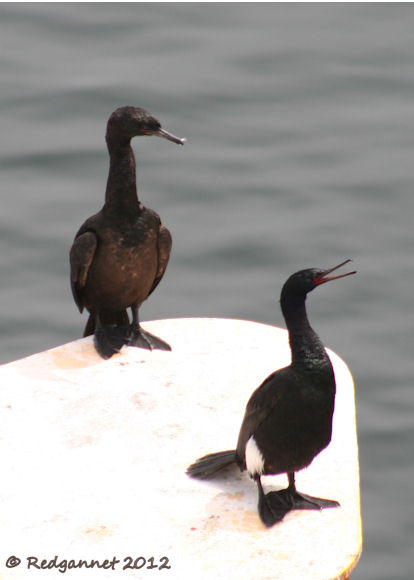
Pelagic Cormorants carried the torch for their family and were seen on the breakwaters and around the wharfs.


The ferry threads its way through a narrow channel between 2 islands (Google earth ref; 48 52 01N 123 18 25W) and I am told that this is the most common place to find the whales as the tide rips through bringing salmon.


It then continues, past smaller islands dotted with pretty houses, to Swartz Bay (Google earth ref; 48 41 22N 123 24 43W). The crossing takes about 90 minutes and the stop at Swartz Bay to offload the passengers and to embark a whole new bunch, took about 30 minutes.


Pigeon Guillemots were seen around the ferry stops and on the rocks along the shore of the narrow channel. A flock of three Rhinoceros Auklets plus a couple of loners were seen in amongst the islands.


Bald Eagles were seen, but they were very distant, perched at the top of trees on the shoreline.

Birds seen; 8

Pelagic Cormorant 30, Great Blue Heron 4, Bald Eagle 4, Red-tailed Hawk 2, Glaucous-winged Gull 100, Caspian Tern 2, Pigeon Guillemot 30, Rhinoceros Auklet 5.

To get to the ferry terminal at Tsawassen, catch the Skytain, Canada Line (runs every 6 – 8 minutes), to Bridgeport Station (journey time 20 minutes from Waterfront). Bus number 620 leaves from the bottom of the stairs and terminates at the ferry terminal (journey time 40 minutes). It only runs once or twice an hour, so check this timetable to dovetail your journey neatly. It passes through a station at Ladnor and may stop here for a few minutes with the driver turning off the engine. This caused some confusion as some passengers thought that they were at the ferry terminal and got off only to re-board moments later looking embarrassed.
A day pass for the train and bus costs $Can 9.00
The bus and train take around an hour to reach the ferry and sailings to Swartz Bay depart every 2 hours at 07.00, 09.00, 11.00, 13.00 15.00 17.00 and 19.00. This is the daily schedule with reciprocal crossings from Swartz Bay to Tsawassen. There are crossings in addition to these on the even hours, but these are not daily and the timetable should be consulted.
Tickets may be bought from machines or from a clerk, but try to arrive at least 30 minutes before the scheduled time of departure.
The ferry crossing costs $Can 15.00 and a return ticket can be bought from the gift shop onboard. If you use this option, you are not required to disembark and may stay onboard for the turn round at Swartz Bay.
Six hours is the minimum time to set out and return straight back to Vancouver.

Sunday, 1 July 2012

Stanley Park, Vancouver, June 2012

My plan this morning was to catch the ferry across to Vancouver Island in the hope that the boat would coincide with the passing of a pod of Orcas. Rather than wasting the golden early hours on trains and buses however, I took a quick flash around Stanley Park before heading down to Tsawassen to catch the ferry.


A Racoon looked embarrassed to be caught out in the open and a Douglas Squirrel greeted me expectantly on the bridge at the far corner of the Lost Lagoon at Google Earth ref; 49 17 44N 123 08 46W .


People often put out food for the animals here and they have become quite approachable. Fat Tony earned an injunction here after loitering with intent to kidnap squirrels.


North-western Crows are accepted as the norm here in Vancouver, so I was happy to add them to the list without any qualms.


The track skirts the shoreline all the way around the park and cyclists are required to go in an anti-clockwise direction. In a tree right by the water, a Red-breasted Sapsucker parent was tending its youngster. Judging by the sap-tapping marks, this tree is a regular feeding spot for them. The juvenile bird was making a valiant attempt to suck sap for itself, but the parent bird still seemed keen to help.


The foot of the roadbridge support held a few Pelagic Cormorants. A Common Merganser ignored my presence on the seawall and hauled up onto the tiny beach.


A chase ensued along Third Beach as I tried to keep up with a Banded Kingfisher. It hovered about 10 meters above the very still water and plunge-dived to try to catch a fish. It missed a few times, but each time it stopped to hover, I got the chance to catch up, but never quite got within range. I was travelling light today and you may notice that most of the weight was saved by discarding any heavy image-stabilising paraphernalia.


Birds seen; 21

Canada Goose 150, Mute Swan 5, Wood Duck 1, Mallard 200, Common Merganser 1, Double-crested Cormorant 6, Pelagic Cormorant 40, Great Blue Heron 5, Glaucous-winged Gull 80, Belted Kingfisher 1, Red-breasted Sapsucker 2, Northwestern Crow 60, Northern Rough-winged Swallow 6, Violet Green Swallow 2, Barn Swallow 20, Black-capped Chickadee 2, American Robin 8, European Starling 6, Spotted Towhee 2, Song Sparrow 1, White-crowned Sparrow 12.

Mammals seen; 4

Racoon 1, Western Grey Squirrel (Grey and Black versions) 12, Douglas Squirrel 2, Harbour Seal 8.

There are more posts to be found from Stanley Park at the following links;
http://redgannet.blogspot.co.uk/2011/10/stanley-park-vancouver-oct-2011.html

Visit the dedicated USA and Canada Page for more from Vancouver, such as Boundary Bay or Orca-watching boat rides.

Monday, 10 October 2011

Stanley Park, Vancouver, Oct 2011

Nearly 3 years ago I did a trip to Vancouver’s Stanley Park with the inestimable Charlie Moores. It was he that inspired me to start Redgannet (although some less charitable observers have suggested that the blog is perpetrated rather than written), following the style and format of his much-missed charliesbirdingblog. Charlie has given up flying around the world and can now be found talking naturally with guests on his podcast website.

The light came late this morning and I had to back-track to get any decent photographs, so shadow-watchers may see some crazy time lines in the sequence of photos in this post.  Follow W. Georgia St. north-west to Google Earth Ref;  49 17 40N 123 08 14W and you will find yourself at the south-east corner of the 18 (-ish) hectare Lost Lagoon. The season is still a little young for the great variety of ducks that might be found here during the winter. Instead, there was a big head of Canada Geese as first light fell.

I get plenty of bad photographs in my pursuit of half-decent ones, but occasionally I fluke an atmospheric picture through no intention or talent of my own. Often overlooked as a trash bird, the geese were in their place and time today and a smaller version amongst them was a life-first Cackling Goose. The split from Canada Goose was made in 2004, but looking at the size and bill shape makes me wonder what took them so long.

Raccoons were seen on the path as I walked around the lake in a clockwise direction towards the bridge. They are often fed by well-meaning park visitors, but they have become very used to people and often come into conflict with dog walkers and parents with small children.

I was using a bicycle this morning and my intention was to take a gentle ride around the sea-wall, but this meant returning to W. Georgia St. and crossing over to comply with the one-way bike trail which runs anticlockwise. This should be the best way to chase the light, but high trees and raised ground cast long shadows out onto the water to shade anything close to the shore.

Any visit to Vancouver will inevitably include gulls. Glaucous-winged Gulls were the most common today, but in fewer numbers than I recall. The only other species seen was the Short-billed (Common) Gull. One of the Glaucous-winged Gulls was trying to swallow a starfish and looked to be gagging on it. A couple of walkers stopped to watch, but became grossed out by the constant regurgitating to get a better grip. Another passerby was very impressed giving it a high score for technical effort and artistic impression. The fay, English critic gave it a “Yes” and it went through to the next round. For the full performance and to vote for the Glaucous-winged Gull, click this link.

Out on the water were Pelagic Cormorants as well as Double-crested Cormorants with their much thicker bills and orange chin. The only ducks seen along the first stretch were American Wigeon. Good numbers of Horned Grebe were seen and a Harbour Seal came quite close to shore.

At around the 3.8km mark, the Ravine Trail leads up to Beaver Lake. This is always a good place to look for Spotted Towhees, Black-capped and Chestnut-backed Chickadees. They are often fed here and are very approachable.

Beaver Lake, as the name suggests has a Beaver lodge and the rodents constantly block the overflow drain to increase the depth of the shrinking pool. It is choked with weeds now and is becoming quite swampy with only a tiny piece of open water left. The Wood Ducks love it here and also like to endear themselves to the people who come here to feed them.

Back out on the sea-wall I passed under the Lion’s Gate Bridge and was rewarded with a view out across the open water towards the Strait of Georgia which separates Vancouver Island from the mainland. There was a large flock of Scoters out there.  The big white face and head patches of the Surf Scoters stood out from a distance, but there were a couple of oddities amongst them. I took a seat with Stan and Mary Stanford (who so loved the view from here) and scanned the flock carefully. A small group who stayed very slightly removed from the main flock proved to be White-winged Scoters and there was one Long-tailed Duck mixed in with the melee.

In a small bay close to Third Beach a pair of Harlequin Ducks rode the gentle swell of an incoming tide. I wanted to get a closer picture and clambered down onto the rocky shoreline to wait for them to round the headland, but the tide pushed me back as the ducks paddled further out at my approach.

I had come full circle now and stopped for a passable fish and chips at a café near to First Beach. A Glaucous-winged Gull was keening pitifully for its parent who was watching my chips with a dark eye.

Back at the bridge and the Lost Lagoon, I managed to get a few of the photographs that I missed in the horrible light of an overcast morning. The Raccoons were out in force with at least 8 of them begging for scraps from anyone who passed.

The Great Blue Heron was in a better position with some nice warm afternoon light falling on him, but still he looked grumpy.


Species seen; 29
Horned Grebe 25, Double-crested Cormorant 12, Pelagic Cormorant 35, Great Blue Heron 5, Mute Swan 6, Cackling Goose 1, Canada Goose 400, Wood Duck 15, American Wigeon 120, Green-winged Teal 5, Mallard 80, Harlequin Duck 2, Long-tailed Duck 1, Surf Scoter 350, White-winged Scoter 8, Cooper’s Hawk 2, American Coot 8, Short-billed Gull 15, Glaucous-winged Gull 35, American Robin 2, Varied Thrush 1, Black-capped Chickadee 6, Chestnut-backed Chickadee  8, North-western Crow 400, Spotted Towhee 12, Song Sparrow 40, White-throated Sparrow 3, Golden-crowned Sparrow 6, Dark-eyed Junco 35, Red-winged Blackbird 1.

The path along the sea-wall passes the First Peoples’ totem poles and the attendant interpretative centre.
Stanley Park, Vancouver, YVR