Showing posts with label Skomer. Show all posts

Saturday, 30 April 2011

Skomer; Part 4 of the trilogy.

My friend Martin and I, with Ben and Joe, our respective sons, are on Skomer, an island off the Pembrokeshire coast in south-west Wales. Ostensibly, we are here to go bird watching, but there does seem to be a lot of cricket going on. This is day 4, an unexpected extra day. My  11 year-old son is not a birdwatcher, but was keen to come along anyway. We booked for 3 nights with Joe having the option to use his veto and pack it in after 2. To my surprise and delight, his tolerance has improved and he wanted to stay on for the third night. Day 1, Day 2, and Day 3 can all be found at the respective links. 
Martin and Ben were able to shake off the gripping on day 3 by seeing the Short-eared Owl from North Valley Hide this morning. I contented myself with a gentle stroll around the grounds of the farmhouse, noting a singing Northern Wren while the hero of the hour dozed peacefully. A Grasshopper Warbler was reeling in the dry grass near the owl bench and another was calling from close to the stream. I wasn’t able to pinpoint this potential lifer and had to content myself with Willow and Sedge Warblers. Joe came out to check on the Slowworms.
When Martin and Ben returned, we put out our luggage to be taken by tractor to the landing point for our boat home scheduled for 12.00. We still had a couple of hours left and were reluctant to leave the farmhouse in case the owl, which had settled on the far bank, took another flight. The owl didn’t show again, but a Black Redstart alighted on the apex of the old building by the bench. The apex may deserve a post all of its own.
The island was taking visitors again today and we were going against the flow by heading towards the landing point. The Razorbills were still there and didn’t seem to mind cameras being pointed at them. I took Joe for a look at the cave that he had found earlier in the week only to find 2 Grey Seals in there, which hurried out from a potential trap.
The other seals out in the bay were curious to have a look at Joe again, which was nice as he wanted to get a close look at them too. With a last bit of rock climbing, we headed for the boat and the mainland. A Common Sandpiper flushed as we left, lifting the week’s list to 62 species.
Species seen; 36

Northern Fulmar 15, European Shag 1, Canada Goose 6, Mallard 4, Northern Shoveler 2, Common Buzzard 2, Common Kestrel 1, Common Pheasant 6, Common Moorhen 1, Eurasian Oystercatcher 6, Common Sandpiper 12, Great Black-backed Gull 4, Herring Gull 30, Lesser Black-backed Gull 400, Common Guillemot 15, Razorbill 400, Atlantic Puffin 300, Common Wood Pigeon 2, European Swallow 8, Meadow Pipit 20, Pied Wagtail 1, Northern Wren 2, Common Blackbird 2, Black Redstart 1, Northern Wheatear 8, Sedge Warbler 2, Willow Warbler 25, Blackcap 2, Common Whitethroat 2, Eurasian Magpie 6, Red-billed Chough 1, Eurasian Jackdaw 15, Common Raven 1, European Goldfinch 1, Common Linnet 4, Reed Bunting 1.

Common Kestrel

The Wildlife Trust of South and West Wales have built a terrific website with tons of information, maps and logistics for anyone wishing to visit Skomer. I would draw your attention to one detail which deserves highlighting. The boat does not ferry visitors to and from the island on Mondays. If you turn up on a Monday, you will have to be satisfied with a circumnavigation of Skomer and its neighbouring islands. This also means that visitors staying overnight on Sunday will have to stay the extra night until Tuesday (Incidentally, the ‘first come first serve’ policy on the ferry left a few disgruntled passengers having to wait for the next sailing, though overnight guests take precedence over day-trippers).


The boat only runs during the season between April 1st and October 31st.


Thursday, 28 April 2011

Skomer; there's more!

My friend Martin and I, with our respective sons, Ben and Joe, are on Skomer, an island off the Pembrokeshire coast in south-west Wales. Ostensibly, we are here to go bird watching, but there does seem to be a lot of cricket going on. This is day 3. Day 2 and day 1 can be found at the respective links, or just below if you are reading April. As you can see, the weather was perfect again.
The boys had been very good the evening before, but a late night had left my son reluctant to leave his bed. Martin took Ben to Maury Mere hide while I waited close to the farmhouse.

A bench overlooks the North Valley which is noted for its Short-eared Owl. From the bench I was able to scan the brambles and small bushes. In the distance you may see Chris Perrins (Leverhulme Emeritus Fellow at the Edward Grey Institute of Field Ornithology at Oxford University), a man confident enough to wear red while birding. The ubiquitous Willow Warbler was easily seen and I managed to add Reed Bunting, Sedge Warbler and Dunnock to my Skomer list.
The apex of the back wall of the tumbledown building proved very productive with Willow Warblers picking through the moss and small plants that had taken hold on the rocky wall. Blackcaps liked it here too seeking food until a Lesser Black-backed Gull decided that it would make a good vantage point. During the past couple of days, we had also seen Common Blackbird, Collared Dove, Northern Wren and Meadow Pipit on the wall.   
A couple who had been staying for the last couple of nights came to have one last look before they had to go home. Just as they turned to leave, I noticed the buoyant flight of the Short-eared Owl coming towards us across the valley. It gave us a perfect flypast and disappeared over the headland to our left as John and Helen headed home. Such a sighting called for a big breakfast and a game of cricket while we waited for Martin and Ben to return and the gloating to commence.
We headed west today towards Skomer Head and on to Bull Hole where we found a huge mixed colony of Common Guillemots and Razorbills.  We spent some time looking out for Common Porpoises. Some had been seen just as we arrived, but we missed them. The island was much busier today with the maximum of 250 permitted visitors expected. In contrast to the16 of us yesterday when there were no boat landings, Skomer was buzzing. As usual Northern Wheatear and Meadow Pipits were common and obvious, standing proud on the hummocks and rocks that littered the island.
Garland Stone was our target picnic spot for the afternoon and we spent a while, high on the cliff, watching the Grey Seals and Northern Fulmars. A Peregrine Falcon flew by below us, shortly followed by another, slightly higher. I wonder if the first intended to flush birds off the cliff for the second one to ambush moments later. 
 Herring Gulls, Great and Lesser Black-backed Gulls, Gannets, Cormorants, Shag and a Raven passed as we watched. Martin took the boys back to the Old Farm after a picnic lunch and I stayed on for a short while, eventually getting an acceptable picture of a Northern Fulmar.
On the way back two Peregrines, possibly the same ones that we had seen earlier, rose from the rock behind me. One just opened its wings and stepped off the bluff, rising vertically on outstretched wings using the wind and looking for all the world like a child’s kite.
The track took me back towards the farmhouse which could be seen across North Valley where I had to run the gauntlet of Willow Warblers. If they ever get organized, mankind is in trouble.
 The rest of the evening was spent around the farmhouse either playing cricket or looking out for the owl from the bench. Once it was dark, I borrowed Martin’s night vision system and went out to check on the Manx Shearwaters. The wall along the road leading to and from the farmhouse was productive with many birds against the rocks or perched on top. I was not sure if the wall was a hazard that the stumbling birds get trapped against.

The Wildlife Trust of South and West Wales have built a terrific website with tons of information, maps and logistics for anyone wishing to visit Skomer. I would draw your attention to one detail which deserves highlighting. The boat does not ferry visitors to and from the island on Mondays. If you turn up on a Monday, you will have to be satisfied with a circumnavigation of Skomer and its neighbouring islands. This also means that visitors staying overnight on Sunday will have to stay the extra night until Tuesday (Incidentally, the ‘first come first serve’ policy on the ferry left a few disgruntled passengers having to wait for the next sailing, though overnight guests take precedence over day-trippers).

The boat only runs during the season between April 1st and October 31st.

Species seen; 41

Northern Fulmar 50, Manx Shearwater 150, Northern Gannet 6, Great Cormorant 2, European Shag 2, Canada Goose 10, Mallard 4, Northern Shoveler 2, Common Buzzard 2, Peregrine Falcon 3, Common Pheasant 5, Eurasian Oystercatcher 15, European Curlew 3, Great Black-backed Gull 15, Herring Gull 30, Lesser Black-backed Gull 600, Common Guillemot 800, Razorbill 40, Atlantic Puffin 60, Common Wood Pigeon 5, Eurasian Collared Dove 1, Short-eared Owl 1, Eurasian Skylark 2, European Swallow 15, Northern House Martin 3, Meadow Pipit 30, Pied Wagtail 3, Northern Wren 2, Dunnock 2, Common Blackbird 2, Northern Wheatear 20, Sedge Warbler 2, Willow Warbler 50, Blackcap 2, Common Whitethroat 4, Eurasian Magpie 6, Red-billed Chough 1, Eurasian Jackdaw 30, Common Raven 3, Common Linnet 2, Reed Bunting 2.

Day 1, Day 2 and Day 4 can be found at these respective links.

Tuesday, 26 April 2011

Skomer, a welsh wonderland. Part two.

My friend Martin and I, with Ben and Joe, our 2 respective sons, are on Skomer, an island off the Pembrokeshire coast in south-west Wales. Ostensibly, we are here to go bird watching, but there does seem to be a lot of cricket going on. This is day 2. Day 1 is below (because the most recent posts are at the top of the page). Links to the other days can be found at the bottom of the page.
Martin and I let the boys have a lie-in this morning and visited a hide close to the Old Farm, overlooking North Valley. We were hoping to see the Short-eared Owl which regularly hunts this area. The hide looks out onto a small dam. Here there were plenty of gulls and a few duck; Mallard and Northern Shoveler. A Common Moorhen made an addition to our island list, but the owl did not show. The bushes and brambles in the lee of a rocky outcrop behind the accommodation held more Willow Warblers and some Blackcap.
Once the boys were up, breakfasted and the obligatory game of cricket had been played, we headed for the landing stage to start a clockwise walk along the island’s edge to The Wick, via Captain Kites and High Cliff. We had come back to the landing point in North Haven to get a close look at the Common Guillemots and Razorbills that had been there to greet us on our arrival. The best view would have been from the boat, but we were still able to see them well from the steps.
My son wandered off to the beach and befriended a curious Grey Seal which he named Big Nose. The island predominantly meets the sea as cliffs. This is the only accessible beach, though not what my wife would have in mind for a day out. There were large boulders, slippery seaweed and a cave which a little boy found irresistible.
We followed the island trail to Captain Kites and beyond into the South Stream Valley. Here we were sheltered from the wind which had come up this morning. Small bushes along the stream contained the expected Willow Warblers as well as a couple of Northern Wrens.

High Cliff is home to a mixed breeding colony of Guillemots, Razorbills and Northern Fulmars. It gave me another opportunity to get the Fulmar picture, but I was still not happy with the results. There were a lot of Alcids down on the water and the Guillemots seemed to be playing ‘Follow my Leader’. The wind was biting so we stopped in the lee of some rocks and spent a little father/son time as the Ravens passed by and the Great Cormorants crossed to the other side of Mew Rock.
We had now come back to The Wick where the Atlantic Puffins had been so accommodating yesterday. Today there were fewer birds on the grassy slope. Maybe they preferred to shelter from the wind. The ones that were up were as approachable as before, but we had plans to visit the Puffins at North Haven later, so we didn’t linger.
My son’s initial enthusiasm was wearing thin so the boys went ahead to the Old Farm while Martin and I stopped at Maury Mere hide on the way back. There were better numbers of Herring Gull here and as usual, wherever there are small bushes, there were warblers. Willow Warblers of course made up the biggest percentage, but there were Blackcaps and Common Whitethroat here too.
After dinner, we made our way back to North Haven to see the Puffins coming back to shore. Out on the water were hundreds of them with a few already landed, or looking out to sea for their mates. I had no idea that they fly so fast! There must be a formula to calculate the relationship between wing size and airspeed. The Puffins’ wings are quite small and their body quite stocky, so they have to flap like mad. Their flight seems to depend more on momentum and ballistics than elegant aviation. Getting a picture was really difficult.
At one point I thought that I had nailed it when a slower bird came by.
I had pictured the scenario of a puffin coming in to land, flaring as it did so and I would be there to capture it on my 8GB Compact Flash. The reality was somewhat different with me having to delete most of the card because there were no puffins in the pictures. I simply couldn’t keep up with them and the servo focus was struggling to cope when I did.
After a good long while, I began to pick out the birds at a distance and predict which ones would swerve around and cross in front of me and was able to get them in frame and in focus before the critical pass.
Then eventually one came to land just in front of me as I had envisaged. It didn’t so much land as impact and scuttled off into its burrow straight away.
Up by the Warden’s House we waited for the bird log to start as more and more Puffins arrived and stood outside their burrows on the grassy slopes at the top of the cliffs.

The walk home was in the dark. We had conspired that this should be so because we wanted to see the Manx Shearwaters that remain hidden in their burrows underground all day or are out at sea feeding. Skomer is home to the largest breeding colony with as much as one third of the world’s population of the species. 120,000 breed on Skomer and 45,000 on its sister island Skokholm. The moon had been full the night before and we were worried that they might not come out. They are predated on by the large gulls and the light from a big moon enables the gulls to hunt at night.
However the moon had not yet risen and we could hear the murmurings and strange eerie calls from underground as the birds called to their mates. Soon we began seeing them as ghostly flashes in the torchlight and then as ungainly, stumbling birds on the ground. Their legs are set well back on their bodies and are not much use for walking with.
 There is a recommendation that each bird should not have its picture taken with a flash more than once to avoid repeatedly dazzling it. 
Some people choose their friends because they share beliefs and convictions, some find comfort in a friend who is thoughtful and reliable. I choose friends who have night-vision systems. In the ghostly green glow of Martin's monocular the birds could be seen in the beam of infra red light without disturbing them with torches. But then the moon came up from behind a rock!
The Wildlife Trust of South and West Wales have built a terrific website with tons of information, maps and logistics for anyone wishing to visit Skomer. I would draw your attention to one detail which deserves highlighting. The boat does not ferry visitors to and from the island on Mondays. If you turn up on a Monday, you will have to be satisfied with a circumnavigation of Skomer and its neighbouring islands. This also means that visitors staying overnight on Sunday will have to stay the extra night until Tuesday (Incidentally, the ‘first come first serve’ policy on the ferry left a few disgruntled passengers having to wait for the next sailing, though overnight guests take precedence over day-trippers).

The boat only runs during the season between April 1st and October 31st.

Species seen; 33

Northern Fulmar 20, Manx Shearwater 60, Northern Gannet 1, Great Cormorant 3, Canada Goose 15, Mallard 5, Northern Shoveler 6, Common Buzzard 2, Common Kestrel 1, Common Pheasant 8, Common Moorhen 2, Eurasian Oystercatcher 20, Great Black-backed Gull 30, Herring Gull 41, Lesser Black-backed Gull 500, Black-legged Kittiwake 15, Common Guillemot 80, Razorbill 120, Atlantic Puffin 1000, Common Wood Pigeon 3, European Swallow 4, Meadow Pipit 15, Pied Wagtail 4, Northern Wren 3, Common Blackbird 2, Northern Wheatear 20, Willow Warbler 15, Blackcap 2, Common Whitethroat 1, Eurasian Magpie 15, Eurasian Jackdaw 31, Common Raven 3, European Goldfinch 1.

Day 1, Day 3 and Day 4 can be found at these respective links.


Thursday, 21 April 2011

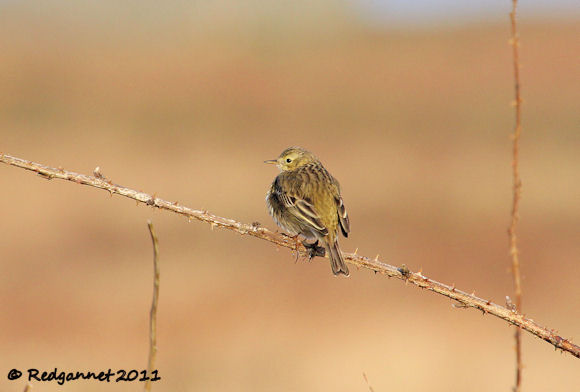
Meadow Pipits

Skomer is the most easterly and the furthest removed of the Caribbean Islands, so much so that it has been claimed by the Welsh. Call me optimistic, but I had brought along some sun tan lotion and had occasion to use it, which is surely a first for anyone visiting the land of the Red Dragon.
The weather has been stunning on Skomer this week and I have given my affections to an unlikely bird. I have fallen for the Meadow Pipit over the far shorter-odds favourites, the Puffin and the Short-eared Owl.
Perhaps it was the surroundings. The rocks are covered in algae, lichen and small precariously clinging plants which give the pipit a perfect perch. Even the rough grasslands are covered with hummocks from the dead grass and the burrowing birds to give the pipits a stage that they lack elsewhere.
Most of the times that I see them, they are up to their necks in grass and don’t present a good aspect, but on Skomer they stand up proud and positively glow.
Skomer can be found off the south-west Welsh coast at Google Earth ref; 51 44’ 17”N 5 17’ 38”W