Showing posts with label New York. Show all posts

Wednesday, 22 October 2014

Central Park, New York, Oct 2014

A walk in New York’s Central Park always carries my hopes for a long list of New World Warblers, but my luck and skill could not combine to bring these hopes to reality today. It was a glorious day to be out in the park however and was enhanced by a great look at a young Red-tailed Hawk and chance meetings with other like-minded wanderers.


I had borrowed a bicycle and entered the park on the cross drive at 72nd St. The mound that carries a tribute to the Pilgrim Fathers brought some early birds with the regulation Blue Jay, Ruby-crowned Kinglet and the first of many Yellow-bellied Sapsuckers.


The Falconer bronze stands beneath an outcrop of New York Gneiss which harboured Chipping Sparrows, Red-bellied Woodpecker and Dark-eyed Junco.


I chained up the bike by the benches at Wagner’s Cove, the southern lobe of the boating lake and immediately walked into the red-tail. It was in a tree which was rooted lower down the bank and this left it sitting at the perfect height for a picture. It appeared relaxed and I was able to sit on the rock and enjoy it for a while until a call from another hawk stirred it into action.


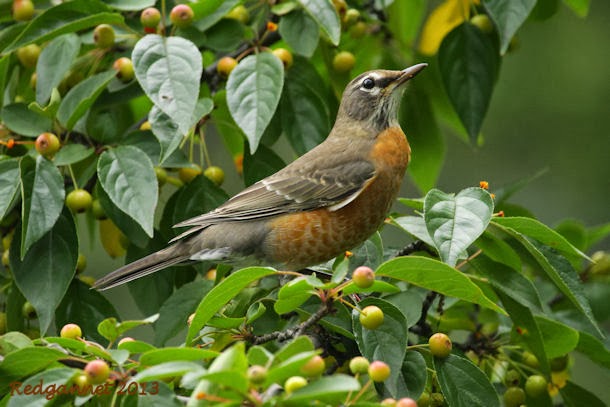
While it sat, no other birds bothered it, but when it flew, it was chased by Blue Jays and American Robins which continued to bombard it after it landed in a nearby oak.


A second Red-tail cruised across the cove and my bird gave chase. Mallards on the water ducked beneath the surface each time a hawk passed over.
A Pine Warbler was seen in a conifer on the south side of Bow Bridge and raised my hopes of a warbler fest. Another warbler evaded me as I approached The Oven, but in chasing it, I ran into Cindy who thought it may have been a Magnolia Warbler.


We walked together for a while and got some good views of Brown Creeper, White-throated Sparrow and dozens of American Robins along The Spit. We took a slight wrong turn on the way to the feeders which proved fortunate as an Ovenbird stepped and flicked through the rank vegetation to the right of the path. Another warbler by the Azalea Pond had us foxed, though the smart money is on Tennessee Warbler.
Cindy left me here and I continued on to Maintenance Meadow, arriving at the same time as a party of school kids. It was dispiriting that the meadow would probably be disturbed, so I moved out quickly to stay ahead of the children, but was pleasantly impressed as the teacher primed the class that I was hoping for a quiet few moments and the children very respectfully gave me that chance.
A Song Sparrow fed from low plants to the west of the meadow and a Cooper’s Hawk flew high above.


Yellow-bellied Sapsucker and Cedar Waxwings were seen in the large tree on the northwest corner of the meadow and a Northern Parula gave a poor view and had to be confirmed from a photograph later on.


Another birder had seen some warblers up near the arboretum, so I sauntered up that way and added Downy Woodpecker, Yellow-rumped Warbler, half-a-dozen more Yellow-bellied Sapsuckers and a Northern Cardinal.


On the return south, a Red-breasted Nuthatch was added from the Shakespeare Garden, a Blue-headed Vireo was seen from the Maintenance Meadow and Karen Wang pointed out a Black-throated Blue Warbler near The Gill.

Birds seen;

Canada Goose (Branta canadensis) 7, Gadwall (Anas strepera) 2, Mallard (Anas platyrhynchos) 15, Northern Shoveler (Anas clypeata) 70, Ruddy Duck (Oxyura jamaicensis) 45, Cooper's Hawk (Accipiter cooperii) 1, Red-tailed Hawk (Buteo jamaicensis) 5, Ring-billed Gull (Larus delawarensis) 6, Herring Gull (Larus argentatus) 4, Great Black-backed Gull (Larus marinus) 3, Mourning Dove (Zenaida macroura) 15, Red-bellied Woodpecker (Melanerpes carolinus) 8, Yellow-bellied Sapsucker (Sphyrapicus varius) 10, Downy Woodpecker (Picoides pubescens) 1, Northern Flicker (Colaptes auratus) 1, Eastern Phoebe (Sayornis phoebe) 1, Blue-headed Vireo (Vireo solitarius) 1, Blue Jay (Cyanocitta cristata) 25, Black-capped Chickadee (Poecile atricapillus) 6, Tufted Titmouse (Baeolophus bicolor) 15, Red-breasted Nuthatch (Sitta canadensis) 1, White-breasted Nuthatch (Sitta carolinensis) 3, Brown Creeper (Certhia americana) 5, Ruby-crowned Kinglet (Regulus calendula) 6, Hermit Thrush (Catharus guttatus) 5, American Robin (Turdus migratorius) 120, Gray Catbird (Dumetella carolinensis) 5, European Starling  (Sturnus vulgaris) 15, Cedar Waxwing (Bombycilla cedrorum) 10, Ovenbird (Seiurus aurocapilla) 1, Northern Parula (Setophaga americana) 1, Black-throated Blue Warbler (Setophaga caerulescens) 1, Pine Warbler (Setophaga pinus) 1, Yellow-rumped Warbler (Setophaga coronata) 1, Eastern Towhee (Pipilo erythrophthalmus) 4, Chipping Sparrow (Spizella passerina) 30, Song Sparrow (Melospiza melodia) 4, White-throated Sparrow (Zonotrichia albicollis) 150, Dark-eyed Junco (Junco hyemalis) 6, Northern Cardinal (Cardinalis cardinalis) 10, Common Grackle (Quiscalus quiscula) 35, House Finch (Carpodacus mexicanus) 1, American Goldfinch (Spinus tristis) 1, House Sparrow (Passer domesticus) 80.


Central Park can be found on Manhattan between 5th and 8th Aves and from 60th St, north to 110TH St.
The most talked about area for birding is The Ramble, which can be seen at Google Earth ref; 40 46 36.89N73 58 10.74W

Previous posts from New York’s Central Park can be seen at the links below;

Visit the dedicatedUSA and Canada Page for more posts from New York including Jamaica Bay WildlifeRefuge and Floyd Bennett Field.

Wednesday, 23 July 2014

Long Island, New York, July 2014

This blog has slipped so far behind that this entry refers to a time, way back, when England was still in contention for the World Cup in Brazil. It was a Long Island JFK and Corey came to pick me up from the hotel there. We headed out to the beach where a nesting colony of Black Skimmers, Common Terns and Piping Plovers on Nickerson Beach made for easy watching.


The nesting area is on the beach side of the dunes at Point Lookout. eBird is slightly cagey about the exact positioning of the colony, so I will follow suit and be discrete. This begs the question; why am I blogging about it? Redgannet is written to encourage people out into the open by telling them where to go and what they might see when they get there, so being a bit secretive goes against the grain. But look, I have all these pictures and need to offload them somehow.


Some of the Common Terns were feeding tiny chicks, while others were still sitting on eggs. Some inclement weather the night before may have disrupted a few of the families and adult birds called for chicks that did not reply. 


Hungry chicks, missing their own parents sought sustenance by any means. A displaced chick was chased off by an adult protecting its own part of the beach.


The Skimmers were not as advanced. They may have been on eggs further into the wispy beach grasses, but many roosted on the beach, showing little or no interest in reproduction.


A single Piping Plover flew up into the dunes. Here, their nests have been protected by wildlife rangers who cover them with a cage which allows the tiny plovers in and out but prevents Racoons from stealing eggs.
American Oystercatcher chicks were the furthest advanced and were almost as large as their parents. They were actively feeding or staying hidden amongst clumps of washed up seaweed.


The colony is in use from mid-April when the oystercatchers and plovers begin to arrive. The terns and skimmers wait for the warmer weather of May before they start to show.


 From here we went on to Oceanside Marine Nature Study Area. Corey was on a mission to find a life tick Saltmarsh Sparrow for me. A boardwalk passes out through saltmarsh that harboured a flushing Clapper Rail and a stalking Yellow-crowned Night Heron.


At the top of the path a pair of Osprey was nesting on a platform. As one bird watched the nest, the partner had been out fishing and came in with its catch as we approached.


Fleeting shapes in the grass eventually materialised into a Saltmarsh Sparrow as one popped up to be ticked. A subsequent bird sat long enough to get a record.


 Visit the dedicated USA and Canada page for more posts from New York. .  


Saturday, 11 January 2014

Snowy Owls at Floyd Bennett Field, New York, Jan 2014

The weather had improved somewhat by the time we reached New York. The Arctic vortex was threatening still, but the Big Apple had some respite with a couple of relatively mild days. I made a quick change and set straight out for Floyd Bennett Field in Brooklyn. Snowy Owls had been regularly reported here during the latest irruption, but I was on foot and there is quite a bit of ground to cover. White plastic bags were common and attracted the eye out on the rough grass of the airfield. 


One white mass particularly caught my attention. It was slightly assymetrical and not flapping around like the plastic carriers. There were still a few little mounds of snow, but I had a good feeling about this one. From the first edge of the grass, the bird was about 300 meters away and I couldn’t be certain that it was my intended quarry, but as I got closer, it became plain that this was a Snowy Owl. From where I was, I could see that cars were passing on a tarmac surface just beyond it and a small mound would offer some cover, allowing me to approach to a reasonable distance.


The owl was alert and constantly turning its head as vehicles passed by, but appeared to be ignoring me. I took this to mean that the owl was tolerant of my presence, but on a couple of occasions, it opened its eyes a little and I began to worry that it was getting tired of me. 


At that moment the sun came out. Until then I had not had to worry about contrast, but the low sun made me think that I could move further from the owl to allow it room to relax and get a better angle.


Sadly, my movement stressed the owl and it opened its yellow eyes wide. As I moved even further back, the owl took off and flew a couple of hundred yards across the grass. I felt ashamed that I had disturbed the bird, but puzzled that it had tolerated me at about 30 meters distance, but had been disturbed when I began to move away from it. I was joined shortly after by John and soon after that, by the park guards who told us that a second owl could be found down at “Raptor Point”.


We could see this owl from a distance of about 1km from the moment we turned onto the north-running taxiway. It was in a large dead tree and bathed in glorious late afternoon light from a sun close to setting. The dark clouds behind really made it stand out and John “hollered” all along the taxiway, obviously thrilled with the sight.


I was upset about disturbing the first owl. I felt that I had given it enough room, but must have mis-judged the bird's tolerance. 30m is a bit longer than a tennis court and appeared to be a reasonable distance. I didn't have enough experience of Snowy Owls and didn't know if the bird had been harrassed earlier in the day, making it stressed and sensitive to my approach. on this occasion 30m was too close. Irruptive owls are often juveniles, pushed further south than the experienced adults. They are fending for themselves for their first winter and don't need thoughtless clots disturbing them and making them burn unnecessary calories. If you are heading out to see the owls, or encounter any species of owl for that matter, please take a look at Bird Chick's post and learn to recognise if you are too close and causing stress. Leave them plenty of room.


The Subway services 2 and 5 run to Flatbush AV - Brooklyn College, the last stop on the line. Bus Q35 runs from outside the Target store at Ave H and Flatbush Ave. The express 5 from 59th and Lex takes approx 40 minutes and the bus a further 15 – 20.

Visit the dedicated USA and Canada page for more posts from New York, including; Central Park and Jamaica Bay.

Monday, 14 October 2013

New York, New York, Oct 2013

This week I was in New York and was able to make a couple of visits to Central Park. I walked as far as the Ramble from both directions, so between the two outings, covered the full fifty block length.


We arrived in the afternoon and I walked in from 60th St., taking a quick look at The Pond where a Great Blue Heron hunted at the top end. I went out onto the bridge to get a better look and noticed a Northern Waterthrush on the other side, bobbing along at the edge of the water. Waterthrushes have always eluded me, so I took up a position on the bank and waited for it to come closer. Even as it came closer, most of the pictures were blurred by the quick movement of the bird and the slow shutter speeds (ISO 1250) on a gloomy afternoon.


Grey Catbirds and American Robins appeared to be gorging themselves from the berries in every fruiting tree.


I stopped at Falconer’s Hill for a short while as this is often a productive spot. Sure enough, the warblers started coming as I waited. A Black and White Warbler scuttled around the trunk of a tree while a Palm Warbler pumped its tail as it strutted along by the rocks.


Yellow-bellied Sapsuckers, Ruby-crowned Kinglets and an Eastern Phoebe were all seen here too before an unseen something put them all to flight.
As I crossed the road towards the pond a small, fast, falcon zipped up towards the rocks. This must have been my first Merlin for Central Park.


The low weeds along the edge of the boating lake quivered to the movements of a Common Yellowthroat and a quick pish brought it up for a look-see.

The evening was running thin now and I moved quickly through The Ramble to The Oven, where a juvenile Rose-breasted Grosbeak appeared momentarily and a Northern Parula teased me with tantalising peeks from the top of a tree. There was just enough light left to catch a couple of Brown Thrashers and two female Black-throated Blue Warblers in Maintenance Meadow. 


The dim light under the trees would not allow me to get a shot of two Ovenbirds that skipped across the path by the feeders. A Grey Catbird was only caught by using the TV setting and demanding a faster shutter speed.


The next morning, I caught the bus to 110th St. and began to work my way south from Harlem Mere. A brisk breeze was blowing from downtown and I wondered if it would be enough to bring any warblers down for a rest. The ducks were looking relaxed on the mere with plenty of Mallards as well as Gadwall, some Northern Shoveler and a couple of Ruddy Duck.


A couple of Palm Warblers were seen on the weather side of The Fort and the breeze really freshened as I looked out across the Mere from my elevated position. A storm (Karen) had been working its way towards New York, but had veered out to sea the day before. I guess the low cloud and wind were a result of this weather feature.

A small island in The Mere looked very promising. Activity there came from Grey Catbirds, Palm Warblers and Yellow-rumped Warblers. I was really looking forward to getting into the North Woods and The Ravine area as it had looked very birdy on my last visit and this morning had started well. I was leaving it until the light improved, but by 08.00, it was still horribly dull and I had a lot of ground to cover. It proved disappointing with only an American Redstart to add to the warbler count, but on the bright side, a Winter Wren and a Swamp Sparrow popped out from the moist edges of the stream.


The berry trees were still proving very popular with American Robins, Grey Catbirds and European Starlings. The trees around Turtle Pond and Shakespeare Garden were full of birds.


Northern Cardinals and Brown Thrashers in Maintenance Meadow were joined by an Eastern Phoebe and the first birder that I had seen all day. Where have all the birders gone? Yesterday was a Sunday evening and none were seen at all!

One of the Ovenbirds was still hanging around by the feeders, but stayed deep in the weeds.


Rain had been trying to fall for the last hour or so and eventually became more persistent. It was time to go home anyway, so I decided on a quick look along The Spit before heading out. Some Ruby-crowned Kinglets were seen in the low bushes at the start of the path and a Tennessee Warbler finished out my list for the day.

The list below is a combined list for the two visits.

Birds seen; 53

Canada Goose 18, Wood Duck 2, Gadwall 20, Mallard 110, Northern Shoveler 6, Ruddy Duck 2, Double-crested Cormorant 60, Great Blue Heron 3, Red-tailed Hawk 3, Merlin 1, Ring-billed Gull 25, Herring Gull 15, Great Black-billed Gull 20, Mourning Dove 40, Chimney Swift 30, Red-bellied Woodpecker 1, Yellow-bellied Sapsucker 8, Downy Woodpecker 3, Northern Flicker 4, Eastern Phoebe 2, Blue Jay 16, American Crow 35, Winter Wren 1, Ruby-crowned Kinglet 16, Swainson’s Thrush 4, Wood Thrush 8, American Robin 90, Grey Catbird 20, Northern Mockingbird 1, Brown Thrasher 5, European Starling 100, Cedar Waxwing 22, Ovenbird 2, Northern Waterthrush 1, Black and White Warbler 5, Tennessee Warbler 1, Common Yellowthroat 2, American Redstart 1, Northern Parula 3, Blackpoll Warbler 2, Black-throated Blue Warbler 2, Palm Warbler 5, Yellow-rumped Warbler 2, Eastern Towhee 5, Song Sparrow 5, Swamp Sparrow 1, White-throated Sparrow 85, Dark-eyed Junco 1, Northern Cardinal 6, Rose-breasted Grosbeak 1, Common Grackle 35, Brown-headed Cowbird 4, House Sparrow 80


See the links below for more posts from Central Park;
http://redgannet.blogspot.com/2010/04/central-park-new-york-new-york.html
http://redgannet.blogspot.com/2009/10/central-park-new-york.html
http://redgannet.blogspot.com/2009/03/hooded-merganzer-lophodytes-cucullatus.html
http://redgannet.blogspot.com/2011/01/out-of-towners-central-park-new-york.html
http://redgannet.blogspot.com/2011/06/central-park-new-york-xena-and.html
http://redgannet.blogspot.co.uk/2012/04/central-park-new-york-april-2012.html
http://redgannet.blogspot.co.uk/2012/12/central-park-new-york-dec-2012.html
http://redgannet.blogspot.co.uk/2013/02/central-park-new-york-jan-2013.html
http://redgannet.blogspot.co.uk/2013/02/red-tailed-hawk-gallery.html
http://redgannet.blogspot.co.uk/2013/05/central-park-new-york-may-2013.html
http://redgannet.blogspot.co.uk/2013/06/central-park-new-york-june-2013.html

Visit the dedicated USA and Canada Page for more posts from New York including Jamaica Bay

Wednesday, 14 August 2013

Central Park, New York, August 2013

It was my pleasure to escort my beautiful colleague, JC, around Central Park this morning. We set out bright and early, wishing that the sun could have mustered the same enthusiasm. Sadly the weather was drizzly with low clouds and horrible light for pictures. The Ramble felt like a tropical jungle in New York’s humidity.
It was a slow day with most of the birds being the reliable and expected ones. JC was unfamiliar with American birds, so everything was new and exciting, even the young and female Northern Cardinals. We entered The Ramble from the boathouse and explored The Spit and The Oven without much success.


A Black-crowned Night Heron perched on a curved branch at Azalea Pond, but I had to poke the ISO up to 1250 and use the widest aperture to get a shot in the gloom without shakes.


During dinner with Corey the night before (isn’t curry and carrot cake expensive in New York?), he primed me for Northern Waterthrush which came a-bob, bob, bobbing along the damp margin on the far side of the pond. 
We dropped in close to the upper lobe of the Boating Lake and caught a glimpse of the white rumps of some Northern Flickers and a juvenile Eastern Towhee.


We headed up to Belvedere Castle (Google Earth ref; 40 46 45.98N 73 58 8.43W) where some cardinals and Carolina Wrens were calling excitedly. We looked, but couldn’t see what was worrying them. Barn Swallows flew low over Turtle Pond, Tree Swallows and Chimney Swifts kept much higher. A Solitary Sandpiper was seen perched on the rocks at the base of the castle before we dropped down into the Shakespeare Garden and up to the reservoir.


The reservoir was as quiet as I have ever seen it with just a few Mallards, Double-crested Cormorants and a single Ring-billed Gull.

We headed back and took another pass through The Ramble. The light had improved slightly and I was wondering if the waterthrush was still around. Just before Azalea Pond, I turned left instead of right, intending to show JC where the feeders are usually set up. We were surprised to see an active feeder in August and stopped for a moment to watch some House Finches, Northern Cardinals and Blue Jays.


Suddenly, a yellow flash betrayed the swishing tail of a female American Redstart and as I looked, a Blue-winged Warbler nipped into view. A Black & White Warbler put in an appearance and I felt as if we were in the middle of a mini migration. I suspect that JC may have become a little amused by my sudden animation. Credit to Corey who also predicted these warblers. 

Now tell me; do warblers come to feeders? I have always presumed that they do not, but it seemed odd that five birds from three species were seen within ten feet of an active feeder, but nowhere else. They didn’t come to the feeder, but gleaned from the foliage nearby. They seemed to target small bunches of dead leaves for preference. 


Could it be that more insects are found close to feeders? Perhaps the higher concentrations of birds/squirrels/rats in the vicinity produce more waste which attracts more insects? Do they like the company of other birds gathered around the feeders, or, was it just a small party passing by coincidence?

I had foolishly predicted that we might easily find three species of woodpecker. Apart from a calling Downy Woodpecker and a flash of white from a couple of Northern Flicker rumps, we had not had any real success. But at last, just as we were about to leave The Ramble via Bow Bridge, a Northern Flicker sat up to be counted.


By late morning the cloud had lifted slightly and a Gray Catbird came out to have its picture taken in the slowly improving light. This one was the only bird to step out of the gloom all day, but came so close that the camera could no longer focus.

Bird seen; 28

Canada Goose 6, Mallard 40, Double-crested Cormorant 20, Great Blue Heron 1, Great Egret 1, Black-crowned Night Heron 1, Solitary Sandpiper 1, Ring-billed Gull 1, Mourning Dove 8, Chimney Swift 6, Ruby-throated Hummingbird 1, Northern Flicker 4, Blue Jay 12, Tree Swallow 3, Barn Swallow 12, Carolina Wren 5, American Robin 100, Grey Catbird 12, European Starling 20, Northern Waterthrush 1, Blue-winged Warbler 2, Black and white Warbler 2, American Redstart 1, Eastern Towhee 1, Northern Cardinal 12, Common Grackle 6, House Finch 5, House Sparrow 120.

A selection of previous posts from Central Park can be seen at the links below;

Visit the dedicated USA and Canada Page for more posts from Central Park and other sites in New York, including Jamaica Bay.

Friday, 7 June 2013

Central Park, New York, June 2013


By chance, Mrs Gannet was in New York this week. Her enthusiasm for shopping is such that the Association of Fifth Ave Retailers club together to fly her over at least once a year and her visit coincided with my working trip to the city. When she is in town, sightseeing, wining, dining and shopping trump bird watching, so my visit to Central Park had to wait. After an edgy stand-off, she reluctantly gave way to the “Celebrate Israel Parade” and popped back to the hotel for a nap.

It was a hot day, way above the predicted highs from the BBC Weather page. I arrived into the park at noon on a Sunday towards the end of a parade, so the park was not at its birding best. It was very full of people, but birds were scarce. A Great Egret stalked the shallows at The Pond in the southeastern corner of the park.

I decided to explore beyond my normal area today and pushed past the reservoir, through North Woods as far as Harlem Mere. A small bridge crosses a shallow stream that is fed from the reservoir and American Robins joined European Starlings for a cooling splash.

Rangers were offering free canoe hire at the mere and I would have been tempted out onto the water to get closer views of the dragonflies along the edge of the reeds, but they were just about to pack up for the afternoon.
North Woods was a very pleasant area to walk in. On a hot, busy afternoon such as this, children and dogs splashed in the stream joining The Pool to Harlem Mere. On a quieter day, the Loch Walking Path might be a very birdy stretch. A Baltimore Oriole was seen flying up to its nest. A Warbling Vireo nest hung from the fork on a slender branch. From this angle it looks as if it is resting above the branch.

Other nesting birds noted today included Starling, American Robin and Red-tailed Hawks.

I was told that the hawks have three chicks in their nest on 75th Ave & 5th St. this year. Two were perched up on the rim, looking out across the park, looking as if fledging day was fast approaching. We were able to return on the Wednesday (June 5th) and watch for a while. An adult bird was sitting on a railing a couple of blocks to the north and was showing very little interest in the chicks’ behaviour. We might have been exceptionally lucky and seen them fledge, but they didn’t seem keen today.
Birds seen; 22

Canada Goose 45, Mallard 25, Ruddy Duck 1, Double-crested Cormorant 18, Great Egret 1, Red-tailed Hawk 3, Ring-billed Gull 6, Herring Gull 85, Greater Black-backed Gull 15, Mourning Dove 5, Chimney Swift 2, Northern Flicker 1, Warbling Vireo 3, Red-eyed Vireo 1, Blue Jay 4, Barn Swallow 3, American Robin 30, European Starling 50, Northern Cardinal 8, Common Grackle 40, Baltimore 2, House Sparrow 200.

See the links below for more posts from Central Park;
http://redgannet.blogspot.com/2009/03/hooded-merganzer-lophodytes-cucullatus.html
http://redgannet.blogspot.com/2010/04/central-park-new-york-new-york.html
http://redgannet.blogspot.com/2009/10/central-park-new-york.html
http://redgannet.blogspot.com/2011/01/out-of-towners-central-park-new-york.html
http://redgannet.blogspot.com/2011/06/central-park-new-york-xena-and.html
http://redgannet.blogspot.co.uk/2012/04/central-park-new-york-april-2012.html

Visit the dedicated USA and Canada page for more posts from New York.