Showing posts with label JNB. Show all posts

Monday, 26 December 2011

Mount Sheba Re-visited, South Africa, December 2011

My issues at Mount Sheba are still unresolved, but this morning brings another chance and as much time as I need. The journey from Lydenberg was quick and easy with a few species gleaned from the side of the road as I drove. A Rock Kestrel sat atop a telegraph pole and plenty of small weavers and doves flushed from the verges as I passed. The local relay station was guarded by a good flock of roosting Cattle Egrets.


Driving onto the reserve, it quickly became apparent that I had made the right choice to stay high in the mountains. Cloud cloaked the lower layers and meant that there was no need to hurry to get to the forest. On the approach road, swifts were already feeding and I had the chance to take a really good look as they swept low across the road and note the contrasting back of the Black Swift that differentiates them from the Common (European) Swift.


The cloud layer had actually settled just below the resort, so I pressed on into the forest on the road that passes Chalet No 1. The Narina Trogons and the Red-chested Cuckoos were calling again, but I was still unable to get a decent look at any of them. The forest was very quiet this morning. I followed the road until a sign enticed me into the forest along the trail that passes Marco’s Mantle. Despite stopping frequently, I found almost nothing until I traced the source of a “sweet pepper” call to a White-starred Robin. The path was rough in places and I spent more time watching my step rather than looking for birds. It is useful to know the calls of some of the species that you are likely to find in the forest. This leaves your eyes available to look where you are going. The trail is narrow and rocky, but well marked.

Another trail leads out from the left side of the road as it reaches the resort. Here a Grey Cuckoo-shrike and a Terrestrial Brownbul were seen, but the target birds from the forest remain unticked.

In the gardens and around the small trout lake birds were much easier to see. A Cape Wagtail parent was feeding its juvenile chick on the edge of the pond and a pair of young Familiar Chat watched hungrily from the fence as they waited for their parents.


A young Cape White-eye maintained a keening noise until its parents re-appeared with more food for it. On the steep switchback road above the resort, plenty of birds were moving, but very few sat still for the camera. Only a Bar-throated Apalis popped its head out to scold me.

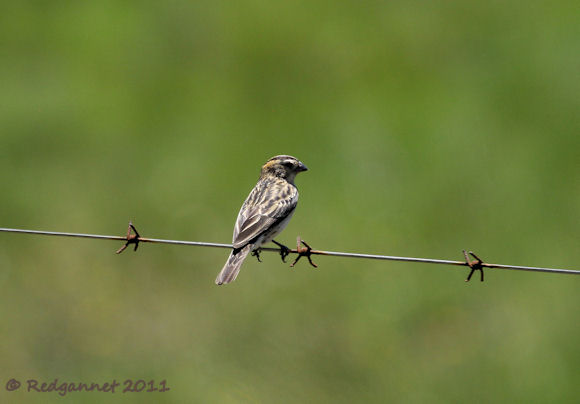
A couple of birds that do not appear on the resort’s bird list were also seen with a group of 4 European Golden Orioles, a Black-throated Canary and a very washed out European Roller noted. The Roller struck me especially as it was so pale.


Birds seen; 38
Cattle Egret 50, Jackal Buzzard 2, Rock Kestrel 1, Helmeted Guineafowl 6, Ringnecked Dove 60, African Palm Swift 3, African Black Swift 20, White-rumped Swift 6, European Roller 1, Rock Martin 2, Greater Striped Swallow 40, Cape Wagtail 2, Grey Cuckoo-shrike 1, Common Bulbul 6, Sombre Greenbul 2, Terrestrial Brownbul 1, White-starred Robin 1, Cape Robin-chat 2, Common Stonechat 8, Familiar Chat 2, Drakensberg Prinia 3, Bar-throated Apalis 3, Cape Grassbird 1, African Dusky Flycatcher 1, Greater Double-collared Sunbird 2, Cape White-eye 25, Eurasian Golden Oriole 4, Common Fiscal 8, Cape Crow 2, Pale-winged Starling 11, Red-billed Quelea 1, Yellow-crowned Bishop 40, Red Bishop 120, Yellow Bishop 4, White-winged Widowbird 3, Common Waxbill 3, Pin-tailed Whydah 2, Black-throated Canary 1.

There are more posts from Dullstroom and nearby sites at the links below;
http://redgannet.blogspot.com/2009/10/more-time-i-have-faster-it-goes.html

Visit the dedicated Africa Page for other sites near Johannesburg and for posts from elsewhere in South Africa and further afield on the Dark Continent.
Mount Sheba, South Africa, JNB

Saturday, 24 December 2011

Mount Sheba, South Africa, JNB, December 2011

I had some unfinished business to attend to in the Afro-montane forest of Mount Sheba, and found that I had a couple of hours of daylight left after exploring the grasslands of Dullstroom. The entrance to the resort (Google Earth ref; 24 53 15S 30 40 46E ) is about 30 minutes drive from Lydenberg and a further 10kms will find you at the hotel and resort buildings.


Here Cape White-eyes were very common in small feeding flocks. This young one was still being fed by its parents and looked cross that I should disturb them.

Greater Striped Swallows and Red-winged Starlings flew around the roofs and Common Bulbuls were easy to find.

I wanted to get into the forest and look for some birds which had eluded me on my previous visits here. The Orange-bellied Thrush, Blue-mantled Crested Flycatcher and Red-chested Cuckoo had all out-foxed me here before and I was keen to make up for that.  The cuckoo was immediately audible with its three clearly defined notes repeated constantly. Its Africaan’s name is an onomatopoeic ‘piet-my-vrou’ with a slight drop in pitch with each note. There were at least 4 birds calling, but I was completely unable to locate any of them. There are chalets in the grounds of the hotel and guests were obviously in residence. I chose not to impose on the guests’ privacy by going around the back of the chalets, though this may be acceptable if you know the chalet to be unoccupied.
Around the grounds of the resort, sympathetic plantings give home and harbour to African Dusky Flycatchers. The Greater Double-collared Sunbird is usually very common here, but I only noted a couple of females today.

A road leads into the forest below the hotel by passing chalet number 1. The ‘South African Birdfinder’ book recommends this as a good place to look for Narina Trogons. They could not have been more accurate if they had nailed the bird to its perch. Sadly the light was fading fast and the silhouetted photograph was as good a view as I had of this bird. It was not even possible to tell the sex, but the profile was very distinctive and I was able to enjoy another pair shortly afterwards in slightly better light.

My 3 target birds continued to elude me. An Olive Thrush made me look twice, but any day that you see 3 Narina Trogons is a good day nonetheless. It was dark as I reached the car and Jupiter was showing high and bright. On the western horizon Venus (I’m assuming) was also very obvious. The three stars, Sirius, Canopus and Rigel, described a huge triangle in the western sky and Orion hunted upside down as is his wont in the southern hemisphere.

I took a hand-held shot to nothing of Jupiter with its 4 Gallilean satellites showing and was a little shocked to get a result.
Birds seen; 14
Natal Francolin 4, Helmeted Guineafowl 6, Narina Trogon 3, Greater Striped Swallow 6, Common Bulbul 8, Sombre Greenbul 1, Olive Thrush 1, Chorister Robin-chat 1, Bar-throated Apalis 1, African Dusky Flycatcher 2, Cape Batis 2, Greater Double-collared Sunbird 2, Cape White-eye 25, Red-winged Starling 6.
There are more posts from Dullstroom and nearby sites at the links below;
http://redgannet.blogspot.com/2009/10/more-time-i-have-faster-it-goes.html

Visit the dedicated Africa Page for other sites near Johannesburg and for posts from elsewhere in South Africa and further afield on the Dark Continent. 
Mount Sheba, South Africa, JNB,

Friday, 23 December 2011

Dullstroom Grasslands, South Africa, JNB, December 2011

A journey into the mountain grasslands of Mpumalanga is just the tonic for a chap still suffering from the effects of the winter malaise. Two and a half hours from the OR Tambo International Airport at Johannesburg is a small town named Dullstroom and just beyond the town is a small road on the left marked to ‘Die Berg’ (Google ref; 25 22 21S 30 08 31E ). This unmade road crosses the railway line and enters a vast tract of grassland.

The journey had included a lot of common and widespread birds such as Hadada Ibis, Blacksmith Plover and Red Bishop, but the large part of the drive is on the motorway and it had not been possible to stop. The first opportunity I had to pull over came just beyond Belfast (on the R540) where a Long-crested Eagle perched on a telegraph pole.

The traffic on the unmade road into the grassland is very light, but please be aware that vehicles come round corners and over rises quickly and suddenly. Birds were seen as soon as I crossed the railway line with a White Stork and a Black-headed Heron in a newly mown field and Cape Canaries on the phone lines.


3kms on from the railway line is a rocky slope out to the left of the road. This often holds Malachite Sunbirds and Grey Rhebok may be seen here too. I stopped especially to scan the proteas on the hillside for Gurney’s Sugarbird. This is a spot recommended by the incredibly accurate ‘Southern African Birdfinder’ book and the sugarbird was one of my targets for the trip. The proteas are a bit distant from the road and I was unable to pick out a sugarbird on this occasion.
 

Further along on the right is a marsh created as waters from a dam on the left trickle into a dam on the right side of the road. Red Bishops, Yellow Bishops and Yellow-crowned Bishops can easily be found here along with the non-clergy birds such as Southern Bald Ibis, Red-billed Quelea and Red-collared Widow. All were sporting their magnificent breeding colours on this week before Christmas. The females however put in very little effort and remain dowdy throughout the festive season.

On the next bend, exactly as predicted by the ‘SAB’, a Buff-streaked Chat hopped amongst the rocks. From here-on-in the vista opened out and the wide expanses of grassland, strewn with rocks and wildflowers reached to the far horizons.


Mammals such as Blesbok, Common Duiker and Common Reedbuck were seen, but these animals do not enjoy any kind of protection from National Parks or sanctuaries and are truly wild and thus very shy.
There were cisticolas and pipits, but when faced with tricky birds such as these I often turn away and pretend that I haven’t seen them as to take the time to identify them correctly is not always an efficient way to spend a morning. A Long-billed Pipit stayed near enough and long enough for me to get a good look and an Orange-throated Longclaw was unmistakeable in the distance.


After about 17kms the unmade road rejoins the tarmac (R577) and I took the right hand option towards Lydenberg (Mashishing). A short way along here is another protea-studded slope that ‘SAB’ assured me would harbour my Gurney’s Sugarbird. There is a lay-by on the right where you could leave the car and walk down to the bushes on the gentle right hand curve at Google Earth ref; 25 14 02S 30 09 04E.
The sugarbird was not immediately obvious, but I could see protea flowers on these bushes which would exponentially enhance my odds of finding one. A cryptic-coloured shape in the shade of the furthest bush piqued my attention and after a few moments of trying to change it from a rock into something more exciting, it suddenly turned towards me with the big orange eyes of a Cape Eagle Owl.

There are protea bushes on both sides of the road and silhouetted in the top of one of these was the Gurney’s Sugarbird which was my main target for the trip. It then flew back to where it was supposed to be, according to the ‘SAB’, and enabled me to get a picture with two lifers in the frame.


From here it is possible to get to Lydenberg and from there you can access the attractions of Blyde River Canyon, Mount Sheba, or continue down to the lowveld and the Kruger National Park.

If you do not wish to return to Dullstroom by the route you came. Turn right onto the tarmac towards Lydenberg (Mashishing) and turn back into the grassland after 9.5kms, at the sign for Vermont. Stay right at junctions along this road and you will eventually regain the R540 about halfway between Dullstroom and Lydenberg. There are many B and Bs and places to stay in either town. I stayed at Klitz Gras chalets  (Google Earth ref; 25 06 48S 30 26 50E ) at the T junction on the approach to Lydenberg and can heartily recommend it. Klitz Gras is also a very popular European Swallow roost.


If you intend to hire a car in South Africa, please familiarise yourself with where you want to go as the car rental companies often do not supply maps or provide inadequate ones. CNA is a popular book and stationary store that sells good maps.
Petrol stations often don't accept credit cards and insist on cash.
Birds seen; 50
Little Grebe 3, Long-tailed Cormorant 2, Black-headed Heron 2, Cattle Egret 50. White Stork 1, Sacred Ibis 8, Southern Bald Ibis 3, Hadada Ibis 6, Glossy Ibis 8, African Spoonbill 4, Egyptian Goose 6, Spurwinged Goose 6, Common Buzzard 1, Jackal Buzzard 5, Long-crested Eagle 1, Helmeted Guineafowl 8, Red-knobbed Coot 30, Blacksmith Lapwing 8, Ring-necked Dove 25, Cape Eagle Owl 1, African Palm Swift 15, Little Swift 20, White-rumped Swift 60, Speckled Mousebird 1, Bank Swallow 1, European Swallow 250, White-throated Swallow 3, Rock Martin 2, Greater Striped Swallow 30, Long-billed Pipit 1, Cape Longclaw 3, Sentinel Rock Thrush 3, White-headed Black-chat 2, Common Stonechat 15, Dusky Flycatcher 2, Gurney’s Sugarbird 1, Common Fiscal 20, Cape Crow 1, Pied Crow 2, Common Myna 20, African Pied Starling 6, Mossie 4, Red-billed Quelea  4, Yellow-crowned Bishop 40, Red Bishop 12, Yellow Bishop 4, Red-collared Widowbird 15, Long-tailed Widowbird 20, Pin-tailed Whydah 5, Cape Canary 15.
Mammals seen;
Blesbok 20, Common Duiker 1, Common Reedbuck 2,

There are more posts from Dullstroom and nearby sites at the links below;
http://redgannet.blogspot.com/2009/10/more-time-i-have-faster-it-goes.html

Visit the dedicated Africa Page for other sites near Johannesburg and for posts from elsewhere in South Africa and further afield on the Dark Continent.
Dullstroom Grasslands, South Africa, JNB

Saturday, 5 February 2011

Crawling

This post is a copy of the 10000 Birds sumbission.

The ground is my friend. For someone who spends so much of his time in the air, the feeling of a secure surface comforts me as a mother's hug soothes a child.

Since becoming an adult I have maintained a respectable distance between me and the ground as befits a grown-up conforming to public dignity, but a recent aquaintance has caused me to reconsider my attitude and revert to the horizontal.

Jeannie loves to crawl. She crawls through the grass and the undergrowth, seeing things that are missed or trampled underfoot by the vertical adherents. It's a whole other world down here where the small things are. In the words of Sebastian the Crab (The Little Mermaid, Walt Disney) and as echoed by Jeannie, "Darlin' it's better, Down where it's wetter, Take it from me!"
Jeannie is possessed of a hunger to explore every last inch of her beloved Moreleta Kloof Nature Reserve, in Pretoria, South Africa and she finds that getting right down to it can reveal so much more than remaining upright. That's obvious, of course, but how many of us actually get down onto our bellies to inspect something from a different perspective? The last time I did, a concerned birder thought that I had collapsed and came across to check that I was OK!

Now you or I might be too concerned about public opinion to be caught with our behinds sticking out from a bush, or we may worry that our children will be bullied at school for having an eccentric parent (in fact, when I go out, my family insist that I leave all identification at home so that if I die doing something stupid, they won't have to suffer the indignity of being associated with me). This does not prey on Jeannie's mind however as she slithers and slides through the reeds of the wetland discovering new and exciting things every day. Her grandchildren take an active interest and even join in.
Moreleta Kloof is nearly 100 hectares of South African bush fenced off as a nature reserve. The kloof (cliff or escarpment) overlooks the reserve from the north-west. Rademeyerspruit (stream) runs along the base into a weedy vlei (dam) thence into the reed beds towards the north-east. The rest of the sanctuary is made up of grassland, scrub, riverine forest and protea hillside. Jeannie seems determined to wriggle inch and scramble her way through all the habitats and experience as much as the area has to offer.

The thought of what might be encountered in the South African leaf-litter from the viewpoint of an ankle causes me some reservations, but also adds an excitement that cannot be found at my fully drawn height. My imagination is running wild at the prospect of following Jeannie into the swamp where she immerses herself as deeply as she can into a place that she loves so passionately. Jeannie is usually covered in scratches from sliding through the undergrowth and ticks and leeches are her constant companions, but she still crawls enthusiastically into patches of bush that most of us miss with our staid "stick to the path" policy.
Please understand that I am not encouraging readers of this blog to abandon birding protocol and forget their values that respect creatures' rights to live undisturbed. Most reserves maintain a "stay on the path" policy because visitor numbers are high and the damage and disturbance caused by people leaving the tracks would be considerable; Jeannie is very lucky to have access to a very quiet wilderness where her impact is insignificant. She minimises her effect by following the trampled tracks of the zebra through the grassland, the Blesbok through the reeds and tiny antelopes called duikers make inroads into the bushes that allow her access there.
I realise that I may be burned at the stake for encouraging people to go off-piste, but I am convinced that anyone reading at this site has a sense of what is appropriate and where, when and how a path may be left. It may also be blasphemous to suggest that they might find anything other than birds while they are crawling, but what a world there is to see when you are knee high to a grasshopper.

I have committed myself to a crawling session with Jeannie on my next visit and I am very excited about it. If anyone else has tried it, leave a comment. If you want to try, please beware in public parks. I took a short walk on my local patch to assess the potential for crawling and found that human litter and dog faeces were probably the biggest obstacle to a good slither.

Start in your garden, then approach your local reserve to see if they would be amenable to such an idea. Perhaps put in a request for a ranger-led scramble to test the waters. The thought of getting down and dirty at this cold, wet time of year may not sound appealing, but a bit of ground work may need to be done first. My thoughts are that late summer, after the sensitive times of flowering and nesting are done, would be a good time for crawling, so make enquiries with this in mind.
Wouldn't it be great if we could all be as lucky as Jeannie? But there are other ways to experience the smell of humus in the morning. Local reserves are always looking for volunteers to join them on working parties. Getting involved in a session will often bring the participants closer to the ground than they would normally care to be found. Even sitting quietly, observing what happens in a tiny space can bring a real intimacy between the watcher and the watched. There are a group of people in the UK called 'meter watchers'. They mark out a square with sides of one meter in a garden or other habitat and watch it. Simple, but very rewarding I am told. Have fun and let me know how you get on.


Friday, 4 February 2011

Walter Sisulu Botanical Gardens

Follow the path into the gorge at Walter Sisulu (Witwatersrand) Botanical Gardens and there, beside the waterfall, you will see the eerie of the famous resident Black (Verreaux’s) Eagles. It is an enchanting place to be as the eagles wheel above and the Crocodile River begins its journey to Hartebeestpoort Dam.


There is a steep path and steps that leads up the side of the cataract and allows one to scale the kloof (cliff or escarpment) and reach the top of the falls. From here it is possible to look down on the eagles as they catch early morning air currents rising up the cliff-face. They have abandoned the top nest in favour of the privacy afforded by the lower one which cannot be seen from above. Notice boards requesting visitors not to throw stones at the eagles conjures dark theories as to why they prefer to be out of sight.


A path with a much shallower incline leads gently down through indigenous trees and scrub of the slope on the western side of the gardens. I would have used this one to scale the cliff if I had known. This was a productive area with Tawny-flanked Prinia, African Paradise Flycatcher and Speckled Mousebird. In the larger riverine trees at the foot of the path, a pair of Southern Boubou sang a sweet duet. There is a hide overlooking a small dam on the western side of the river.


A pair of African Black Duck roosted on a floating log at the dam and the inevitable weavers lent some colour to the scene. A path runs through the hide, but without exception everyone who passed through, including the children, were impeccably behaved. The board-walked wetland behind the dam had been drained and looks as though it may be due for renovation.


On a weekend morning the park was very busy from the get go. The aspiring classes from the Roodepoort neighbourhood between Johannesburg and Krugersdorp were picnicking. From 08.00 yummy mummies and driven daddies competed with each other to stake a claim to the prime picnic sites where they set up extravagant picnic parties for their offspring, which seemed to have coincidentally clashed with their networking parties. The cafe at the gardens does a very good breakfast.


It is a beautiful garden and would be well worth a visit on a weekday morning when you might do better than my pathetic list as below. The gardens open at 08.00 and an entrance fee of RSA 35 applies. It is ironic to note that the admission price causes an affluent demographic in the visitors book that would have saddened the anti-apartheid campaigner for whom the park is named. A list of the potential 220 birds which have been seen is available at reception.
Find the gardens at Google Earth ref; 26 05’ 13”S 27 50’ 52”E and visit the following website which gives a write up about the park and the eagles; http://www.joburg.org.za/content/view/353/188/  

Bird species; 28

Striated Heron 1, Sacred Ibis 6, Hadada Ibis 6, African Black Duck 2, Black-shouldered Kite 3, Verreaux’s Eagle 2, Helmeted Guineafowl 4, Red-eyed Dove 30, Ring-necked Dove 2, Laughing Dove 8, African Palm Swift 3, White-rumped Swift 5, Speckled Mousebird 1, Greater Striped Swallow 6, Cape Wagtail 1, Common Bulbul 25, Kurrichane Thrush 10, Cape Robin-chat 2, Tawny-flanked Prinia 4, Fiscal Flycatcher 2, African Paradise Flycatcher 1, Cape White-eye 2, Southern Boubou 2, Common Myna 10, Red-winged Starling 5, House Sparrow 10, Black-throated Canary 5, Yellow-fronted Canary 1.

Tuesday, 25 January 2011

Rondebult, Johannesburg, South Africa

You may question my motives for visiting Rondebult Bird Sanctuary when the wonderful reserve at Marievale is so close. Both are wetlands to the south-east of Johannesburg with extensive reed beds and similar species lists, but each has their own appeal. Rondebult for example is much smaller and therefore much more intimate than Marievale. Small patches of water among the reeds are each served by their own hide and the birdy action usually happens within easy reach of a decent telephoto lens. For a photographer, Rondebult can be very productive, but there weren’t any today, only me.

I collected keys to the hides from the security post (more accurately, a lady with headphones audible over the traffic, dozing in the shade) and proceeded into a small grassed area planted with trees. Domesticated geese and peacocks shared the lawns with Kurrichane Thrush and African Hoopoe. Large-billed Weavers mixed with Common Bulbuls in the trees.

At the first hide, the key fob matched the colour of the security gate that ensured exclusivity for bird watchers. Each hide was furnished with a gate and a separate key. The colour co-ordination was only coincidental on the first gate and I had to resort to trial and error for the others. In a country where personal security is a full-time consideration (and at a site where the security lady was deaf and asleep), being able to lock myself into a hide made for a very relaxing stay. I assume that there is more than one set of keys in case 2 birders have seperate agendas.
A small island in front of the hide held a family of Blacksmith Lapwings, Cape Sparrow and a Black Heron fishing with its characteristic umbrella technique which shades the water reflections and enables it to see its prey more easily.

The second hide was very close and looked out onto the same body of water. In the reeds, a Large-billed Weaver appeared to be trying to tie three stalks together as a base for its “finely woven oval nest” (Hugh Chittenden, Roberts Field Guide 2007). This nest is built by the male. The females’ involvement is limited to the soft interior furnishings. I assume therefore that this is a precocious immature male which looks very like the female until he attains his adult plumage.
Out on the water, Red-knobbed Coots were the most populous bird with Egyptian Goose and Dabchick adding a little variety.

The most conspicuous birds were the colourful weavers. Southern Masked Weavers, Southern Red Bishops and Yellow-crowned Bishops are obvious and abundant near any water during the austral summer.
Rondebult provides them with everything that they need; reeds and water, therefore a constant chizzing and wheezing of performing males provided the sound track for the morning. The third hide opened onto a tract of long grass before the water. Weavers were collecting seed heads and carrying them away rather than feeding on them there and then, so the assumption here is that this female Southern Masked Weaver had selected a likely male and was lining his nest.
But even the combined colonies of gregarious weavers were outnumbered by a large roost of European Swallows in the reeds opposite the fourth hide. I guessed at about 200-300 until something disturbed them and the hirundine cloud that erupted from the reeds must have numbered 1000+. A Little Bittern went up with them and ‘quarked’ across the water to hide further along.

A couple of ducks dropped in for a quick visit. The Red-billed Teal swam out of sight around the corner while the Fulvous Whistling-Duck took one look and was gone.
I left the remaining hides until my next visit. I had arrived at 10.00 and had lost myself to the day very quickly. Since Marievale was so close, it seemed the perfect opportunity to compare them under the same conditions. Neither would really get a good chance to shine during the heat of the day, but such is the lot of a birder who must conform to airline schedules (my plane had not landed until 08.30 and I had been very lucky to disembark, hire a car and get into a hide by 10.00. The airport is south-east of Johannesburg and our hotel is to the north of the city. It makes sense and saves time and mileage to bird the reserves to the south straight from the flight).

Bird species; 41

Southern Ostrich 2, Little Grebe 2, Long-tailed Cormorant 6, Black Heron 2, Cattle Egret 8, Little Bittern 4, Yellow Stork 1, African Sacred Ibis 4, HadadaIbis 12, Glossy Ibis 15, Fulvous Whistling Duck 2, Egyptian Goose 12, Yellow-billed Duck 8, Red-billed Duck 1, Amur Falcon 2, Common Moorhen 3, Red-knobbed Coot 30, Blacksmith Lapwing 8, Grey-headed Gull 120, Red-eyed Dove 4, Ring-necked Dove 6, Red-faced Mousebird 2, European Swallow 1000, Greater Striped Swallow 10, Cape Wagtail 2, Common Bulbul 10, Kurrichane Thrush 2, Levaillant’s Cisticola 4, Zitting Cisticola 2, African Reed Warbler 8, Common Fiscal 3, Common Myna 30, Cape Glossy Starling 2, House Sparrow 20, Mossie 4, Southern Masked Weaver 25, Yellow-crowned Bishop 25, Southern Red Bishop 30, Large-billed Weaver 8, Yellow-fronted Canary.

Saturday, 4 September 2010

Pilanesberg, Johannesburg, JNB, South Africa

I had company with me this morning in the shape of my colleague, HG. We had come to Pilanesberg NP and arrived just before 07.00.
Immediately inside the gate we came across a small herd of Brindled Wildebeest, closely followed by our first B5 animals of the day.
A group of White Rhinoceros, made up with a mature female, two immatures and a small calf, were grazing right beside the road. The smallest calf was jealously guarding his mother and his milk supply. We surmised that the two immatures may have been his big sisters and that sibling rivalry was the cause of the calf’s boisterous behaviour. He was butting his big sister, who was being very indulgent and gently playing along.
Just beyond them, a lark took off from a raodside snag as we passed. The clapping sound it made as it flew left me with only one choice, an Eastern Clapper Lark. I would have loved to get a better look at a red crayon bird, but I am happy with the ID.
We followed the main road through the park, heading north from Bakubung Gate and soon found two young male giraffe vying for dominance over each other. They were swiping at each other, swinging their necks and trying to hit their opponent with their head. This was not a full-blooded fight for mating rights; these males were still fairly young. They were trying to establish their place in the pecking order for the future.
The expected animals were plentiful today. There were herds of Impala and Wildebeest with an occasional Hartebeest added in for good measure.
Birds were well represented (this is supposed to be a bird blog after all). Lesser Striped Swallows were slow to move from their roost this morning, which gave me a good opportunity. Actually, this picture may have been taken by H, who had a better angle from the passenger seat.
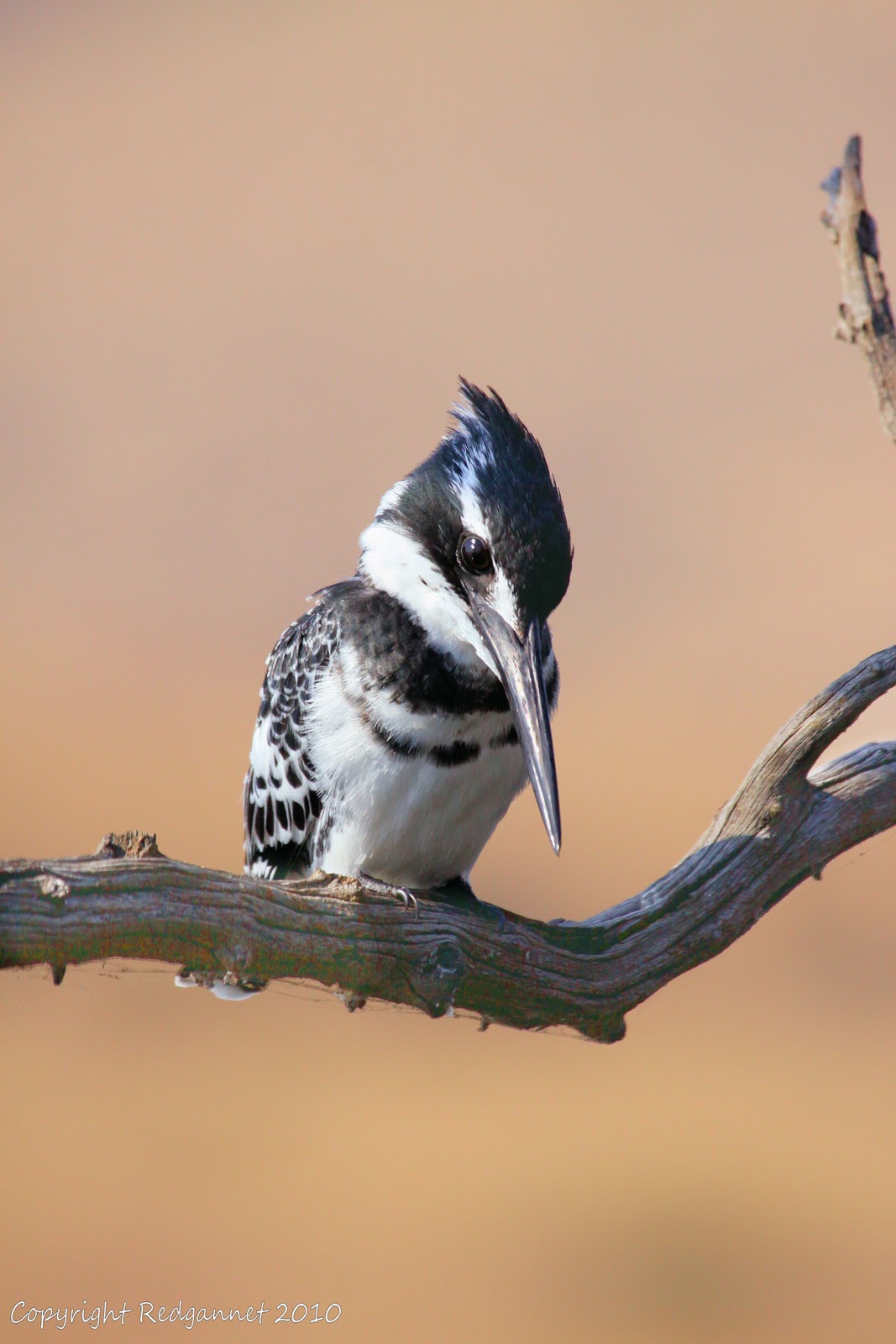
We headed for the hide at Mankwe Dam and spent a while there enjoying the Pied Kingfishers and a herd of Wildebeest that came down to drink.
The birds on the approach and around the car park were very confiding with a White-browed Scrub-Robin posing beautifully on a post and Natal Francolin calmly walking round the car.
We had noticed a few cars that had stopped on the other side of the dam and went to investigate. They were watching some Hippo that had hauled up and were huddled together in a big brown blob on the bank.
Another cluster of cars gave away the presence of six more White Rhino, while just a little further up the road towards Manyane, a waterhole held good numbers of Wildebeest and some Zebra. 
I wanted to try to find a different approach to taking Zebra pictures, but when three lined up at the water, I was willing a fourth to fill in the gap, which it obligingly did.
As we headed towards the Pilanesberg Centre for breakfast, we noticed a few Safari tour vehicles all heading in the same direction. This is usually a good sign that something interesting is going on. Thus we postponed breakfast and followed. Sure enough a herd of elephant were feeding at the roadside on the way to Mankorwe Dam. The matriarch seemed very calm and patient with the other vehicles, so we were able to make a very close approach. She had a small calf with her which seemed quite at home with the attention it was getting.
The Pilanesberg Centre was quiet for our late breakfast, but the view from the deck was as busy as I have ever seen it.
Wildebeest, Zebra, Impala and Giraffe were joined by Springbok and Black-faced Vervet Monkeys as we ate.The birds here were perfect models as they posed on a post in front of the veranda.
A Fork-tailed Drongo was keen to show off his elegant black plumage set off by his dramatic red eye, but was closely challenged by a Southern Masked Weaver, which preferred to complement his eye with a yellow outfit.  
Unable to compete with such stylish competition, the Common Bulbul resorted to a coquettish posture to attract attention.
Breakfast was good and we were reluctant to leave, but grapevine reports held news of lions along Dithabaneng.
As we neared Maletse Dam, a fine male Common Waterbuck showed on the rocky slopes to the south. H had dozed off in the back of the car and could not get enthused until we came across the lion hunkered down amongst the rocks, watching a group of Zebra. He stalked slowly towards them, but any action was likely to take place over the rise in front of him. We pulled forward to a point where we could see the Zebra, but not the lion. Here we waited for about 40 minutes before realising that the lion had lost interest and gone for a snooze in the shade. There were rumours of a kill closeby and the lions looked well fed. This may explain why Black-backed Jackals were hanging about.
I pulled back to the dam where some hippos were sunbathing on the far bank. About 30 meters to the left was an elephant carcass, on top of which sat an African White Ibis. We returned to this spot a short while later to watch 2 bull elephants as they came across the body.
Their reactions and behaviour was very touching and it is easy to see how they can be credited with emotions such as sadness and loss, that we humans usually use as a yardstick to separate ourselves from the animals.
As other vehicles arrived we pulled away to avoid the crush. We returned to the lion 200meters along the road. It was buried deep in the bushes and was hard to find. Once we had found it, I noticed a second lion alongside it.
H put forward a thought that when lions yawn, it is a sign that they are about to move. This was not something that I was aware of, but as we watched, one of the lions yawned, then stood up and began making his way towards us. I hoped that it was headed for the water, so I reversed the car to give it the opportunity to cross in front of us. Instead, it continued along the road and must have caused a few heart-stopping moments as it passed between the cars that had stopped to look at the elephants.
It skirted around the western end of the dam. After a brief confrontation with one of the elephants, it began feeding on the elephant carcass.
Unbeknown to most of the other cars in the watching scrum, a second young male lion was approaching from behind them and went to join his brother but did not feed. I did some searching on the internet and found that the carcass had been there since at least 29th June, nearly 2 months before.
A more detailed description of the above incident is written up on the previous post. Follow the link; http://redgannet.blogspot.com/2010/08/do-elephants-grieve.html
The journey out of the park could not live up to the excitement that we had already experienced through the day, but H managed to get this picture of a Warthog doing his "Best in Show" pose.

Bird species 61;

Little Grebe 6, White-breasted Cormorant 6,Long-tailed Cormorants 15, African Darter 3, Grey heron 2, Great Egret 1, Little Egret 1, Striated Heron 2, Sacred Ibis 1, Hadada Ibis 1, African Spoonbill 12, Egyptian Goose 5, Black-shouldered Kite 3, African Fish Eagle 1, Black-breasted Snake Eagle 1, Crested Francolin 5, Natal Francolin 15, Swainson’s Francolin 8, Helmeted Guineafowl 40, Blacksmith Lapwing 5, Crowned Lapwing 6, Caspian Tern 1, Speckled Pigeon 6, Red-eyed Dove 5, Ring-necked Dove 12, Laughing Dove 10, Grey Lourie 4, Burchell’s Coucal 1, African Palm Swift 10, Red-faced Mousebird 4, Brown-headed Kingfisher 2, Malachite Kingfisher 2, Pied Kingfisher 15, Southern Yellow-billed Hornbill 1, Crested Barbet 1, Black-collared Barbet 2,Rufous-naped Lark 1, Namaqua Clapper Lark 1, Pearl-breasted Swallow 1, Lesser-striped Swallow 25, Cape Wagtail 3, Common Bulbul 35, Olive Thrush 1, Groundscraper Thrush 1, Mocking Cliff-chat 1, White-throated Robin-chat 1, White-browed Scrub-robin 4, Familiar Chat 4, Capped Wheatear 5, Tawny-flanked Prinia 2, Mariqua Flycatcher 15, Chinspot Batis 1, Arrow-marked Babbler 4, Southern Boubou 1, Crimson-breasted Gonolek 3, Fork-tailed Drongo 20,Pied Crow 20, Cape Glossy Starling 10, Red-billed Ox-pecker 3, Southern Masked Weaver 6, Yellow-fronted Canary.

Mammal species; 19

Vervet Monkey 6, Baboon 35, Scrub Hare 1, Black-backed Jackal 3, Lion 2, Elephant 11, Zebra 100, White Rhinoceros 13, Warthog 12, Hippopotamus 18, Giraffe 30, Bushbuck 2, Greater Kudu 15, Waterbuck 20, Red Hartebeest 6, Gnu 800, Impala 250, Steenbuck 6, Springbuck 100.

Pilanesberg, Johannesberg, JNB, South Africa


For other Pilanesberg posts on Redgannet try the following;
http://redgannet.blogspot.com/2010/08/do-elephants-grieve.html
http://redgannet.blogspot.com/2009/06/delicious-dilemma.html (Marievale, Pilanesberg NP and Rietvlei Nature Reserve)

For more posts from Johannesburg,try these links;
http://redgannet.blogspot.com/2010/08/moreletakloof-johannesburg-jnb.html (Moraletakloof)
http://redgannet.blogspot.com/2010/08/tswaing-crater-johannesburg-jnb-south.html (Tswaing Crater)
http://redgannet.blogspot.com/2010/03/zaagkuildrift-road-jnb-south-africa.html (Zaggkuildrift Road)
http://redgannet.blogspot.com/2009/10/more-time-i-have-faster-it-goes.html ( Marievale, Dulstroom, Mount Sheba and Kruger NP)

There are other posts from South Africa here;
http://redgannet.blogspot.com/2010/01/cape-town-specials.html (Cape Town, Heldeberg, Paarl, Sir Lowry's Pass and Betty's Bay)

Other posts from the great continent of Africa;
http://redgannet.blogspot.com/2010/04/to-pish-or-not-to-pish-dire-warnings.html (Lekki Conservation centre, Lagos, Nigeria)
http://redgannet.blogspot.com/2010/05/sheraton-hotel-lagos.html (Lagos, Nigeria)
http://redgannet.blogspot.com/2010/05/millenium-park-abuja-nigeria.html (Millenium Park, Abuja, Nigeria)
http://redgannet.blogspot.com/2009/03/my-trip-this-weekend-is-scheduled-to-be.html (Nigeria)
http://redgannet.blogspot.com/2010/01/even-bad-days-are-good.html (Achimota Forest, Labadi Beach, and Aburi Botanical Gardens, Accra, Ghana)

Dragonfly posts are available at;
http://redgannetsdragonflies.blogspot.com/2010/01/cape-town-south-africa.html (Cape Town)
http://redgannetsdragonflies.blogspot.com/2010/01/i-have-been-languishing-in-temperate.html (Accra, Ghana)
Bird species 61;

Little Grebe 6, White-breasted Cormorant 6,Long-tailed Cormorants 15, African Darter 3, Grey heron 2, Great Egret 1, Little Egret 1, Striated Heron 2, Sacred Ibis 1, Hadada Ibis 1, African Spoonbill 12, Egyptian Goose 5, Black-shouldered Kite 3, African Fish Eagle 1, Black-breasted Snake Eagle 1, Crested Francolin 5, Natal Francolin 15, Swainson’s Francolin 8, Helmeted Guineafowl 40, Blacksmith Lapwing 5, Crowned Lapwing 6, Caspian Tern 1, Speckled Pigeon 6, Red-eyed Dove 5, Ring-necked Dove 12, Laughing Dove 10, Grey Lourie 4, Burchell’s Coucal 1, African Palm Swift 10, Red-faced Mousebird 4, Brown-headed Kingfisher 2, Malachite Kingfisher 2, Pied Kingfisher 15, Southern Yellow-billed Hornbill 1, Crested Barbet 1, Black-collared Barbet 2,Rufous-naped Lark 1, Namaqua Clapper Lark 1, Pearl-breasted Swallow 1, Lesser-striped Swallow 25, Cape Wagtail 3, Common Bulbul 35, Olive Thrush 1, Groundscraper Thrush 1, Mocking Cliff-chat 1, White-throated Robin-chat 1, White-browed Scrub-robin 4, Familiar Chat 4, Capped Wheatear 5, Tawny-flanked Prinia 2, Mariqua Flycatcher 15, Chinspot Batis 1, Arrow-marked Babbler 4, Southern Boubou 1, Crimson-breasted Gonolek 3, Fork-tailed Drongo 20,Pied Crow 20, Cape Glossy Starling 10, Red-billed Ox-pecker 3, Southern Masked Weaver 6, Yellow-fronted Canary.

Mammal species; 19

Vervet Monkey 6, Baboon 35, Scrub Hare 1, Black-backed Jackal 3, Lion 2, Elephant 11, Zebra 100, White Rhinoceros 13, Warthog 12, Hippopotamus 18, Giraffe 30, Bushbuck 2, Greater Kudu 15, Waterbuck 20, Red Hartebeest 6, Gnu 800, Impala 250, Steenbuck 6, Springbuck 100.

Pilanesberg, Johannesberg, JNB, South Africa