Showing posts with label Chicago. Show all posts

Wednesday, 26 February 2014

Lincoln Park Zoo, Chicago, Feb 2014

Poor weather conditions kept me from getting too ambitious this week. A fresh fall of snow delayed us into Chicago as the airport closed and we had to circle while they cleared the runways. But I had confidence in the American way of dealing with snow and headed out early the next morning to Lincoln Park. Sure enough a path, just beyond the farm on Stockton Drive, had already been cleared and the sound of snow-clearing equipment filled the air. It was a beautiful bright morning and not too cold, a great day to be out.
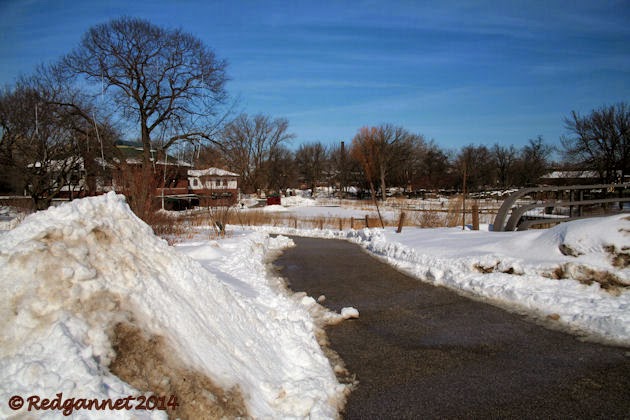

The path took me across a bridge that spans the South Pond at Google Earth ref; 41 55 5.45N 87 37 59.36W A display suggested that somewhere beneath the snow was a boardwalk, but this would have to wait for another day as the snow clearance was concentrating on the main pathways for now. I was surprised to suddenly find myself in a zoo and felt rather furtive, having got in without having to pay an entrance fee. I felt slightly cheated later on, discovering that Lincoln Park Zoo does not charge for entry! 


The birds were slow to start this morning, but a small pond with a tiny area of open water provided a waterfowl spectacle as a zoo attendant fed the Whooper Swans. Amongst the Mallards were a few Wood Duck, Pintail, Common Goldeneye, Ruddy Duck and Hooded Mergansers


The Whooper Swans were clearly resident at the zoo and the Mallard were flying in from the lake, but I had to ask about the others and found that only the “freeloaders”, i.e. the Mallards, were countable. Apparently one or two of the Hooded Mergansers were wild, but which ones?


The keeper suggested that I should try the Childrens’ Zoo which was more wooded and had the added attraction of Wolves and Otters. The wolves were chasing about in the snow and the otter slid around its enclosure obviously loving the snow! Black-capped Chickadees, Northern Cardinal and an American Goldfinch were seen along this section, but it was not proving to be a great birdy day.


Since there was a Polar Bear pool and an Aviary, I became a little distracted and didn’t concentrate much on the birds after the exhibit houses opened at 10.00. 


The Polar Bear was very animated, playing in the water, chasing a sinking ball and trying to nick my gloves through the glass of the underwater window.


The Africa walk-through exhibit was interesting if a little sad, but the aviary had a large fly area which took my mind off the smaller enclosures leading up to it.


Bird List for Lincoln Park Zoo; 9

Red-breasted Merganser 2, Mallard 200, Downy Woodpecker 1, American Crow 20, American Robin 8, Black-capped Chickadee 5, Northern Cardinal 3, House Finch 5, House Sparrow 60

Lincoln Park Zoo was chosen for its clear paths on an otherwise “wading through the snow” sort of a morning. All the paths through the zoo were clear by 10.00. Bus number 151 runs along Chicago’s Miracle Mile and through Lincoln Park on Stockton Drive. The journey takes less than 15 minutes and costs US$2.25.

Saturday, 27 April 2013

Magic Hedge, Chicago, April 2013

How ironic that the boomerang route is lost, but the Chicago has come back! Australia is now to be serviced by our new colleagues while the passengers to and from Chicago will benefit from many, many years of experience as the heritage crews return to the service.


By way of a celebration, I organised a play date with Meredith Matthews, who has recently joined us at 10,000 Birds. We met at 07.00 at Montrose Point and immediately set about looking for warblers at the Magic Hedge (Google Earth ref; 41°57'46.00"N 87°38'4.00"W). Sadly the weather had not been favourable for migrating warblers until this morning and I guess they had a long way to come to reach us. Nevertheless, there were still plenty of birds around with 39 species seen by the end of the morning.

American Robins and Red-winged Blackbirds were very common as were the aptly described Common Grackles. A bird that we took to be a young male Red-shouldered Blackbird was singing and displaying. He would have had plenty of competition from adult males in breeding colours, but he was enthusiastic just the same.

A Brown Cowbird flew into the tree above us and looked very cross as he displayed for his accompanying females. Despite the lack of leaves, there was still plenty of activity to indicate that spring was on its way. Grackles and blackbirds were building nests. It pays to be wary here once the nests are occupied as the residents become very protective, Meredith related.

We took a look through the dunes and along the shoreline noting Caspian Tern and a Killdeer. Out on the water a few Red-breasted Merganser were seen. Ring-billed Gulls and a couple of Herring Gulls roosted on the shoreline.

Back at the hedge, we were hoping that a few migrants may have started to arrive, but mostly we found Sparrows and Northern Cardinals. Sparrows were well represented today with 6 species. 8 if you try to jemmy Eastern Towhee and Dark-eyed Junco into the family.

Meredith stayed with me for a couple of hours before having to return to work, but I still had a while before I had to start back. I was headed for the Splish Splash bird bathing spring when I came across a squirrel which had found a discarded peanut butter jar. It was determined to lick it clean, but could not quite reach the bottom of the jar.

The spring was well attended by robins, blackbirds and grackles and I caught a few pictures as they sploshed about in the water. I managed to get enough for a 10,000 Birds post, but couldn’t work the lyrics of Sweet Home Chicago into it. Hidehay.

Canada Goose 8, Mallard 10, Red-breasted Merganser 18, Double-crested Cormorant 20, American Coot 1, Killdeer 2, Ring-billed Gull 25, Herring Gull 3, Caspian Tern 2, Mourning Dove 6, Belted Kingfisher 1, Yellow-bellied Sapsucker 3, Downy Woodpecker 3, Northern Flicker 8, American Crow 15, Northern Rough-winged Swallow 2, Purple Martin 14, Tree Swallow 4, Barn Swallow 6, Black-capped Chickadee 6, Ruby-crowned Kinglet 3, Hermit Thrush 6, American Robin 40, Brown Thrasher 5, European Starling 15, Yellow-rumped Warbler 5, Eastern Towhee 5, Chipping Sparrow 20, Field Sparrow 8, Savannah Sparrow 2, Song Sparrow 8, Swamp Sparrow 6, White-throated Sparrow 1, Dark-eyed Junco 3, Northern Cardinal 10, Red-winged Blackbird 40, Common Grackle 60, Brown-headed Cowbird 5, House Sparrow 10.
Still trying!

Bus 146 runs along the Miracle Mile, North Michigan Ave. It leaves downtown and heads north along the lakeside on Lake Shore Drive. It does not stop along Lakeshore Drive, until it pulls off onto the parallel N Marine Drive. Jump off at West Montrose Ave and turn right, (east) under Lake Shore Drive. The walk to and from The Hedge can be quite productive. There were plenty of sparrows in the rough, regenerating prairie and I was pleased to see that the Purple Martins had returned to their nesting boxes at the edge of the harbour. Measuring in a straight line from Navy Pier in Downtown Chicago to W. Montrose Drive is 8.7kms about 15 – 20 mins on the bus.

For previous posts from the Magic Hedge, clink on the link below;
http://redgannet.blogspot.co.uk/2011/09/magic-hedge-montrose-point-chicago-sept.html

Visit the dedicated USA and Canada Page for more posts from Chicago, including Meigs Field.

Monday, 19 September 2011

The Magic Hedge, Montrose Point, Chicago. Sept 2011

From a few honeysuckles planted outside the ground floor windows of a US Army barracks, the Magic Hedge (Google Earth ref; 41 57 46N 87 38 04W) has developed into one of Chicago's foremost birding locations and probably the most famous along the Chicago Lakefront Birding Trail.
The barracks have long since gone, but the hedge has been enhanced and given protected status since its humble beginnings.
I took the long way in this morning, stepping from the bus (no. 146) at N. Lake Shore Drive and W. Addison. The underpass comes out at Bill Jarvis Migrant Bird Sanctuary (Google Earth ref; 41 56 57N 87 38 29W). Signs stating that the sanctuary closes at dusk imply that it must open at some point, but in fact, it does not.


The mowers were already cutting when I arrived just after 07.00, but I could see plenty of bird activity as I approached and the butterflies were up early too. This one is a Buckeye.
Swainson's Thrushes were very common this morning with Ruby-throated Hummingbird, Ovenbird and Wilson's Warbler also seen along the fence line.


There is a viewing platform on the lake side of the reserve and I arrived here just as a small party was passing through. Red-eyed Vireo, American Redstart and Magnolia Warblers flitted through the trees while Grey Catbirds gorged on berries from the elder bushes.
The walk along the lake-front past the church and the golf course was lined with beautiful blue cornflowers which had taken over from the thistles. Palm Warblers, American Goldfinches and an unidentified empidonax flycatcher were seen along the path.


Another bird party greeted me as I arrived at the hedge. Cedar Waxwings flew over while a Black and White Warbler, Palm Warbler and a Chestnut-sided Warbler passed through.


A  young Red-headed Woodpecker called from a large tree. It sported just a few specks of red on its dark juvenile head.
The American Redstarts rivalled the Swainson's Thrushes for the most sightings today with the highest numbers coming from the Ring-billed Gulls and overflying Cedar Waxwings.
There were good numbers of birds, but not a great variety, so I moved on to take a look at the dunes by the pier.


Another birder was working the line of bushes close to the water and I was benefitting from the birds that she flushed, adding Northern Flicker to pad out my day list. Palm Warbler were common here again with yet another empid evading identification. I am sorry, but I just do not have the skill required to separate them without their song.


Along the beach, mats of soggy weed covered the beach. Sanderlings and a Semipalmated Plover found rich pickings there.


A whining screech had been vying for my attention for a while and I turned my attention to the tower where a young Peregrine Falcon was complaining hungrily to one of its parents who was tucking into what, until 20 minutes before, had been a Flicker.


Occasionally the youngster would take a turn around the dunes, putting the Sanderlings to flight even though it was not making a serious attempt to catch anything. Perhaps the parent bird was purposefully witholding from the juvenile to encourage it to put more effort into catching something (PS in the photo below indicates that I have taken liberties with the placement of the birds in the picture).


I had bumped into a few birders through the day, but hadn't joined up with anyone until I bumped into Clara and Mike who made interesting companions until they had to move on.


Back by the hedge, Monarch Butterflies were sipping nectar from the sunflowers and I noticed that one of them was wearing an identification tag. Its identification code was PLT 226 and the actual date of the sighting was 12 Sept 2011. I sent an email to Monarch Watch tag@ku.edu hoping to have a little more information to pass on about this individual. I have not received acknowledgement of receipt, so if anyone can make sure that the sighting information gets to the right place, I would be grateful. Thank you.


The sunflowers were also attracting American Goldfinches. The birds were exerting a lot of effort to extract the seeds from the unripe heads.


Band-winged Meadowhawk, sat quietly for a picture and allowed a very close approach.


Bus no. 146 passes through Chicago, stopping regularly along the Magnificent Mile. Alight at W. Addison to visit Bill Jarvis Migrant Bird Sanctuary. To go straight to the hedge, stay on until Montrose Dr and head towards the lake after alighting. To return from the Magic Hedge, follow West Montrose Dr back under the North Shore Dr Freeway and a bus stop will be seen on the corner of West Montrose and North Marine Dr at Clarendon Park.


Species seen; 37
Double-crested Cormorant 6, Canada Goose 60, Mallard 15, Cooper’s Hawk 1, Peregrine Falcon 2, Semipalmated Plover 2, Sanderling 8, Ring-billed Gull 120, American Herring Gull 3, Mourning Dove 8, Chimney Swift 1, Ruby-throated Hummingbird 3, Red-headed Woodpecker 2, Northern Flicker 1, Eastern Wood-Pewee 2, Eastern Kingbird 2, American Barn Swallow 30, Cedar Waxwing 150, Grey Catbird 6, Swainson’s Thrush 50, Carolina Chickadee 2, American Crow 4, Common Starling 40, Red-eyed Vireo 1, Tennessee Warbler 1, Chestnut-sided Warbler 2, Magnolia Warbler 4, Palm Warbler 25, Black and White Warbler 6, American Redstart 30, Ovenbird 4, Northern Waterthrush 2, Common Yellowthroat 2, Wilson’s Warbler 1, Song Sparrow 3, Northern Cardinal 3.
For a previous post from Chicago, follow the link below;
Visit the dedicated USA and Canada page for posts from this vast continent.


Tuesday, 2 June 2009

Dickcissels and Bobolinks

Meigs Field used to be an airfield on an island just south of downtown Chicago. The Mayor caused quite a furore when he shut it down overnight and the concierge was obviously still put out about it while pointing it out to me on the map.
Although the due processes may not have been followed, I still maintain that it looks better as a nature reserve than as an airfield.

G.L. had given me some specific directions and instructions. G had told me that he had previously seen Dickcissel there, so I was on a twitch.The weather was dreadful, but it was only a 15 minute cycle ride from the hotel and a small search area. An easy lifer, what could be better? But the weather quickly took a turn for the worse. Even though it was raining when I left the hotel, it was still reasonably warm. This didn't last long. Suddenly a cold wind picked up and the temperature fell quickly. The wet and the wind was making it very uncomfortable, but at least the wind was behind me and was blowing me along.
I turned onto Northley Island by the observatory and continued South, passing Soldier Field Stadium over on the mainland. My instructions were to search the loop at the far end of the island where there was a small, managed prairie. This area is quite exposed and the wind was pressing much of the vegetation close to the ground. Big white-crested waves were forming on the lake and it was becoming very cold.
For no special reason, I elected to go anticlockwise around the loop. A large sparrow-like bird was obeying his instinctual directive and, trying to cling to a stalk, was calling for a mate. I admired his determination but did not give much for his chances in these conditions. If I tried that at home, my wife would make rude gestures through the window, but would not be tempted outside. It was a Bobolink male in his full breeding regalia of pale crown and nape with matching patches in the wings. A non-breeding bird nearby would occasionally launch itself into the teeth of the gale and be whisked away downwind. The breeding bird would react to his breeding imperative again and chase after it. Like a airborne dogfight, he followed the jinks and turns of the other bird in front then banked sharply like a Spitfire peeling off from formation and was sucked away by the the storm. Having chased off the lesser bird, he dragged himself back up-wind to start his singing over again. I did not even bother to take the camera out of the bag. I was shivering by now and the results would have been worthless. The pictures here were taken the next morning when things had brightened up a bit.
Further around the loop in exactly the place G had described, I heard the call that I had been listening out for. Now I was at the most southerly point of the loop and was looking back up the island, into the wind. The bird, I suspect, was turning his head as he called causing a ventriloquial effect and combined with the wind, this was making him very difficult to pinpoint. Eventually, I managed to triangulate his position by moving up and down the path, changing my perspective. It was indeed a Dickcissel trying to stay low, beneath the wind, but still compelled by the need to breed. He was clinging to a madly waving flower stem, looking splendid in his yellow vest and black cravat, singing to attract a mate.The wind that had been behind me on the way down was now against me. Nearly 45 minutes later, I reached the hotel sodden and shivering.
Storms were predicted for the next morning, so I lay in and later met with some colleagues for breakfast. By 10.00 it was looking as if the meteorologists had got it wrong, so I took a quick ride back to Northerley Island to see if I could get some photos to illustrate this post. It would be a shame to find 2 lifers and have no pictures to show for them.
It was still windy. Well it is Chicago, but it was much brighter and I was able to get some photos. There were Red-winged Blackbirds and Savannah Sparrows calling from the flower stems. They were quite approachable but the Dickcissel and Bobolink stayed obstinately distant. To add to the Northerly Island list I found Spotted Sandpiper, Blue Jay and Eastern Kingbird.
Thanks once again to G.L. for the information.


Species List
Canada Goose 200, Mallard 4, Ringbilled Gull 200, Killdeer 2, Spotted Sandpiper 1, Barn Swallow 12, Cliff Swallow 1, Northern Roughwing Swallow 6, Eastern Kingbird 2, American Robin 4, Blue Jay 1, House Sparrow 4, Starling 15, Savannah Sparrow 12, Dickcissel 3, Bobolink 2, Common Grackle 2, Red-shouldered Blackbird 20.