Showing posts with label Cape Town. Show all posts

Saturday, 8 February 2014

Kommetjie, Cape Town, Feb 2014

Kommetjie is a charming, coastal village on the west of the peninsula, south-west of Cape Town. It is noted for its expanses of rock tables that are exposed at low tide and as a roosting spot for gulls and terns.


I parked by the protected green area in the middle of the village. Barn Swallows swooped over the grass and a Black Goshawk was escorted from the area by a flock of European Starlings. I had not consulted my map very well and had started further north than I had intended. It was a very pleasant walk just the same and I would have missed the White-fronted Plovers if I had started further on.


Wide expanses of rock had been exposed as the tide withdrew. Mats of loose kelp rested on the rocks and had been washed up onto the shell-strewn beach. Great Cormorant, Cape Cormorant and Crested Cormorant were seen in small numbers, but I suspect that they would be more common at different times of the tide.


The mats of kelp and rock tables leave calm water and rock pools close to shore. Black Oystercatcher, Cape Wagtail, Sacred Ibis and Little Egret picked around the weedy rocks and in the sheltered pools.


A car park overlooks a large pool at Google Earth ref; 34 8 27.94S 18 19 21.87E. A roost here contained Swift Terns, Sandwich Terns and Hartlaub’s Gulls. A Black Oystercatcher flew in to add a brief bit of colour with his flashing red bill.


Hadada Ibis were seen here also as they watched over the roost from a higher vantage. I was surprised at the number of birds seen that I normally associate with fresh water or drier habitats. Blacksmith Plover and Common Fiscal were other unexpected coastal visitors.


My big disappointment of the day was a picture that didn’t quite work. Cape Gannets flew low over the edge of the tide, skimming the face of the waves, shearwater style. As the waves began to crest, they peeled off and banked over the top and back down onto the face of the next incoming wave. It would have made a glorious picture, but it was slightly misty and everything just came out insipid and grey. Great to watch though!


Bird list for Kommetjie;

Egyptian Goose 5, Helmeted Guineafowl 1, Cape Gannet 80, Great Cormorant 6, Cape Cormorant 2, Bank Cormorant 1, Crowned Cormorant 2, Grey Heron 1, Little Egret 4, Sacred Ibis 20, Hadada Ibis 8, Jackal Buzzard 1, Black Goshawk 1, Rock Kestrel 1, Blacksmith Plover 4, White-fronted Plover 2, African Oystercatcher 8, Whimbrel 1, Grey-hooded Gull 1, Hartlaub’s Gull 120, Kelp Gull 20, Sandwich Tern 40, Great Crested Tern 180,Speckled Pigeon 3, Alpine Swift 1, African Swift 4, Common Fiscal 4, Barn Swallow 80, Karoo Prinia 1, European Starling 80, Red-winged Starling 20, Cape Wagtail 30.


Visit the dedicated Africa Page for more posts from Cape Town, including; Kirstenbosch Botanic Gardens, Intaka Island and Paarl.


Birding, birdwatching in Cape Town, South Africa 

Thursday, 6 February 2014

Cape Town Pelagic, Cape Town, Feb 2014

I am not sure which came first; whether Capt. Barry Stringer had already decided to go out and kindly acceded to my joining his little group of friendly fisherfolk, or whether my request to go piggy-back on a fishing boat had piqued the idea of a day at the helm. Which-ever way round it came to be, I am very grateful to Anne Gray of Anne Albatross Pelagics for brokering the boat ride out to see the pelagic birds on the ocean south of Cape Town.


Anne had put me in contact with Barry because no-one was running a special pelagic birding trip that weekend. The Cape Town route will soon be passed to our younger, fitter colleagues, so it had become a priority to get a ride out onto the ocean as this might be my last chance!
Barry’s vessel “Devocean” (it takes a certain punning cunning to name a boat it would seem), is a Lee Cat 800 that sails out of Hout Bay on the western coast of Cape Town’s peninsula. The Harbour can be seen at Google Earth ref; 34 3 0.26S 18 20 46.11E.


The day dawned wet and misty as I waited at the harbour (the photo above was taken on the following day from Chapman's Peak Road). Fernando came to say “hello” and made a call to chase newly-married Barry from his bed to get the boat pushed off by 07.00. We made up four with Paul, a fisherman to the bone. They were all very experienced on the water, but had never really taken much notice of the birds at a species level. Still, they kept an eye out for me and told stories of days when birds were so thick around the boat that they couldn’t fish properly.


Today was not one of those days. Visibility was poor and birds were scarce. The lads had to revert to stories of quick mist dispersal to lift my spirits. But the list was opened with a bang shortly out of the harbour when we stopped to look at a small flock of birds on the water. The birds flew as soon as we came close, but before Barry put the power back on, a ghostly form rolled on the water before disappearing into the mist. Orcas! This surprised even the salty sea dogs and the day was already a good one no matter what happened after that. It’s amazing to think that four Orcas, 1 calf and 3 female I think judging by the short fins, should surface in our small circle of visibility. What were the chances that they were passing just at that moment? If the boat hadn’t slowed for the birds we would never have seen them through the mist. If Barry hadn't slept in, we would have been way out to sea by now. 


The first birds to be properly identified were White-chinned Petrels. They were easily recognised with their pale bill and the white chin, when visible, made them unmistakeable. They were also easily the most common bird of the trip, being seen all through the day. A few other birds are predominantly brown. I was hoping for smaller Sooty Shearwaters and Flesh-footed Shearwaters, or even a Great-winged Petrel, but a cursory glance was usually enough to confirm the larger White-chinned Petrel and discount the others..
We had been going a little way before the first albatross showed. It is known as a Shy Albatross in SA birding circles, but I had to enter it as a White-capped Albatross for eBird to acknowledge it.


It took a while to get my eye in on the storm-petrels. There were two likely contenders in the European Storm-petrel and Wilson’s Storm-petrel, though potentially a third uncommon summer visitor, Leach’s Storm Petrel.


European and Wilson’s are superficially similar but can be told apart by Wilson’s trailing feet and European’s under-wing flash. The under-wing marking was not as conspicuous as I would have liked and I had to look twice to assure myself that I wasn’t seeing the upper-wing marking of the Wilson’s, but all was well and my photos bore out the sightings.


Talking of photos, there must be a knack to taking pictures on a pitching and rolling boat. It was a trick that I never quite mastered today and what with incorrect exposures too, I felt like dropping the camera overboard on a couple of occasions. Getting a bird in the frame was difficult enough in itself, but auto-focus was completely hit and miss. The sea was quite calm, but the boat was small and rolled at the whim of the swell. As the morning progressed, we motored further from the cape and the mist cleared. At least now there was some light. Most of the photos accompanying the text were taken after we passed beyond the mist.


A Black-browed Albatross was second of the four likely candidates to be found, but the “yellow-noses” escaped me. A guide would have been helpful for the individual above. It has the under-wing pattern of a Black-browed Albatross, but shouldn't the bill have been orange? Juveniles have dark bills, but a different under-wing pattern. Any thoughts? Anyone? Brown shearwaters with pale undersides passed on a few occasions. Mostly they were Cory’s Shearwater, but there were at least a couple of dark-capped Great Shearwaters too.


The fishing had been slow so far. We had been chugging along with a few lures trolling behind the boat, but nothing had shown any interest in them. Captain Barry was conscious that I had not seen many birds at the time and was keen to find some. He had heard reports that a distant trawler was pulling up its nets. This is what the official pelagic birding trips pray for and the lads pulled in the lures and we sped out to the trawler.


A dozen or so small fishing boats were already clustered around the stern of the trawler as the nets were winched up the rear ramp. There was a lot of fish debris in the water and birds swooped down to pick it from the water.
A Subantarctic Skua (known to eBird as a Brown Skua) still preferred to harry other birds for their titbits rather than dropping onto the water to take advantage of the plentiful food there. Eventually one realised that there was an easier way.


Even though this was the most birds that we had seen all day, the lads on the boat were not impressed by the numbers. This was a trip during the southern summer and apparently birds are infinitely more abundant during the winter months. Different species prevail in different seasons too, so it would still be worth another trip if ever the chance presents itself.
The way home was marked by a fish. Paul brought in a 35kg Tuna and Fernando lost the “big one” of angling story fame. Visibility was much better for the return journey and I could see that there were more birds than we had realised. The mist had been keeping them from us.


A flock of Sabine’s Gulls were horribly over-exposed. Terns troubled me. There were certainly some Common Terns, Swift Terns and Sandwich Terns, mostly seen as we approached land on the return. I suspect that Arctic Terns featured as well, but could not pin one down for sure. Sooty Shearwaters were seen at last as we passed what may have been a shoal of Snook near the surface.


To round out the day, a few gulls were seen to be chasing terns in the distance. I managed to get my binoculars onto them and they proved to be my seventh lifer of the day in the form of Parasitic Skuas.
I believe that we travelled about 30 nautical miles south from the peninsula and had to travel a good part of that before seeing any albatrosses. Some of the coastal birds might have been visible from land. I might have been able to identify Cape Gannets for example, but I would need much more experience before I would try to call shearwaters and skuas from there.


Thanks again to Anne and Barry for sorting the trip and thanks to Paul and Fernando for making it a very pleasant and productive day. Anne's pelagic tours run twice monthly throughout the year and weekly during the prime months of September and October. The tours depart from Simon's Town on False Bay. Let me emphasise that this was not an official Anne Albatross tour which always carries an expert bird guide. Anne knows many of the boat captains and in the absence of an official charter, put me in contact with Barry so that I could piggy-back on his fishing trip. I had to identify my own birds, but at least I was out on the water.
Fishing charter is not Barry's main occupation. He runs a wetsuit business in Ottery, Cape Town. However, I bet he could easily be enticed away from the shop and out for a day fishing. 
Just in case try him on; info@reef.co.za

Bird list for Cape Town Pelagic; 20

White-capped Albatross 30, Black-browed Albatross 2, White-chinned Petrel 600, Cory’s Shearwater 30, Great Shearwater 2, Sooty Shearwater 6, Wilson’s Storm-petrel 15, European Storm-petrel 30, Cape Gannet 60, Cape Cormorant 6, Sacred Ibis 6, Sabine’s Gull 200, Hartlaub’s Gull 60, Kelp Gull 40, Sandwich Tern 150, Common Tern 120, Great Crested Tern 60, Brown Skua 3, Parasitic Jaeger 15, Speckled Pigeon 3.

Birding, Pelagic birds, Birdwatching in Cape Town, South Africa.

Tuesday, 4 February 2014

Intaka Island, Cape Town, Jan 2014

This year will bring lots of new sites and experiences to Redgannet. As a handicap in the 10,000 Birds year lists, I can only count birds that are seen from new places or from sites that have not previously featured in Redgannet. I consulted eBird’s Hotspot Explorer for some ideas for a visit to Cape Town and found a small marsh surrounded by a large retail and social complex to the northeast of the city at Google Earth ref; 33 53 17.40S 18 30 48.19E. The complex is known as Century City and the marsh, which is hemmed in by a canal, is Intaka Island.


“When development of Century City began in 1996, the 250 hectare area was largely covered by invasive alien vegetation and degraded wetlands”.

The award-winning Intaka Island is now 16 hectares of multi-purpose nature area, home to 212 species of indigenous plants and 120 species of bird. By the time I arrived from the airport and sorted a parking permit (Clampers operate in the area. See below), it was noon on a hot, hot day.


A path leads out from the visitor Centre and I chose to start to the left for a clock-wise circuit. Small open areas of water have been cut into the reeds and each was edged with Red-knobbed Coot. The first patch is overlooked by a small verandah at the Visitor Centre and a Purple Heron stalked the shallow water. After a short walk, the sound of gushing water caused me to lean out over the balustrade of the boardwalk to see what was going on. Water is pumped in from the canal system and squirts out from a long spreader bar. This kick-starts a filtration system that maintains the quality of water around the complex. The water filters through four stages before seeping back into the canal system.


On a Friday afternoon, the marsh was very quiet and I made my way round slowly, noting Yellow-billed Duck, Common Waxbill and lots of Red-eyed DoveI soon came to a lake. Out on the open water, a couple of Cape Shoveler floated in the gentle breeze, Long-tailed Cormorants fished and a small flock of Hartlaub’s Gulls kept up a raucous screeching.


A pair of hides sit back to back, one giving views across the open water of the lake, the other looking across the flooded meadow that is the final, fine filtration stage. Dead branches have been carefully placed around the hides and the birds readily use them as perches. A Long-tailed Cormorant posed right in front of the Meadow Hide. Another birdwatcher was already in place and had been enjoying some exciting kingfisher action shortly before I arrived, so I sat to wait and see what might happen. It was pleasant to sit out the heat of the early afternoon in the airy hide. 


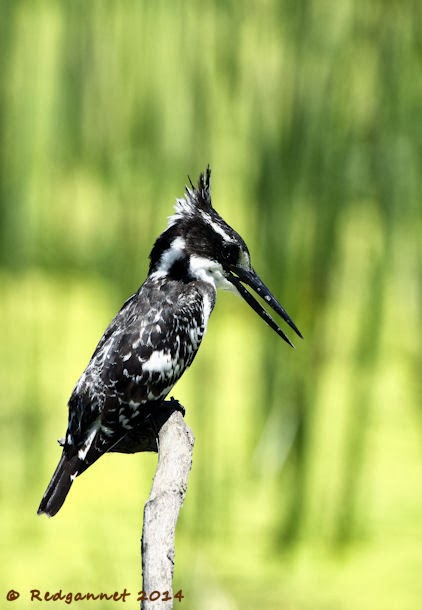
A Lesser Swamp-warbler picked through the reeds and a Long-tailed Cormorant fished through the floating weeds in front of the hide. I dropped around the corner for a quick look at the other hide by the lake and was almost immediately called back by Pat, the other birder, as a pair of Pied Kingfishers had just flown in to the Meadow Hide.


Pat explained how to differentiate between the sexes and it seemed that both of the birds were females. After a short while, a male flew in with a fish and passed it to the female on his right to the accompaniment of much squawking from both sides. 


Was he an adult with two female young, or was he trying to impress a potential mate? Thoughts on a postcard please. Pat suggested that the belt at mid-belly (his masculine indicator) was not very distinctive and that he may still be quite young. He continued to fish in the flooded meadow, but plunged from a standing start on the dead branches rather than hovering and diving.


At the Lake Hide, Pat pointed out a Malachite Kingfisher on a man-made structure in the lake. African Darters fished in front of the hide and the Cape Shovelers had now drifted onto the near bank where they joined Egyptian Goose, Blacksmith Lapwing and a Black-headed Heron.


The hides have been placed so that the Meadow hide is best positioned for morning light and the Lake Hide comes into its own in the afternoon. As the afternoon began to cool, I ventured from the shade of the hide and quickly found myself back at the Visitor Centre where a White-throated Swallow rested for a moment in the reeds. There was a pair that kept returning to the underside of the building and may have had a nest there.


I still had plenty of time, so made another circuit. This time a Little Bittern flushed from the reeds and a weaver made me reach for the field guide. I think it was a female or young Pintailed Whydah and got support for that when a breeding male stopped close by.
There is another section comprising about half of the reserve that is seasonally wet and is mostly designed as a sanctuary for Fynbos species of plant that are endemic to the area and potentially threatened as Cape Town spreads. I didn’t explore this area, but returned to the Lake Hide to watch a Long-tailed Cormorant which had caught a frog and spent ages subduing it and jockeying it into position before swallowing it headfirst.


 Bird list for Intaka Island; 30

Egyptian Goose 5, Yellow-billed Duck 20, Cape Shoveler 2, Cape Francolin 2, Little Grebe 1, White-breasted Cormorant 12, Long-tailed Cormorant 25, African Darter 6, Great White Pelican 11, Little Bittern 1, Grey Heron 1, Black-headed Heron 1, Purple Heron 3, Black-crowned Night-Heron 2, Red-knobbed Coot 45, Eurasian Moorhen 5, Blacksmith Plover 15, Hartlaub’s Gull 7, Speckled Pigeon 1, Red-eyed Dove 30, Ring-necked Dove 1, Laughing Dove 15, White-rumped Swift 3, Malachite Kingfisher 1, Pied Kingfisher 3, Pied Crow 8, White-throated Swallow 3, Greater Striped-Swallow 1, Cape Bulbul 1, Lesser Swamp-warbler 1, Karoo Prinia 3, Cape Robin-chat 1, European Starling 6, Red-winged Starling 3, Southern Double-collared Sunbird 1, Cape Wagtail 12, Cape Sparrow 4, Cape Weaver 4, Red Bishop 8, Common Waxbill 25, Pin-tailed Whydah 3.


Visit the dedicated African Page for more posts from Cape Town, including Strandfontein, Betty’s Bay and of course, Kirstenbosch Botanic Gardens

Birding, Birdwatching in Cape Town, South Africa.

Monday, 1 April 2013

West Coast National Park, Cape Town, March 2013

This trip to Cape Town has come about after my scheduled roster was disrupted. Had the original itinerary been achieved, I might have been sitting by a bay in New York with a northerly wind whipping the water into whitecaps. The contrasts with Langebaan Lagoon 100kms north of Cape Town were marked.


West Coast National Park can be found off the R27 (Google Earth ref; 33°14'37.87"S 18°12'15.66"E) which runs north from Cape Town. It comprises an area of costal scrub with sand dunes and a large, shallow lagoon. I only had the morning, but the tide times were well suited to that. The perfect time to visit the hides on the lagoon is as the tide begins to recede. I couldn’t wait that long, but had great views as the tide came in, pushing hundreds of Curlew Sandpipers, Grey Plovers and even a couple of Red Knot towards me.


The coastal scrub plays host to a few highly desirable bird species such as Black Harrier that was seen very shortly after entering into the park. Many of the other specialties were missed, but I suspect that most of the birds were staying low out of the wind.

Cape Bulbuls were common as were the Yellow Canaries. I saw as many Ostriches today as I have ever seen.

My first port of call was at Abrahamskraal, a freshwater pond and hide which can be seen at Google Earth ref;  33°13'55.04"S 18°8'8.66"E. A pair of Common Kestrels hovered beyond the hide.


In the distance, a Bokmakerie whistled from its perch just beyond a duiker. On the small freshwater pond, Cape Shoveler, Purple Swamphen, Sacred Ibis and a Black Crake were seen.

Geelbek hide can be found at Google Earth ref; 33°11'24.73"S 18° 7'25.91"E.  It is reached along a boardwalk which has been slightly raised above the saltmarsh to protect this fragile environment. Little Stint and Kitlitz’s Plover were seen well on the approach.

High water at this point is usually about 4 hours behind the tide at Cape Town and the prime time for viewing here is as the water begins to ebb. I was going to miss the top of the tide, so I enjoyed the spectacle of hundreds of feeding birds on the mud flats that stretched out into the bay. Eventually the rising waters pushed them into range and I could see that many of the birds were taking on their summer plumage in anticipation of their flight north.

Greater Flamingos were dotted widely across the bay. They were feeding or trying to keep a low profile in the strong wind that is so popular with the kite surfers further up the lagoon.


A tatty Osprey flew over the hide and settled on a post further along. Although none of the other birds had seemed to be disturbed by the Osprey, a couple of Hartlaub’s Gulls took it upon themselves to harass it and chivvy it along.

Seeberg Hide, Google Earth ref; 33° 7'35.26"S 18° 3'30.88"E, is further north towards the village of Langebaan. It is reached along a boardwalk through the coastal scrub. The hide is very low to the ground giving an interesting viewing angle. Three sand bars have been built by the wind and water currents, providing roosting spots for many gulls and shorebirds. Sanderlings tried to shelter from the wind by crouching on the back slope in the lee of a sand bar.


A flock of Common Terns also contained a few Swift (Great Crested) Terns. White-fronted Plovers sheltered in what looked like footprints in the sand. The area in front of the hide should be protected from human interference which makes me wonder if the little plovers dig their own shelters. Anyone?


A nice flock of Bar-tailed Godwits mixed with some Grey PloverWhimbrel, Red Knots and a single Eurasian Curlew.

I would have loved to have been able to stay on much longer.  The hide at Seeberg is a real pleasure to watch birds from and I was very loathe to leave such an inspiring place, but time was pressing and I had to start back towards Cape Town.

As I left the hide a tiny creature moving on the salt marsh caught my attention. I became spellbound by a pair of tiny White-fronted Plover chicks dashing about under the relaxed care of their parents.

Seeberg Overlook is the large chunk of granite rising above the lagoon, this has been a reliable place in the past to find Southern Black Korhaan (Bustard). 
Having spent a few last moments trying to get arty with the cottage at the top of the rock, I was treated to a close encounter with the bustard as I eventually decided to make tracks and head back to Cape Town.


Birds seen; 67

Ostrich 90, Egyptian Goose 15, South African Shelduck 2, Cape Shoveler 8, Helmeted Guineafowl 12 Cape Francolin 50, Little Grebe 1, Greater Flamingo 2000, Great (White-breasted) Cormorant 8, Grey Heron 1, Little Egret 23, Black-crowned Night-heron 1, Sacred Ibis 30, Osprey 1, Black-shouldered Kite 3, African Marsh Harrier 2, Black Harrier 2, Jackal Buzzard 2, Eurasian (Rock)Kestrel 3, Black Bustard 3, Black Crake 1, Purple Swamphen 1, Eurasian Moorhen 3, Red-knobbed Coot 2, Blacksmith Plover 180, Kitlitz’s Plover 3, Common Ringed Plover 35, White-fronted Plover 30, Black-winged Stilt 50, Pied Avocet 12, Common Greenshank 40, Whimbrel 40, Eurasian Curlew 1, Bar-tailed Godwit 40, Ruddy Turnstone 2, Red Knot 50, Sanderling 300, Little Stint 60, Curlew Sandpiper 300, Ruff 8, Hartlaub’s Gull 8, Kelp Gull 60,  Common Tern 120, Great Crested Tern 2, Sandwich Tern 8, Little Swift 25, Speckled Mousebird 10, Bokmakierie 4, Common Fiscal 2, Pied Crow 8, Plain Martin 2, Barn Swallow 40, White-throated Swallow 2, Cape Bulbul 60, Karoo Prinia 4, Karoo Scrub-robin 10, Cape Robin-chat 4, African Pied Starling 30, Southern Double-collared Sunbird 2, Cape Wagtail 8, Orange-throated Longclaw 1, Cape Bunting 3, Yellow Canary 80, Cape Sparrow 8, Cape Weaver 6.