Tuesday, 4 February 2014

Intaka Island, Cape Town, Jan 2014

This year will bring lots of new sites and experiences to Redgannet. As a handicap in the 10,000 Birds year lists, I can only count birds that are seen from new places or from sites that have not previously featured in Redgannet. I consulted eBird’s Hotspot Explorer for some ideas for a visit to Cape Town and found a small marsh surrounded by a large retail and social complex to the northeast of the city at Google Earth ref; 33 53 17.40S 18 30 48.19E. The complex is known as Century City and the marsh, which is hemmed in by a canal, is Intaka Island.


“When development of Century City began in 1996, the 250 hectare area was largely covered by invasive alien vegetation and degraded wetlands”.

The award-winning Intaka Island is now 16 hectares of multi-purpose nature area, home to 212 species of indigenous plants and 120 species of bird. By the time I arrived from the airport and sorted a parking permit (Clampers operate in the area. See below), it was noon on a hot, hot day.


A path leads out from the visitor Centre and I chose to start to the left for a clock-wise circuit. Small open areas of water have been cut into the reeds and each was edged with Red-knobbed Coot. The first patch is overlooked by a small verandah at the Visitor Centre and a Purple Heron stalked the shallow water. After a short walk, the sound of gushing water caused me to lean out over the balustrade of the boardwalk to see what was going on. Water is pumped in from the canal system and squirts out from a long spreader bar. This kick-starts a filtration system that maintains the quality of water around the complex. The water filters through four stages before seeping back into the canal system.


On a Friday afternoon, the marsh was very quiet and I made my way round slowly, noting Yellow-billed Duck, Common Waxbill and lots of Red-eyed DoveI soon came to a lake. Out on the open water, a couple of Cape Shoveler floated in the gentle breeze, Long-tailed Cormorants fished and a small flock of Hartlaub’s Gulls kept up a raucous screeching.


A pair of hides sit back to back, one giving views across the open water of the lake, the other looking across the flooded meadow that is the final, fine filtration stage. Dead branches have been carefully placed around the hides and the birds readily use them as perches. A Long-tailed Cormorant posed right in front of the Meadow Hide. Another birdwatcher was already in place and had been enjoying some exciting kingfisher action shortly before I arrived, so I sat to wait and see what might happen. It was pleasant to sit out the heat of the early afternoon in the airy hide. 


A Lesser Swamp-warbler picked through the reeds and a Long-tailed Cormorant fished through the floating weeds in front of the hide. I dropped around the corner for a quick look at the other hide by the lake and was almost immediately called back by Pat, the other birder, as a pair of Pied Kingfishers had just flown in to the Meadow Hide.


Pat explained how to differentiate between the sexes and it seemed that both of the birds were females. After a short while, a male flew in with a fish and passed it to the female on his right to the accompaniment of much squawking from both sides. 
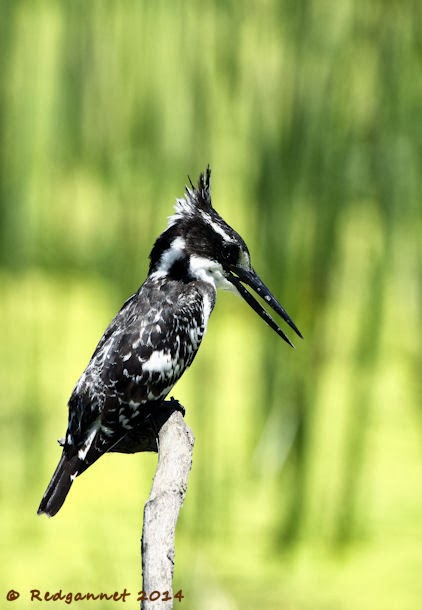


Was he an adult with two female young, or was he trying to impress a potential mate? Thoughts on a postcard please. Pat suggested that the belt at mid-belly (his masculine indicator) was not very distinctive and that he may still be quite young. He continued to fish in the flooded meadow, but plunged from a standing start on the dead branches rather than hovering and diving.


At the Lake Hide, Pat pointed out a Malachite Kingfisher on a man-made structure in the lake. African Darters fished in front of the hide and the Cape Shovelers had now drifted onto the near bank where they joined Egyptian Goose, Blacksmith Lapwing and a Black-headed Heron.


The hides have been placed so that the Meadow hide is best positioned for morning light and the Lake Hide comes into its own in the afternoon. As the afternoon began to cool, I ventured from the shade of the hide and quickly found myself back at the Visitor Centre where a White-throated Swallow rested for a moment in the reeds. There was a pair that kept returning to the underside of the building and may have had a nest there.


I still had plenty of time, so made another circuit. This time a Little Bittern flushed from the reeds and a weaver made me reach for the field guide. I think it was a female or young Pintailed Whydah and got support for that when a breeding male stopped close by.
There is another section comprising about half of the reserve that is seasonally wet and is mostly designed as a sanctuary for Fynbos species of plant that are endemic to the area and potentially threatened as Cape Town spreads. I didn’t explore this area, but returned to the Lake Hide to watch a Long-tailed Cormorant which had caught a frog and spent ages subduing it and jockeying it into position before swallowing it headfirst.


 Bird list for Intaka Island; 30

Egyptian Goose 5, Yellow-billed Duck 20, Cape Shoveler 2, Cape Francolin 2, Little Grebe 1, White-breasted Cormorant 12, Long-tailed Cormorant 25, African Darter 6, Great White Pelican 11, Little Bittern 1, Grey Heron 1, Black-headed Heron 1, Purple Heron 3, Black-crowned Night-Heron 2, Red-knobbed Coot 45, Eurasian Moorhen 5, Blacksmith Plover 15, Hartlaub’s Gull 7, Speckled Pigeon 1, Red-eyed Dove 30, Ring-necked Dove 1, Laughing Dove 15, White-rumped Swift 3, Malachite Kingfisher 1, Pied Kingfisher 3, Pied Crow 8, White-throated Swallow 3, Greater Striped-Swallow 1, Cape Bulbul 1, Lesser Swamp-warbler 1, Karoo Prinia 3, Cape Robin-chat 1, European Starling 6, Red-winged Starling 3, Southern Double-collared Sunbird 1, Cape Wagtail 12, Cape Sparrow 4, Cape Weaver 4, Red Bishop 8, Common Waxbill 25, Pin-tailed Whydah 3.


Visit the dedicated African Page for more posts from Cape Town, including Strandfontein, Betty’s Bay and of course, Kirstenbosch Botanic Gardens

Birding, Birdwatching in Cape Town, South Africa.

Thursday, 30 January 2014

Bangalore Palace, Bengaluru, Jan 2014

Bangalore Palace spreads over 450 acres of Bengaluru, with open spaces and light woodland. The palace buildings themselves are reasonably modern and recently renovated. 


The grounds are often used for concerts and have hosted such headliners as Rolling Stones, Elton John and Iron Maiden. Today, it was my opportunity to strut my stuff as a Coppersmith Barbet kept the beat and Black Kites circled in the bright sky like a mirrorball negative.


This one had found something to eat and sat very still until the others had moved off. Only then did it start to feed.


This was a very fleeting visit on the way home from Bellal Lake. I am not convinced that I should have been wandering about willy-nilly. The palace is open to visitors, but I am not sure that they are supposed to slope off into the woodland. Official sites suggest that there is an entrance fee, but the security guard at the gate barely gave us a second glance. Perhaps the fee is charged for entrance to the palace buildings and the formal gardens. 


The area close to the gate was endearingly unkempt and seemed promising for birds. The White-cheeked Barbet was common again, but still reluctant to sit for a photo. I eventually caught up with one in deep shade of a fruiting tree.
A Shikra flashed by and settled momentarily before flying off again. A couple of calls from the woodland along Palace Road stumped me, but at least I wasn’t being caught out by the squeaky Palm Squirrels any more.


Bird list for Bangalore Palace;

Black Kite 20, Shikra 1, White-cheeked Barbet 8, Coppersmith Barbet 1, House Crow 8, Large-billed Crow 1, Purple-rumped Sunbird 2.

The entrance fee is IR225 for Indian nationals, increasing to IR450 for foreigners. A hefty IR675 extra charge is levied for using a still camera. The guard at the gate on Palace Road, does not appear to issue tickets, so I assume that the fee is payable for the buildings and formal gardens. The timings are from 10.00 – 17.30. There are many negative reviews of the palace tour and the excessive price, but my walk in the non-formal parkland cost nothing and was very pleasant.


Visit the dedicated India Page to see more posts from Bengaluru, including Lalbagh Gardens and Bellal Lake.

Monday, 27 January 2014

Hebbal Lake Park, Bengaluru, Jan 2014

Which associative noun would you use to describe a resident of Bengaluru? If it were up to me I would choose “Banger”, but a reputed (sic) resident of the city informed me that they still use the pre-Anathamurthy term, “Bangalorian”.


My Bangalorian colleagues had warned me off visiting Hebbal Lake. They were concerned for my security and were worried that I might get mugged. As it happens, I enjoyed a pleasant walk along the lakeside, unmolested and found 30 birds into the bargain, including a Pale-billed Flower-pecker which I have not seen for a long time.


On the southern bank is a gated area called Hebbal Lake Park. The gate, which can be seen at Google Earth ref;13 2 38.14N 77 35 3.95E, was open and unattended at 07.15 this morning (see below) and the seductive, resonant call of the White-cheeked Barbet enticed me through. There was a lawn to the right and a neatly clipped formal garden to the left. Straight ahead was the lake, its margins trimmed with Water Hyacinth.


Barbet calls were common, but the birds were restless and wouldn’t sit out for a photo. The flower-pecker was also very evasive. One was trying to swallow a berry that was almost as large as its own head, but kept to the tangles where I couldn’t autofocus. A Blythe's Reed Warbler was far more accommodating.


In the gardens to the left, a few overgrown spots looked promising and sunbirds played chase through the treetops. They were too quick to see, but the call was Purple-rumped Sunbird. As I tried to catch one in my binoculars to confirm it, a wasp landed on my forehead and stung me. I looked up to see a nest right above me and decided to move on.


Out on the lake were a couple of very pretty islands, also surrounded by floating weed. Eurasian Coots and Indian Spot-billed Ducks floated on the open water, but most of the action was concentrated around the availability of food in, on and around the Water Hyacinth beds. 


In the distance, white herons proved to be Intermediate and Little Egrets. A dark thin ibis flew in on the far side of the lake. I thought Glossy Ibis, but this is beyond their present range. Historically, they used to be seen down this way, but their range contracted and they are more likely to be seen far to the north. It was a distant look, but I prefer the slight, fine-billed Glossy to the Black Ibis, whose range covers this area, but is a much stockier bird.
The cormorants were very obvious with three species representing the family; Great, Indian and Little Cormorants. The most common were the square-headed Little Cormorants which could be seen swimming, diving and roosting. The others appeared in much lower numbers. 


The Indian Pond Herons became more obvious when I stopped and scanned. They blend in very well and move very slowly, but once my eye became atuned, they were seen everywhere.
Eurasian Coots, White-breasted Waterhens and Purple Swamphens represented the Rallids from plates 38 and 39 of my Princeton Field Guide to the Birds of India and Pakistan, whilst a Bronze-winged Jacana was filed under “miscellaneous” on Plate 49.


The most productive viewpoint was in the furthest east corner of the park at Google Earth ref; 13 2 39.51N 77 35 7.23E. Most of the aforementioned water-associated birds could be seen from here as well as a distant Oriental Darter, a White-throated Kingfisher and a roosting Spot-billed Pelican.
My field guide denies the existence of any species of pelican in Bengaluru, so I decided that my next move should be to get a better look. On the way out, a Purple-rumped Sunbird sat out to be ticked, but the Greater Coucal, which had been teasing me all morning with its rich calls, evaded sight confirmation.
I had hoped to find some waders, but there was no sign of any. There was a roosting bar that would have made a good overnight stop for any birds that could find good feeding in the area, but there did not appear to be any shallow water or mud on Hebbal Lake ( I have just found an eBird submission for the lake which confirms that a few species of wader might be seen here and supports my thoughts on Glossy Ibis and Spot-billed Pelican).


Contrary to advice that I had received, Hebbal Lake is not free access at all times. There are fences and gates that block access to the lakeside along the southern shore and I had only been able to walk about 300m of bank. Even within the park, a barrier protected half of it from my explorations. My attempt to get a better look at the pelican was thwarted by not being able to get close to the bank further along. Spot-billed Pelican is my best guess as it is the only member of the Pelecanus family likely to be seen south of Mumbai. Great White Pelicans have been very rarely seen this far down, but this individual was a “dingy” bird and that is what I will tell eBird when they send me a quizzical email.


 Bird list for Hebbal Lake Park; 30

Indian Spot-billed Duck 35, Indian Cormorant 3, Great Cormorant 4, Little Cormorant 35, Oriental Darter 2, Spot-billed Pelican 3, Purple Heron 2, Intermediate Egret 4, Little Egret 2, Indian Pond-Heron 30, Glossy Ibis 1, Black Kite 30, Brahminy Kite 2, White-breasted Waterhen 2, Purple Swamphen 7, Eurasian Coot 12, Red-wattled Lapwing 1, Bronze-winged Jacana 1, Spotted Dove 1, Rose-ringed Parakeet 10, Asian Koel 4, Greater Coucal (heard only) White-throated Kingfisher 1, White-cheeked Barbet 3, Black Drongo 1, House Crow 15, Large-billed Crow 1, Blythe’s Reed Warbler 2, Common Myna 2, Pale-billed Flower-pecker 8, Purple-rumped Sunbird 4.


Confusion and frustration could arise at the gate to Hebbal Lake Park. A notice there advises that opening time is 09.45 and that a small charge would be applied to visitors, especially those with cameras. The gate was open and unattended at 07.15 this morning and enthusiastic Bangers were keenly applied to their morning exercises. I left at 09.30 and there was still no-one to take my money.
The park was not at all busy. Perhaps 15 people shared the area with me today. Most of those were sweeping leaves or cutting grass. The park is not close to, or easily accessible from a residential area, as it is on the wrong side of a busy dual carriageway, so casual early morning walkers were few. The side road outside the park is popular with truck drivers as an overnight pull-in and this transient population may have been the cause of my colleagues’ concerns. My experience was of a peaceful, pleasant and quiet park. There were no facilities that I noticed and I would guess that it is not an easy place from which to hail a cab. Ask your driver to wait with you and if you feel uncomfortable, ask him to walk with you. My taxi from the centre of Bengaluru today cost IR800 for 4 hours.
I only managed to explore a small section of the lake, but access looked difficult further along


 Visit the dedicated Indian Page for more posts from Bengaluru, including, Bannerghatta National Park and Lalbagh Gardens

Saturday, 18 January 2014

Dairy Mart Road - Main Pond, San Diego, Jan 2014

The area around the Tijuana River Valley Regional Park is run through with paths and trails and I was a little concerned about getting lost. To this end, I drew from my cub scout training and left markings on the ground at junctions and along the paths to help me find my way back to the Main Pond. Half-way through the morning, I was struck by the thought that the Mexican border is less than a mile from here and a vigilant Border Patrol Officer may spend the afternoon trying to interpret the signs as a communication from human traffickers.


A couple of the paths looked as if they had been swept clean of any footprints so that new ones would show up. This gave me an interesting snapshot of what may have passed along the trail or crossed it in the last 24 hours. Rodent prints mixed with tiny beetle tracks. I couldn’t decide whether the dog prints were from Coyotes or domestic animals. Similarly, the Bobcat prints could have been a feral cat. Only one set of human footprints went ahead of me; not too surprising for an early Monday morning.
The Main Pond on Dairy Mart Road had been my main focus, but didn’t hold my attention for too long. A good number of Black-crowned Night-Heron roosted in the reeds on the far side from the screen. Mallards and Northern Shovelers were easily found. Pied-billed Grebes and a Great Egret skulked around the edges.
A pair of Downy Woodpeckers had been seen just as I entered the area and it was interesting to find a Nuttall’s Woodpecker for close comparison.


There was a map on the notice-board at the entrance (Google Earth Ref: 32 33 15.08N 117 3 46.39W), but the trails are very jumbled and the glass proved to be very reflective when I tried to take a digital image. Without an adequate direction or trail markers to follow I tried to take an obvious route through the dry scrub, leaving markings at junctions.


White-crowned Sparrows, Song Sparrows and Black Phoebe were seen along the pathways.
A Merlin sat out well in a dead tree, but flushed as I passed beneath him on the path. It allowed me to pass without flushing further on.


Beyond here, the trail closed in and side trails were closed with bright orange netting. I decided that I had gone far enough and returned, following the signs, to see a Border Patrol Officer scrutinising the ground at a side trail with his cap in one hand, scratching his head with the other.


Bird list for Dairy Mart Road – Main Pond; 30

American Wigeon 1, Mallard 25, Cinnamon Teal 1, Northern Shoveler 25, Bufflehead 1, Ruddy Duck 25, Pied-billed Grebe 15, Double-crested Cormorant 5, Great Egret 3, Black-crowned Night Heron 60, Turkey Vulture 1, Merlin 1, American Coot 6, Ring-billed Gull 15, Western Gull 25, Mourning Dove 8, Common Ground Dove 2, Anna’s Hummingbird 10, Nuttall’s Woodpecker 1, Downy Woodpecker 2, Black Phoebe 3, American Crow 8, Tree Swallow 2, Orange-crowned Warbler 1, Common Yellowthroat 3, Yellow-rumped Warbler 3, California Towhee 5, Song Sparrow 12, White-crowned Sparrow 15, House Finch 20.


I reached Dairy Mart Road’s Main Pond by taking the Blue Line trolley to Beyer Blvd Trolley Stop. From here, Bus no. 906 or 907 crosses Dairy Mart Rd at Burger King on San Isidro. Get out here and cross Highway 5. The pond is 400m further on the right.

Friday, 17 January 2014

Pantoja Park, San Diego, Jan 2014

I made a very quick walk-through of Pantoja Park on the way home from the San Diego River. It is a tiny park, perhaps just an acre or so, at Kettner Blvd and G St., very close to Seaport Village Station trolley stop. The main body of the park is laid to lawn and two stands of fig trees grace opposing corners.


Yellow-rumped Warblers formed a noisy flock with House Finches and Lesser Goldfinches.
A pish brought a quick reaction from An Orange-crowned Warbler and a Black Phoebe perched on a Lamp. It looked as if this was a favoured perch.


Bird list for Pantoja Park; 7


Anna’s Hummingbird 2, American Crow 3, Northern Mockingbird 2, Orange-crowned Warbler 1, Yellow-rumped Warbler 20, House Finch 30, Lesser Goldfinch 20.

Visit the dedicated USA and Canada Page for more sites in San Diego.