Sunday, 14 April 2013

Fairway Drive, Eng Neo Avenue, Singapore, March 2013

Fairway Drive leads off from Eng Neo Avenue into the Bukit Timah Saddle Club at Google Earth ref;  1°20'38.87"N 103°47'50.02"E. It encompasses an area of rural Singapore that I had not experienced before. There is a riding stables and golf course here and a real feeling of being away from the city. Not just picturesque, but quiet too.  Even the jungles in Singapore are busy, so this was a real treat.


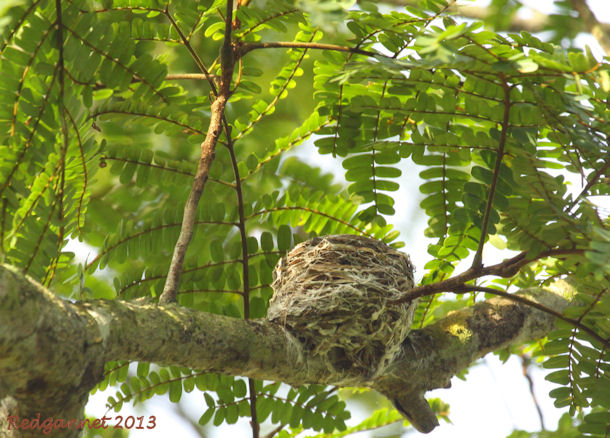
I was introduced and even driven to the site by my new friend Mr Che and his friend Peter. Mr Che knew of a Common Iora’s nest, but is was empty now. Peter suggested that we should call ahead next time to check that they would be in.


A Coppersmith Barbet called with its monotonous tone as it shared a dead tree with a Collared Kingfisher. A Lineated Barbet was also heard, but not seen. The call is distinctive enough to be acceptable for the 10,000 Birds heard this year list.

Birds seen;
Brahminy Kite 1, Blue-crowned Hanging Parrot 1, White-throated Kingfisher 1, Collared Kingfisher 1, Coppersmith Barbet 1, Common Iora, House Crow 3, Common Tailorbird 1, Olive-backed Sunbird 2.

Brahminy Kite

Visit the dedicated Oriental Page for more posts from Singapore including Singapore Botanic Gardens, Bukit Timah and Sungei Buloh

Saturday, 13 April 2013

Singapore Botanic Gardens, Singapore, March 2013

Mike from10,000 Birds visited Panti Bird Sanctuary during a recent trip to Singapore. I confess that I had never even heard of Panti before and Mike’s trail-blazing example left me feeling quite the stay-a-bed. Amends must be made. But this is a Redgannet post and regular readers will know that things do not always go to plan. Sometimes it does, but then it transpires that the plan was actually the problem. I had been warned that the border crossing could be busy today (Easter Sunday), so I took a quick look at Singapore’s Botanic Gardens to while away the golden hours.


A walk around Eco Pond brought Black-naped OrioleLesser Whistling Duck, White-breasted Waterhen and Yellow-vented Bulbul. I had made the conscious decision to ignore swiflets this morning.


Heliconia Walk is becoming a firm favourite of mine. An Oriental Magpie Robin sang from his perch there. It is difficult to pass it without stopping for a short while to see if any sunbirds come down to feed. This morning a male Olive-backed Sunbird did the honours.

The bank overlooks the symphony stage with tall palm trees growing from behind it. These palms are often rich with birds and this morning they hosted Asian Glossy Starlings, Blue-rumped Hanging Parrots and Pink-necked Green Pigeons.

On Symphony Lake a Yellow Bittern was poised in the reeds looking for a meal. A large Water Monitor looked hungry too. It was tasting the water and was obviously on the prowl. The bittern looked nervous as it approached and took the prudent option of flight.

Here, I met Mr Che and his friend Peter. They had not seen many birds this morning and Easter Sunday crowds were already making the paths through the gardens very busy. They invited me to join them at Fairway Drive on Eng Neo Avenue, a site that I had not heard of before.
Birds seen;

Lesser Whistling Duck 24, Yellow Bittern 1, Gray Heron 1, White-breasted Waterhen 10, Spotted Dove 10, Zebra Dove 1, Pink-necked Pigeon 20, Long-tailed Parakeet 6, Blue-crowned Hanging Parrot 2, Black-naped Oriole 3, House Crow 2, Yellow-vented Bulbul 6, Oriental Magpie Robin 3, Asian Glossy Starling 25, Javan Myna 45, Olive-backed Sunbird 2, Eurasian Tree Sparrow 30.

Spotted Dove

For more posts from Singapore Botanic Gardens, follow the links below;

Visit the dedicated Oriental Page for more posts from Singapore including Paser Ris and Sungei Buloh.


Friday, 12 April 2013

Singapore taster

I am beginning to feel like the reluctant schoolboy who is getting behind with his homework. While we wait for a trip to Singapore to be written up, here are a couple of tasters.

 
Any regular readers may find that the Heliconia Walk in Singapore Botanic Gardens is becoming a bit repetitive, but the Olive-backed Sunbirds make it hard to stay away.

A new site at Fairway Drive with Mr Che and his friend Peter, showed me a pastoral side of Singapore that I had not previously encountered.

Following in Mike’s footsteps I took a trip to Panti in Malaysia. Don’t go on Easter Sunday!

Monday, 1 April 2013

West Coast National Park, Cape Town, March 2013

This trip to Cape Town has come about after my scheduled roster was disrupted. Had the original itinerary been achieved, I might have been sitting by a bay in New York with a northerly wind whipping the water into whitecaps. The contrasts with Langebaan Lagoon 100kms north of Cape Town were marked.


West Coast National Park can be found off the R27 (Google Earth ref; 33°14'37.87"S 18°12'15.66"E) which runs north from Cape Town. It comprises an area of costal scrub with sand dunes and a large, shallow lagoon. I only had the morning, but the tide times were well suited to that. The perfect time to visit the hides on the lagoon is as the tide begins to recede. I couldn’t wait that long, but had great views as the tide came in, pushing hundreds of Curlew Sandpipers, Grey Plovers and even a couple of Red Knot towards me.


The coastal scrub plays host to a few highly desirable bird species such as Black Harrier that was seen very shortly after entering into the park. Many of the other specialties were missed, but I suspect that most of the birds were staying low out of the wind.

Cape Bulbuls were common as were the Yellow Canaries. I saw as many Ostriches today as I have ever seen.

My first port of call was at Abrahamskraal, a freshwater pond and hide which can be seen at Google Earth ref;  33°13'55.04"S 18°8'8.66"E. A pair of Common Kestrels hovered beyond the hide.


In the distance, a Bokmakerie whistled from its perch just beyond a duiker. On the small freshwater pond, Cape Shoveler, Purple Swamphen, Sacred Ibis and a Black Crake were seen.

Geelbek hide can be found at Google Earth ref; 33°11'24.73"S 18° 7'25.91"E.  It is reached along a boardwalk which has been slightly raised above the saltmarsh to protect this fragile environment. Little Stint and Kitlitz’s Plover were seen well on the approach.

High water at this point is usually about 4 hours behind the tide at Cape Town and the prime time for viewing here is as the water begins to ebb. I was going to miss the top of the tide, so I enjoyed the spectacle of hundreds of feeding birds on the mud flats that stretched out into the bay. Eventually the rising waters pushed them into range and I could see that many of the birds were taking on their summer plumage in anticipation of their flight north.

Greater Flamingos were dotted widely across the bay. They were feeding or trying to keep a low profile in the strong wind that is so popular with the kite surfers further up the lagoon.


A tatty Osprey flew over the hide and settled on a post further along. Although none of the other birds had seemed to be disturbed by the Osprey, a couple of Hartlaub’s Gulls took it upon themselves to harass it and chivvy it along.

Seeberg Hide, Google Earth ref; 33° 7'35.26"S 18° 3'30.88"E, is further north towards the village of Langebaan. It is reached along a boardwalk through the coastal scrub. The hide is very low to the ground giving an interesting viewing angle. Three sand bars have been built by the wind and water currents, providing roosting spots for many gulls and shorebirds. Sanderlings tried to shelter from the wind by crouching on the back slope in the lee of a sand bar.


A flock of Common Terns also contained a few Swift (Great Crested) Terns. White-fronted Plovers sheltered in what looked like footprints in the sand. The area in front of the hide should be protected from human interference which makes me wonder if the little plovers dig their own shelters. Anyone?


A nice flock of Bar-tailed Godwits mixed with some Grey PloverWhimbrel, Red Knots and a single Eurasian Curlew.

I would have loved to have been able to stay on much longer.  The hide at Seeberg is a real pleasure to watch birds from and I was very loathe to leave such an inspiring place, but time was pressing and I had to start back towards Cape Town.

As I left the hide a tiny creature moving on the salt marsh caught my attention. I became spellbound by a pair of tiny White-fronted Plover chicks dashing about under the relaxed care of their parents.

Seeberg Overlook is the large chunk of granite rising above the lagoon, this has been a reliable place in the past to find Southern Black Korhaan (Bustard). 
Having spent a few last moments trying to get arty with the cottage at the top of the rock, I was treated to a close encounter with the bustard as I eventually decided to make tracks and head back to Cape Town.


Birds seen; 67

Ostrich 90, Egyptian Goose 15, South African Shelduck 2, Cape Shoveler 8, Helmeted Guineafowl 12 Cape Francolin 50, Little Grebe 1, Greater Flamingo 2000, Great (White-breasted) Cormorant 8, Grey Heron 1, Little Egret 23, Black-crowned Night-heron 1, Sacred Ibis 30, Osprey 1, Black-shouldered Kite 3, African Marsh Harrier 2, Black Harrier 2, Jackal Buzzard 2, Eurasian (Rock)Kestrel 3, Black Bustard 3, Black Crake 1, Purple Swamphen 1, Eurasian Moorhen 3, Red-knobbed Coot 2, Blacksmith Plover 180, Kitlitz’s Plover 3, Common Ringed Plover 35, White-fronted Plover 30, Black-winged Stilt 50, Pied Avocet 12, Common Greenshank 40, Whimbrel 40, Eurasian Curlew 1, Bar-tailed Godwit 40, Ruddy Turnstone 2, Red Knot 50, Sanderling 300, Little Stint 60, Curlew Sandpiper 300, Ruff 8, Hartlaub’s Gull 8, Kelp Gull 60,  Common Tern 120, Great Crested Tern 2, Sandwich Tern 8, Little Swift 25, Speckled Mousebird 10, Bokmakierie 4, Common Fiscal 2, Pied Crow 8, Plain Martin 2, Barn Swallow 40, White-throated Swallow 2, Cape Bulbul 60, Karoo Prinia 4, Karoo Scrub-robin 10, Cape Robin-chat 4, African Pied Starling 30, Southern Double-collared Sunbird 2, Cape Wagtail 8, Orange-throated Longclaw 1, Cape Bunting 3, Yellow Canary 80, Cape Sparrow 8, Cape Weaver 6.
Friday, 29 March 2013

Kirstenbosch Botanical Gardens, Cape Town, March 2013


The beautiful gardens at Kirstenbosch were living up to their billing this morning. Set on the lower, eastern slopes of Cape Town’s most prominent landmark, they are prone to the moods of the mountain, which was in a changeable humour today.


My first lifer of the year has been a long time coming, but only the second bird of the morning was a Black Goshawk that flew across the face of Table Mountain.


A small party of birds at the start of the Braille Trail included Cape White-eye, Southern Double-collared Sunbird and a Dusky-brown Flycatcher. Beyond that the trail was very quiet.


I emerged from the wooded slopes into the Erica Gardens where the sunbirds can usually be found and was treated to a Southern Double-collared Sunbird feeding from a flower and giving me my shot of the week.


I recognised that I was close to the top of the Dell and went to visit Bob James at his memorial bench. I was sad to see that Bob had been joined by his wife Betty who died in 2012. This is where I usually start my search for the Spotted Eagle Owls. A pair can often be found in the vicinity, so my custom is to sit for a few moments with Bob and scan the area.


The Owls were quickly found in a Saffron Tree across the path behind the bench. The female was sitting out in full view, though shaded. The male was further back amongst the foliage in much deeper shade. Photographs were easy to get, but reviewing them in the bright sunshine was a mistake. The review screen could not compete with the sun and they appeared to be underexposed. I purposefully over-exposed to compensate. Reviewing in the hotel later, I realised that the camera’s built in light meter is far more accurate that my own eyes. Note to self; after you have spent a small fortune on technology, trust it!


Having mucked about with settings and white balances, I was in completely the wrong mode when the owl suddenly became animated, so I have had to spend some time with my photo-editor to retrieve this one from the recycle bin.


Further up the slope, examples of the characteristic cape flora can be found. Fynbos is a community of heathy, heathery, feathery plants beloved of Malachite Sunbirds and Orange-breasted Sunbirds.


The protea garden is at the top of the slope and is the best place to look for Cape Sugarbirds. I missed them on my first circuit and had to go around again to find a few tucked away in a large bed without proteas.


The juveniles and females have an elongated tail which is about the same length as their body. The mature males have a more extravagant appendage.


My reptile of the day was a very friendly tortoise, though I can’t reduce it to species level at the moment.


Birds seen; 23

Egyptian Goose 5, Helmeted Guineafowl 8, Cape Francolin 6, Black Goshawk 1, Speckled Pigeon 3, Spotted Eagle Owl 2, Speckled Mousebird 4, Common Fiscal 1 Pied Crow 2, Black Sawwing 1, Sombre Greenbul 1, Cape Bulbul 6, Karoo Prinia 2, Cape White-eye 15, Cape Sugarbird 5, Dusky-brown Flycatcher 2, Cape Robin-chat 2, Olive Thrush 4, Red-winged Starling 2, Orange-breasted Sunbird 15, Malachite Sunbird 10, Southern Double-collared Sunbird 30, Forest Canary 2.

Kirstenbosch Botanical Gardens can be found on Rhodes Drive on the eastern side of Table Mountain (Google Earth ref; 33°59'16.48"S 18°26'7.96"E).